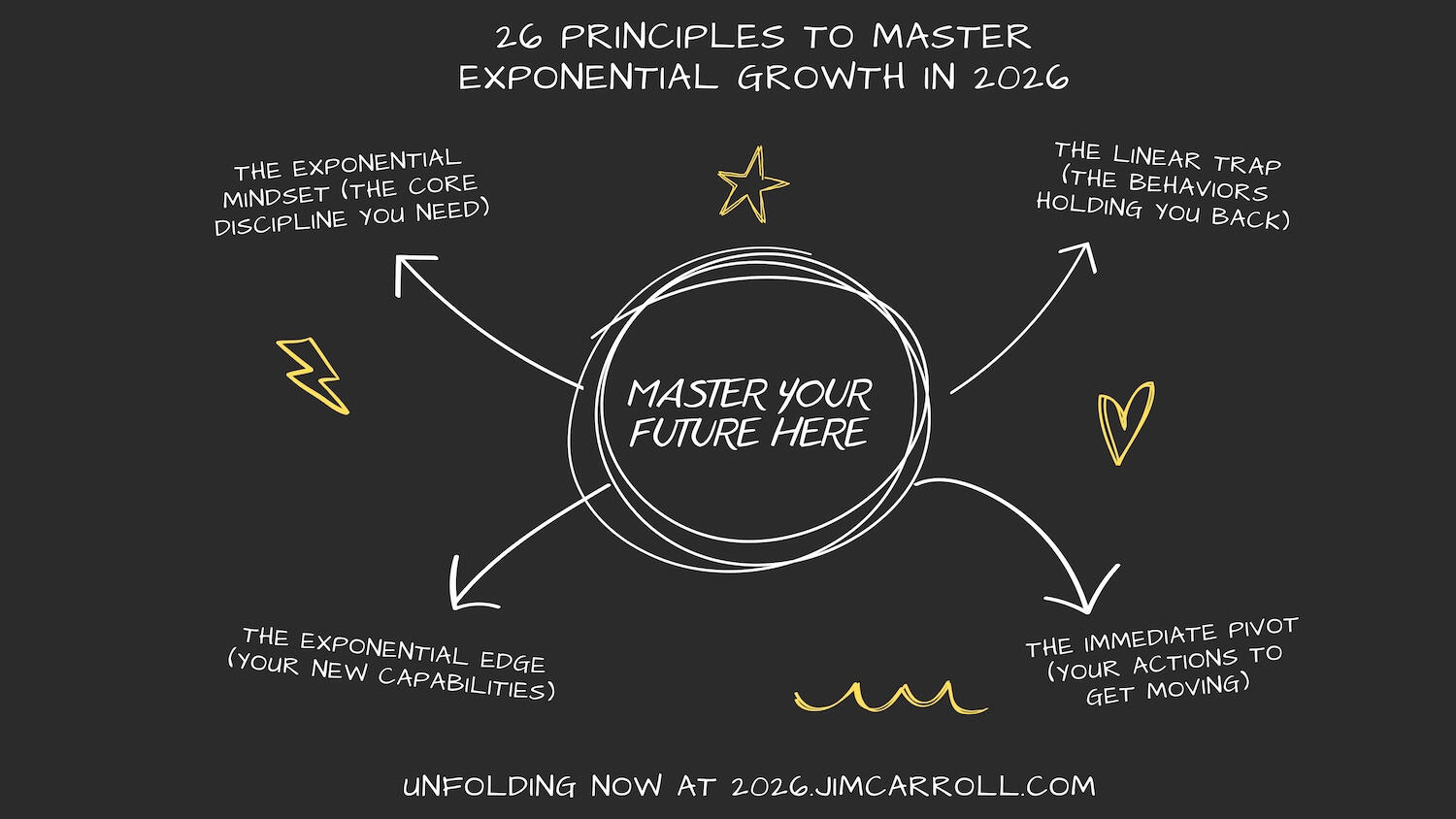
26 Principles to Master Exponential Growth in 2026
Stop planning for linear growth.If 2026 is the year you reinvent your career, master future-ready skills, and accelerate your impact, you need a new playbook.Join me for 26 Principles of Exponential Growth: Mastering 2026, my annual end-of-year series.Over 26 days, I'll deliver a high-impact framework that pairs a core Discipline you must master (like Temporal Literacy) with a single, powerful Self-Reflection Question you must ask.This is the blueprint for shifting from a state of reaction to a state of reinvention and achieving non-linear career success.
26 Principles of Exponential Growth: Mastering 2026
Each daily post in this transformative series delivers a powerful, four-part framework designed to reshape your mindset and accelerate your future success.

The Discipline to Master
Uncover a vital personal skill or mindset (your "Principle") essential for navigating rapid change and unlocking non-linear career growth. This is what you must become.

The Self-Reflection Questions
Confront a critical internal question designed to challenge your assumptions, shed linear thinking, and spark immediate personal reinvention. This is what you must rethink.

The Futurist's Metric
Gain a unique metric to quantify your progress, assess your adaptability, and measure your personal shift towards exponential impact. This is how you will know you've succeeded.

Your Immediate Action
Receive a concise, high-impact step you can take today to apply the principle, break old habits, and propel your personal growth forward. This is what you must do right now.
Unlock Your Exponential Future
Move beyond linear thinking. This series is engineered to provide actionable insights and profound self-reflection, equipping you for unmatched personal and professional growth.
Your Foundational Insights
A Core Discipline: Master a vital personal skill or mindset essential for navigating today's accelerating world.
A Key Self-Reflection Question: Challenge your assumptions and spark immediate personal and professional reinvention.
A Unique Futurist Metric: Quantify your adaptability and measure your progress toward exponential impact.
What You Will Achieve
A Blueprint for Reinvention: Develop a comprehensive framework to fundamentally rethink your career and future impact.
Accelerated Skill Acquisition: Gain the mindset and tools to rapidly absorb and apply new, high-value capabilities.
Strategic Foresight: Cultivate the ability to anticipate and capitalize on exponential trends before they become mainstream.
26 Principles to Master Exponential Growth in 2026.
Ideas and issues to get you ready for a world that continues to accelerate faster than ever before.
Introduction
The greatest barrier to exponential growth is linear thinking.
Why the Series Matters
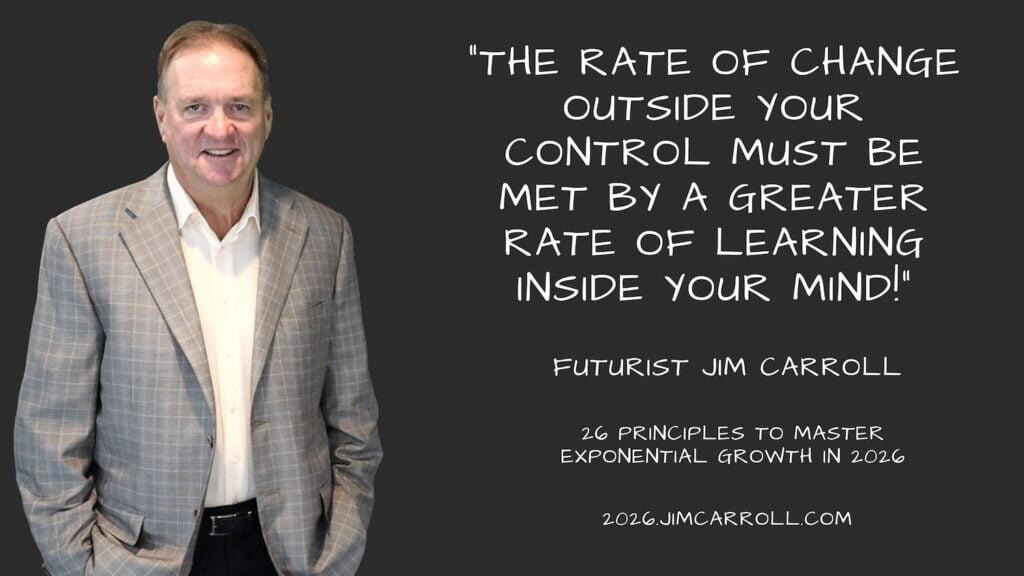
The rate of change outside your control must be met by a greater rate of learning inside your mind!
#1 Temporal Literacy
Stop judging the speed of your future by the slow pace of your past.
#2 Strategic Self-Pruning
If you want to move fast tomorrow, you must unburden yourself from the anchor that is yesterday.
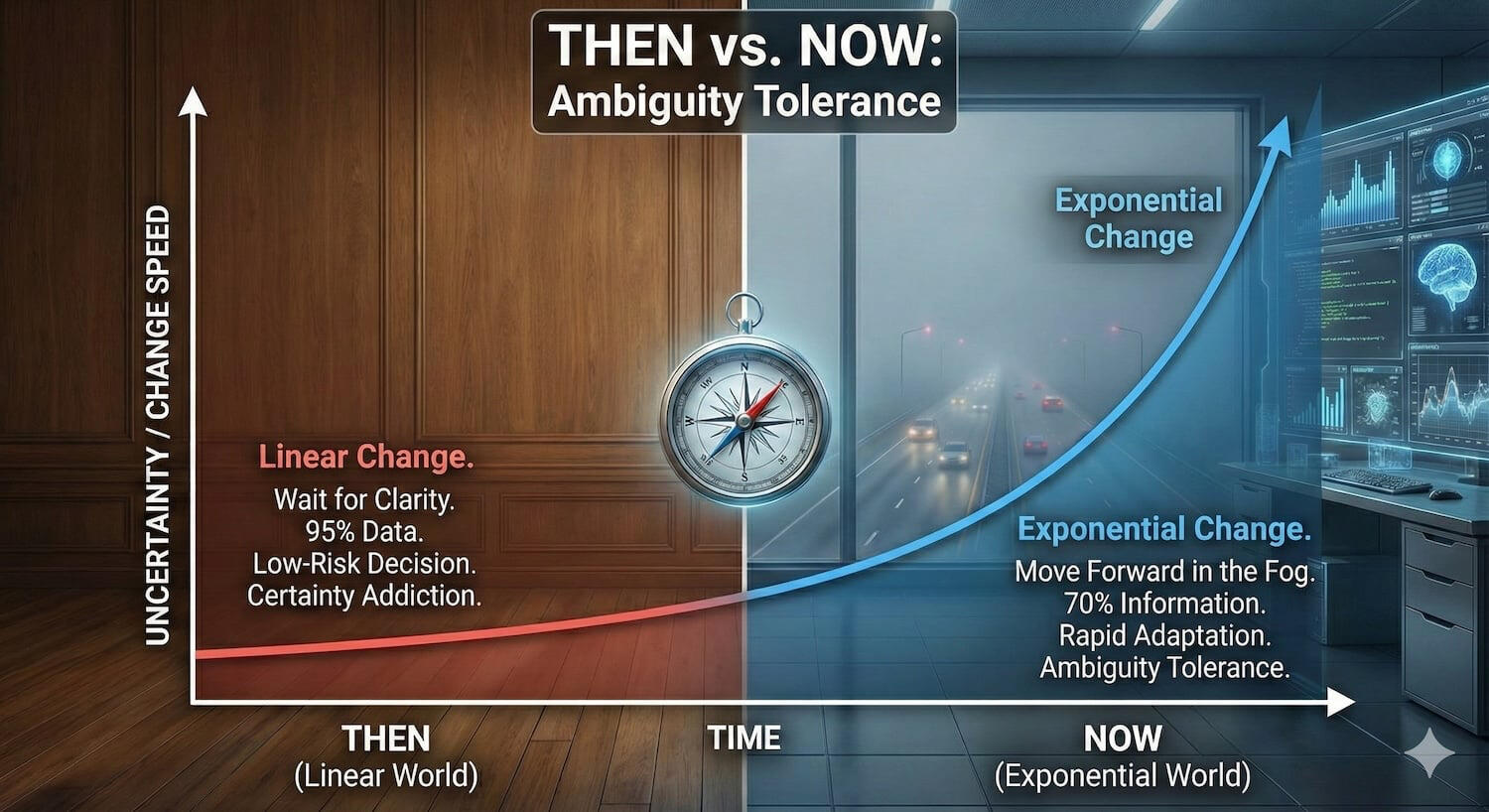
#3 Ambiguity Tolerance
Don’t try to be certain, be decisive.
#4 Anticipatory Intelligence
Know that the future whispers before it shouts. Listen now.
#5 Knowledge Velocity
Learn faster than knowledge appears. It’s your only sustainable advantage.
#6 Iterative Obsession
Make more ‘better’ mistakes!
#7 Relentless Reinvention
Remember – in an exponential world, the static become extinct.
#8 Velocity Alignment
The greatest risk today isn’t the speed of change: it’s your failure to pick up your pace.
#9 Aim Higher
Know this: if your goals feel ‘realistic,’ you are thinking too small.
#10 Collaborative Velocity
Don’t protect your
knowledge; connect it.
#11 Radical Subtraction
To move fast, you don’t need more gas. You need less drag
#12 Strategic Humility
The hubris of experience guarantees failure.
#13 Wisdom Inversion
Know when to get your age out of the way.
#14 Hype Immunity
Leadership today isn’t about what you chase. It’s about what you ignore.
#15 Escape Velocity
Scale immediately or fail slowly. There is no middle ground
#16 Scale Blindness
Your brain is built for addition. The future is built on multiplication.
#17 Unapologetic Uniqueness.
Always remember that conformity is where tomorrow's greatness goes to die
#18 Anti-Fragility
Don’t fear the chaos. Feed on it.
#19 Optionality Architecture
Throw out the roadmap. Build a portfolio of instant pivots instead.
#20 Network Velocity
If you are the fastest person in the room, you are in the wrong room.
#21 Signal Intelligence
Your new challenge isn’t finding the insight – it’s filtering out the noise.
#22 Boundary Divergence
Don’t stay in your lane. The future is happening in the blur between the lines.
#23 Algorithmic Partnership
Don’t ‘learn’ AI. Redesign your personal productivity around it.
#24 Trust Capital
In an era of synthetic perfection, your flaws are now the ultimate watermark of your authenticity.
#25 The Collapse of Time
The moment between having an idea and executing it is gone
#26 Escape Mediocrity
Don’t be average. Don’t be boring. Be bold. Be fascinating!”
Introduction
“The greatest barrier to exponential growth is linear thinking.”
It’s that time!This is annual end-of-year / looking-forward-to-next-year series – 26 Principles to Master Exponential Growth in 2026.I’ve been doing this type of series every year for years!It started out with my ‘10 Great Words for …” outline, which I’ve shared every year since 2006, and I’ll do that post on January 1 – with my ‘10 Great Words for 2026′. Stay tuned!And every year for years, I’ve been doing a write-up of trends, attitudes, mindsets, and more that can carry us into the future, such as 25 Things for 2025, 23 Trends for 2023, 19 Trends for 2019, 17 Trends for 2017, and other similar series, The feedback I get from my thousands of readers is that they love this stuff – it helps get them into the right mindset and the right way of thinking for the year toi come.This year, I’ve been busy with multiple series of other things that got people thinking and talking, and sharing.
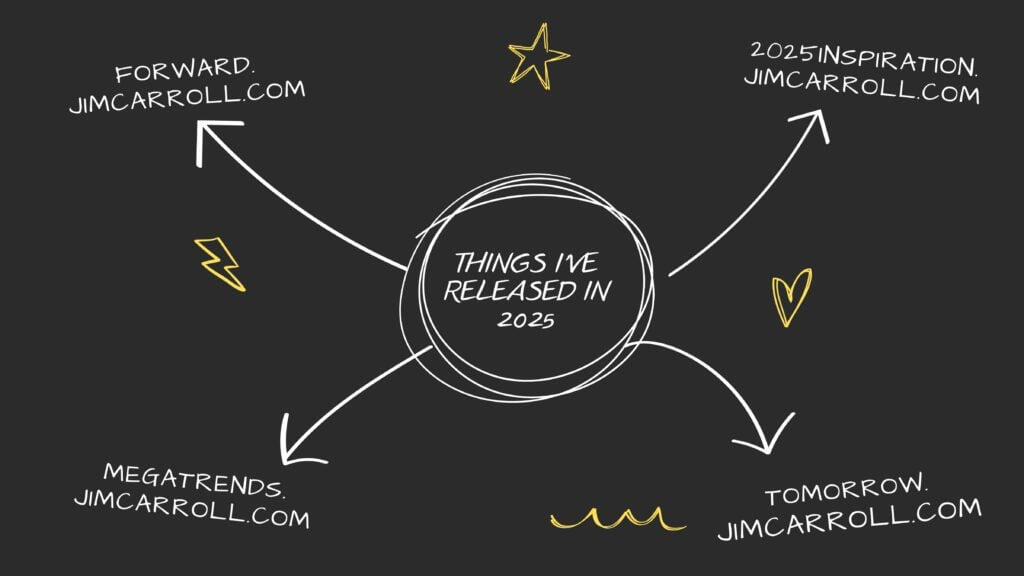
This included my 2025 motivational outlook series, which covered mindsets for a complex year (at 2025inspiration.jimcarroll.com), my Tomorrow series at tomorrow.jimcarroll.com (which became the foundation for my book, Dancing in the Rain: How Bold Leaders Grow Stronger in Stormy Times), my 30 Megatrends series at megatrends.jimcarroll.com, and the way Forward for industries at forward.jimcarroll.comFeedback? People love this stuff!And I think I like to write!And so – it’s time for 2026! It will all unfold right here, and 2026.jimcarroll.comWhat is it? Ideas and issues to get you ready for a world that continues to accelerate faster than ever before. The fact is, every trend is moving from a slow and steady acceleration to exponential acceleration, and that has profound implications on what you do, what you need to do, and how you need to think.In that context, if 2026 is the year you reinvent your career, master future-ready skills, and accelerate your impact, you need a new playbook. That’s why I’m writing these 26 Principles of Exponential Growth: Mastering 2026. Over 26 days, I’ll deliver a high-impact framework that pairs a core Discipline you must master (like Temporal Literacy) with a single, powerful Self-Reflection Question you must ask. Combined with some metrics to get you thinking, and actions you need to take to get moving.
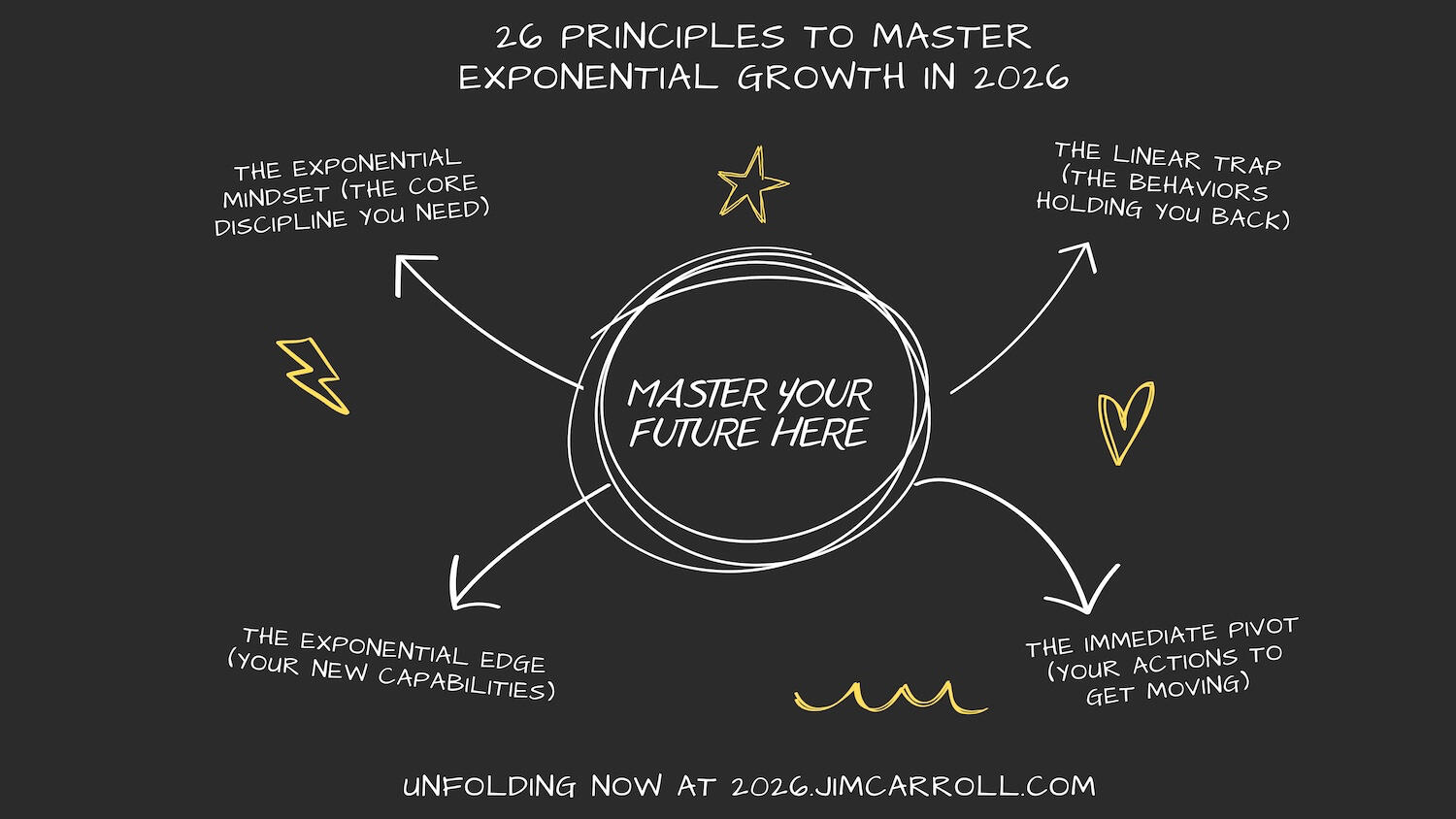
Got it?I’ll share more tomorrow about my plans before jumping right in.Bottom line: It will be your blueprint for shifting from a state of reaction to a state of reinvention and achieving non-linear career success.Stay tuned, tune in, and don’t drop out!
Structure of the Series
The rate of change outside your control must be met by a greater rate of learning inside your mind!
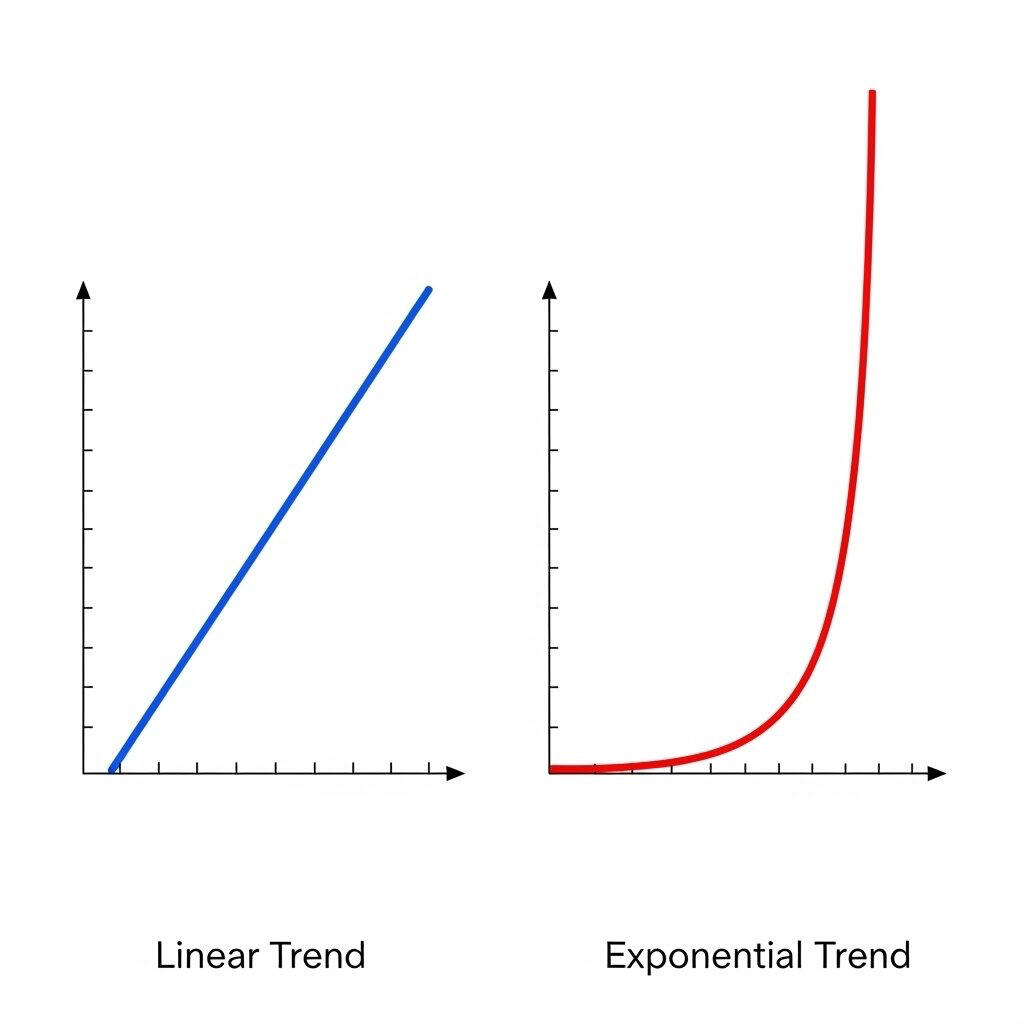
Most people don’t realize what is happening with the exponentiation of trends. And yet, it is and will continue to have a p[profound impact on them. That’s why I’m writing this new 2026 series.The best way to understand what is happening and why it is important is by comparing two graphs. Normal, linear trends, and exponential trends. Notice a difference?
Peter Diamandis, the founder of the XPrize Foundation, often describes exponential trends like this:
Once upon a time, long, long ago, the King of India offered to reward the inventor of chess because of the beauty of the game.The King asked the inventor, “What would you like as a reward? Name anything in my Kingdom and it will be yours!”The inventor responded: “Dear King, all I ask is that you place one grain of rice in the first square, two grains on the second square, four on the third square and so forth, doubling the number of grains of rice on each subsequent square.”The King, who did not understand the power of exponential growth, was surprised by what he considered such a meagre request.”A chessboard has 64 squares.By the time the first row of 8 squares was counted, the King’s team had placed 128 grains of rice (a handful) on the 8th square. (This is the deceptive phase of exponential growth.)Halfway through the board (32 squares), the number of grains of rice had become frightening at 2.1 billion grains of rice (equal to 10,000 kilograms).By the 64th doubling, the amount of rice had become unfathomable, reaching 461 billion tons of rice, a mound the size of Mount Everest.That is the power of exponential growth. It goes without saying that the King was not happy to find this out.
(Fair point: he has often posted about linear vs. exponential trends – this is a common idea in futurist circles).It’s best to put this into perspective in the context of the reality of trends today.A year ago this month, I was invited by the Office of the Prime Minister of the United Arab Emirates to address the annual AGM of the region – a room full of 700 cabinet ministers and government executives. We spent a lot of time polishing my slide deck, and here are a few key slides. (Forgive the small type – these were prepared for a really big room with a really big LED screen!)The first had to do with what I call ‘the era of acceleration.’
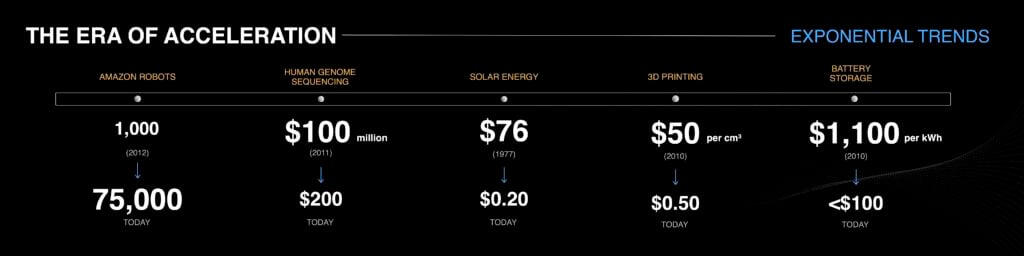
Consider these numbers:
Amazon Robots: from 1,000 (2012) to 75,000 ↑ Significant Increase (Volume)
Cost of Human Genome Sequencing: from $100 million (2001) to $200 ↓ Massive Cost Reduction
Solar Energy: $76 per watt (1977) to $0.20 ↓ Cost Reduction
3D Printing: $50 per cm³ (2010) to $0.50 ↓ Cost Reduction
Battery Storage: $1,100 per kWh (2010) to <$100 ↓ Cost Reduction
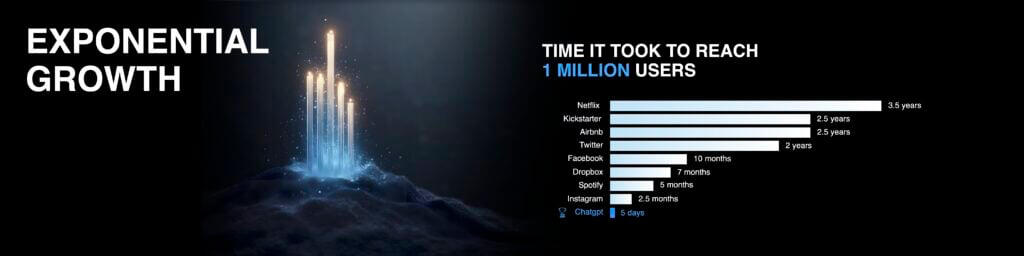
Given that it was a year ago, these numbers are already wildly out of date, particularly the number of Amazon robots!Then there is what we call ‘Global Adoption Speed’ – simply put, people and industries adapt to new trends faster. It took Netflix 3 1/2 years to reach 1 million users – it took ChatGPT 5 days.
AI? In another slide, I shared that the number of parameters used in developing AI models continues to increase at an exponential rate.

When you get into these numbers, it gets pretty interesting! As I like to say, ‘but wait, there’s more!’
AI Inference Cost, $20.00 / Million Tokens (Nov 2022) to $0.07 / Million Tokens (Oct 2024)
Access to Space (Low Earth Orbit): $54,500 per kg (Space Shuttle Era) to $2,720 per kg (Falcon 9)
IoT Capacity (5G), 4G: 100,000 devices per km² to 5G: 1,000,000 devices per km²
And then there is knowledge itself; I know I’ve shared numbers around this before, but it’s worth sharing again:
General knowledge doubling : 100 Years (Until 1900) to 12 Hours (Projected 2020)
Medical knowledge doubling time, 50 Years in 1950 to 73 Days in 2020
Professional skills relevance: from 30 years historically to a half-life of 6 years today
Put all of these trends into context by thinking about the sheer acceleration of the biggest trend in our lives today – AI. Lost in the numbers above is the fact that in the span of just a few years, AI models scaled rapidly from 175 billion parameters (GPT-3) to current sophisticated models now surpassing 170 trillion parameters.(This is a 1,000-fold jump in complexity.) If you aren’t saying whoah, you’re doing it all wrong!What’ the impact? It’s what it does to your career and the industry you work within:f
Skills Obsolescence: If your professional development is linear (e.g., one course per year), you are falling exponentially behind the curve of required knowledge. The skills needed in 2026 are not incremental steps from 2025; they are a multi-step jump.
Opportunity Blindness: Exponential change always starts small, looking like a “toy” or a fringe idea (e.g., the internet in 1995, early GenAI). Linear thinkers dismiss it because it’s not a major factor yet. Exponential thinkers invest and experiment because they know the explosion is imminent.
The Drag of Legacy: Linear habits—like budgeting based on last year’s performance or delegating by seniority—become dead weights when the required pace is non-linear. They consume your finite time and energy.
One result of all this, even though the knowledge you know goes out of date faster than ever before, is that the systems designed for a linear world are now straining to keep pace with the exponential reality. Consider U.S. governance: the volume of federal final rules published in 2024 hit a record high of 45,028 pages, representing a 71% increase over the previous year. This is the linear system’s desperate attempt to manage exponential chaos, and the resulting friction acts as a dead weight on every industry. Laws, regulations, industry structures – nothing can keep up.The data is in, and it’s unforgiving. What do you do in a world of sheer, hyper-speed velocity that is right outside your window? A world where the cost of mapping a human genome has collapsed over 475,000-fold (from $95 million to $200), and the sum of human knowledge now threatens to double every 12 hours?This exponential compression is precisely why my opening quote is not a catchy phrase, but your absolute, professional prime directive: “The rate of change outside your control must be met by a greater rate of learning inside your mind!”When the fundamental relevance of your professional skills is shrinking from 30 years to just six, and the linear systems around you are spewing a record-high 45,000 pages of new, complex regulation in a single year, the choice is not optional.A linear pace of learning guarantees you fall exponentially behind.That’s why you need to wrap your head around what it is you need to do – and that’s why I’ll be writing my 26 Principles of Exponential Growth. I’m hoping they will be your necessary antidote to linear bias!
he Discipline you need to master.
The Question you need to ask yourself.
The Metric you need to measure your progress.
The Immediate Action you need to take right now.
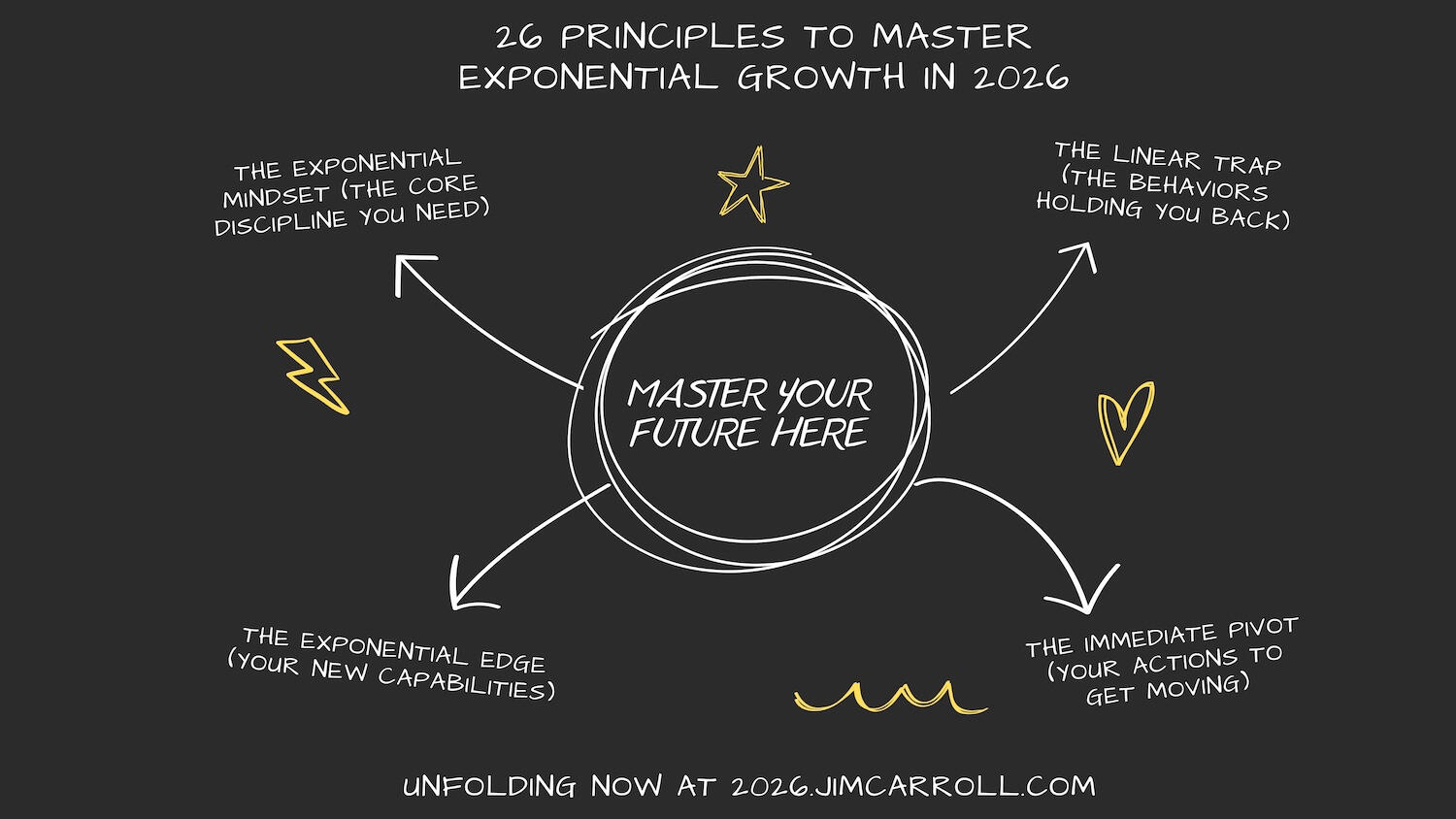
Starting tomorrow, I’ll be taking you on the first principle of adaptation: Temporal Literacy. This is the foundational skill for every futurist, leader, and individual aiming for reinvention. It’s the ability to stop judging the future by the slow pace of the past.Get ready to reset your internal clock!
Tomorrow? Principle #2 – New Skills Acquisition! And we’ll keep using the same frame – the key concept or principle, an honest self-assessment, your strategic solution, the immediate actions you need to take!
#1 - Temporal Literacy
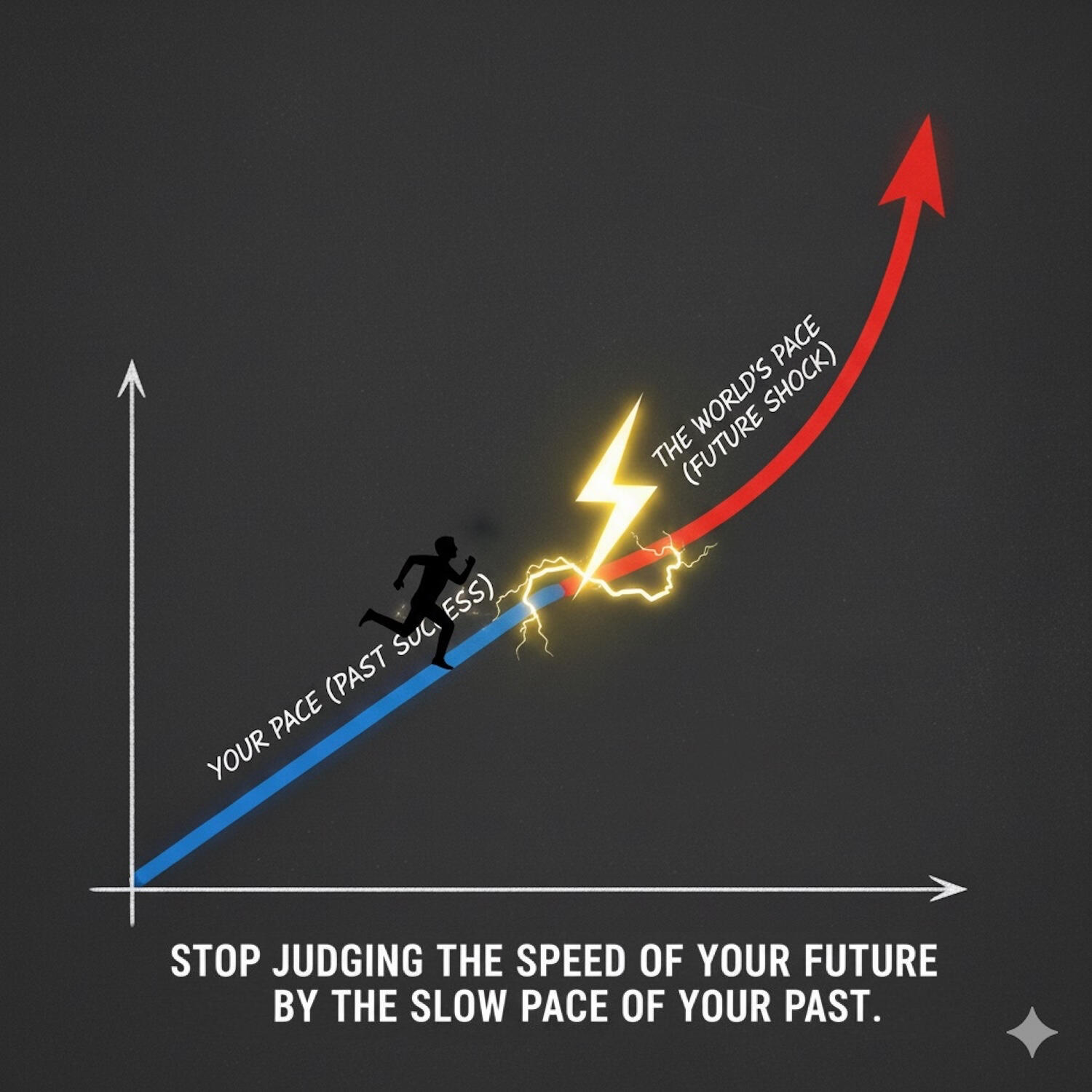
Stop judging the speed of your future by the slow pace of your past.
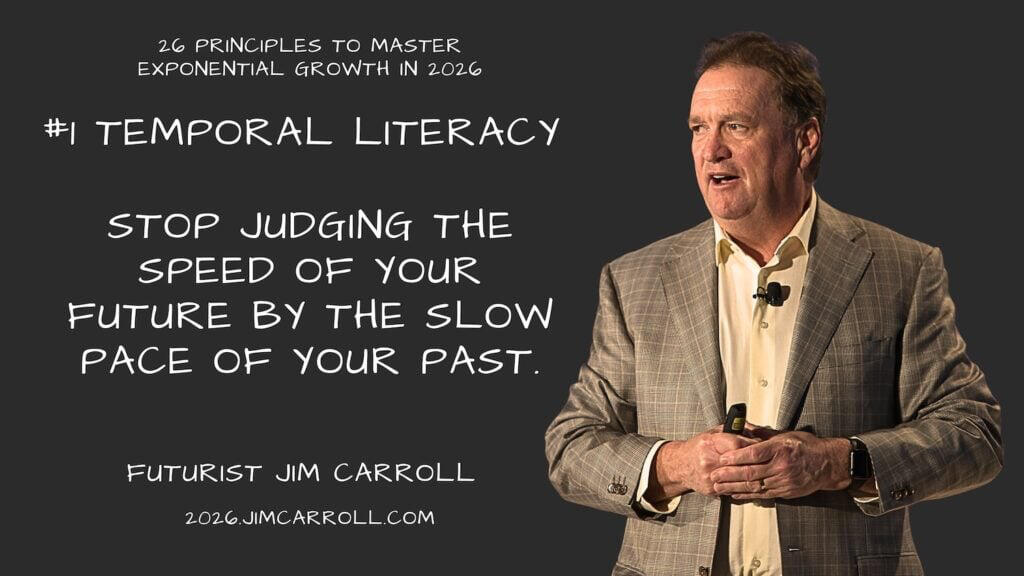
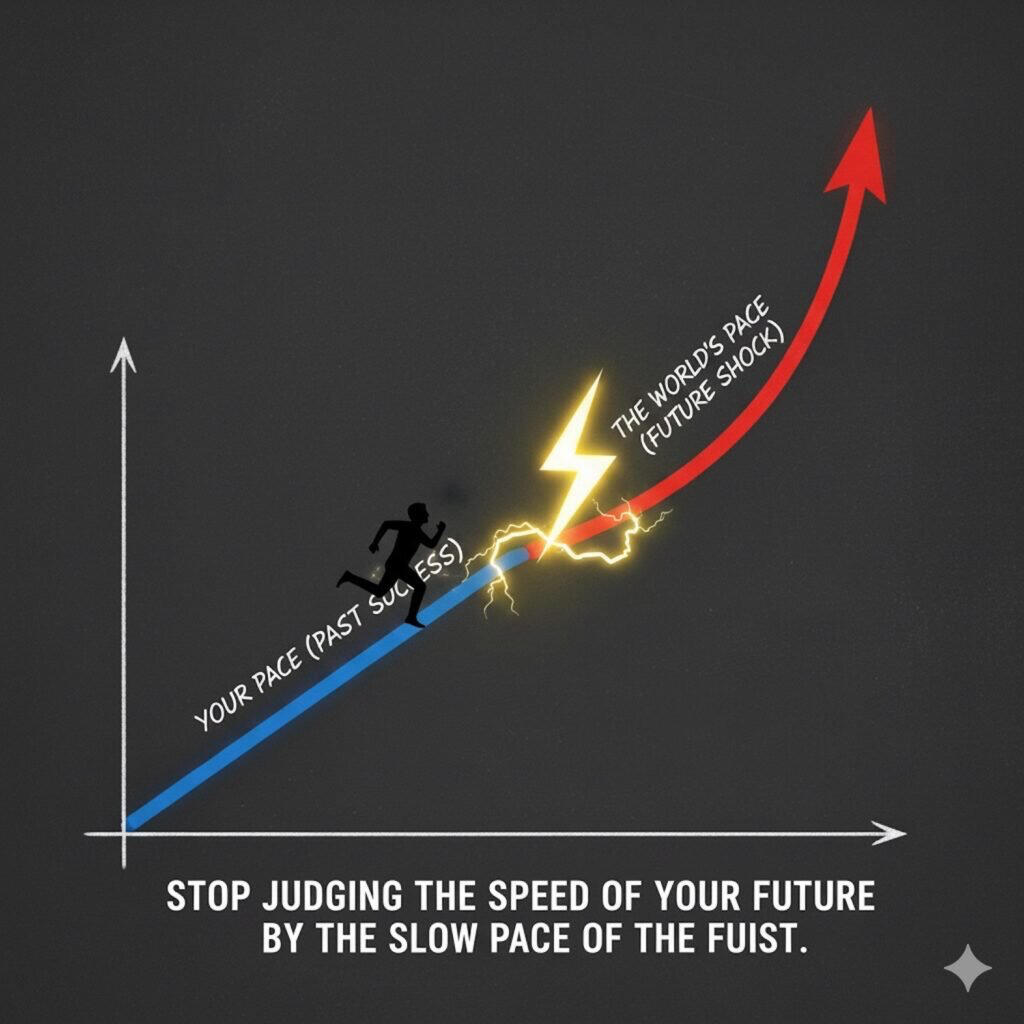
It’s Day 1 of your new path for 2026! 26 days, 26 principles to get you into the exponential mindset.Step 1? Master “Temporal Literacy” – in which you stop judging the speed of your future by the slow pace of your past!The single biggest mistake you can make right now is to believe that you can just keep doing the same old things at the same old deliberate pace that worked for you yesterday.You can’t.Think about it – your past career success, your accumulated knowledge, and your daily routine have all been built on a ‘linear’ world – one that involves a slow, steady and expected rate of change. That’s gone. The world is accelerating exponentially, creating a massive Temporal Lag between the speed you move and the speed the world demands.
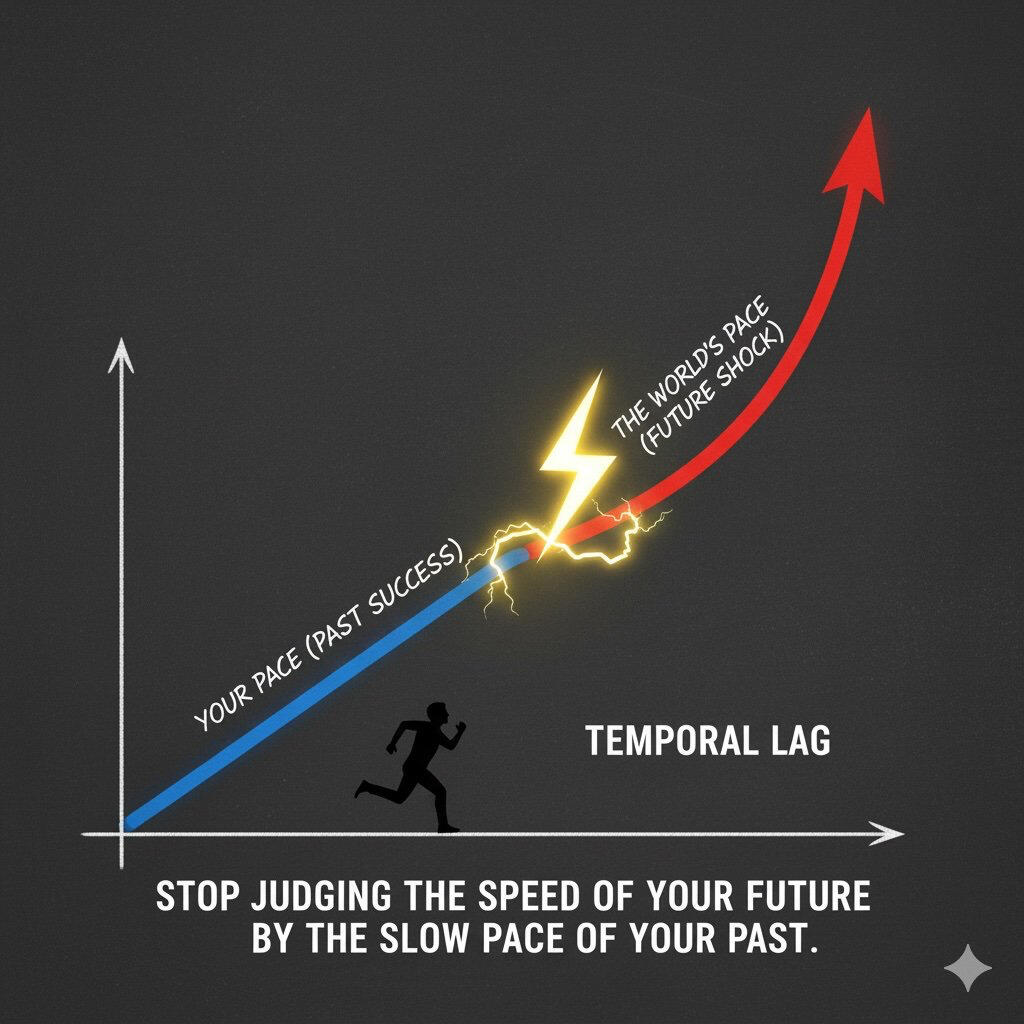
Alvin Toffler called that “Future Shock.” You are in the midset of that right now.Here’s what you need to do1. Get Into The Exponential Mindset – And The Idea of Temporal LiteracyThis is the personal discipline of intentionally shifting your focus from the urgent, day-to-day demands of the immediate present (everything involves this moment and a 90-day execution) to the strategic planning required to align with the inevitable future (5- to 50-year vision).Stop living every moment for the short-term: start thinking more about what matters for the long term.It is the realisation that the future is accelerating far faster than your experience suggests, and it’s deciding to change yourself to close the gap.In essence, it’s deciding to do this!
2. The Linear TrapHow do you do that? that?By examining what mindset you currently have that binds you to linear thinking in an exponential world!!Ask yourself if you are guilty of any of these things. (I bet you are!) Answering yes to any of them means that you are letting a temporal lag define your future, because the speed of change is outstripping your ability to act. These are like the innovation killers I often share, but at a personal level.
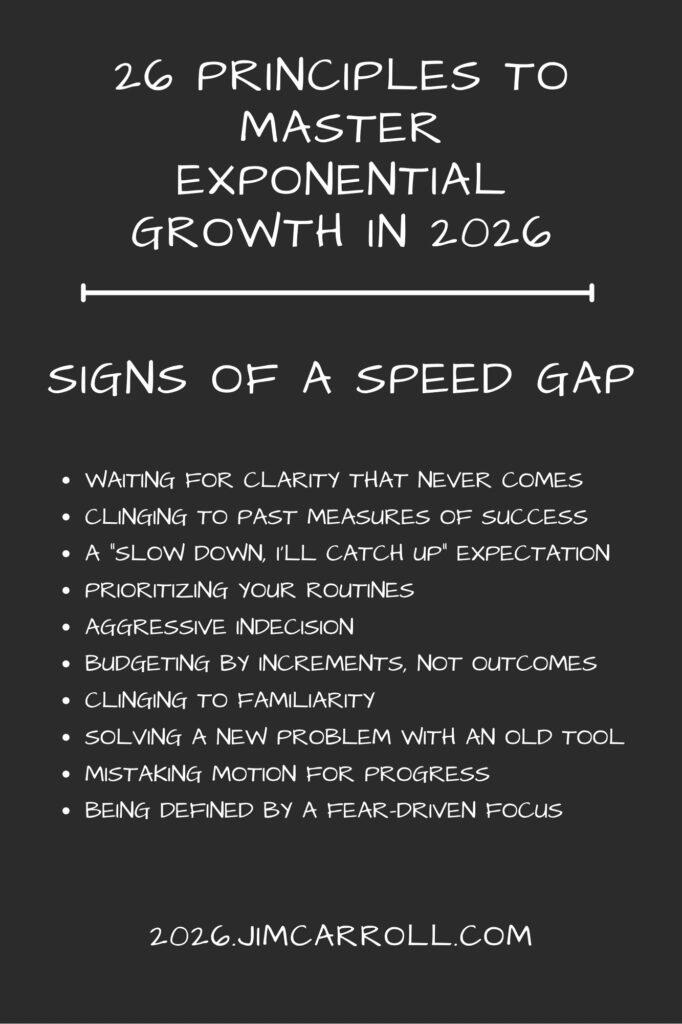
Waiting for clarity that never comes: assuming you must reach 90% certainty before acting, delaying movement while exponential trends speed past you.
Clinging to past measures of success: measuring your current value using the linear standards of the last decade (e.g., years of experience), instead of future readiness.
The “Slow down, I’ll catch up” expectation: assuming a trend (like AI) will slow down or pause its development to give you time to catch up, disregarding the exponential growth curve.
Prioritizing your routines: allocating 90% of your time to tasks that leverage comforting, old skills while neglecting the new, challenging skills that will define your career in five years.
Aggressive indecision: postponing a difficult strategic choice (e.g., career pivot) due to the fear of making the wrong choice, where the inaction is actually the most definitive, negative decision.
Budgeting by increments, not outcomes: structuring your personal development with a linear 5% increase from last year’s efforts, preventing the non-linear investment required for an exponential jump.
Clinging to familiarity: surrounding yourself with those who reinforce your existing knowledge, creating a temporal echo chamber.
Solving a new problem with an old tool: failing to update your fundamental toolkit (software, methodology, or thought process) to match the problem’s current complexity.
Mistaking motion for progress: confusing the sheer linear volume of activity (long hours, full calendar) with actual exponential progress (high-impact outcomes, strategic breakthroughs).
The fear-driven focus: allowing external fear to dictate your learning agenda rather than proactively selecting skills based on future opportunity.
Do an honest self-assessment.Are you stuck?3. The Exponential EdgeTo close the loop, you must replace those old, linear habits with a new set of new, exponential ones. This is what you’ll get by going there: you’ll gain the ability to:
Aligning to the inevitable: Stop waiting for clarity or perfection and instead master the skill of moving first with speed and agility. You don’t try to predict the future; you proactively align with the trends you know are accelerating.
Think long term, act short term: Develop the capacity to hold a clear 5-year vision in your mind while executing rapid, high-impact daily actions. You use the long-term view to filter and prioritise what matters most right now. Stop doing the things that don’t matter!
Practice “strategic obsolescence“: Your skills and knowledge are going out of date faster than you know. Gain the courage to intentionally shed past successful skills, assumptions, and commitments before the future forces you to. You become the architect of your own career, constantly getting rid of the old to make room for the exponential new.
Get better at ‘foresight’: Move beyond vague feelings about the future and better insight into what comes next. Become your own futurist! That will help you turn the abstract challenge of accelerated change into a tangible, measurable goal for personal growth.
Start to operate on “exponential time”: Stop being surprised when a major change happens fast. Get ready for it before it hits you!
That’s how exponential thinkers think. Become one!4. The Immediate PivotSo what should you do right now? Decide that your journey to exponential growth begins with the next 15 minutes.
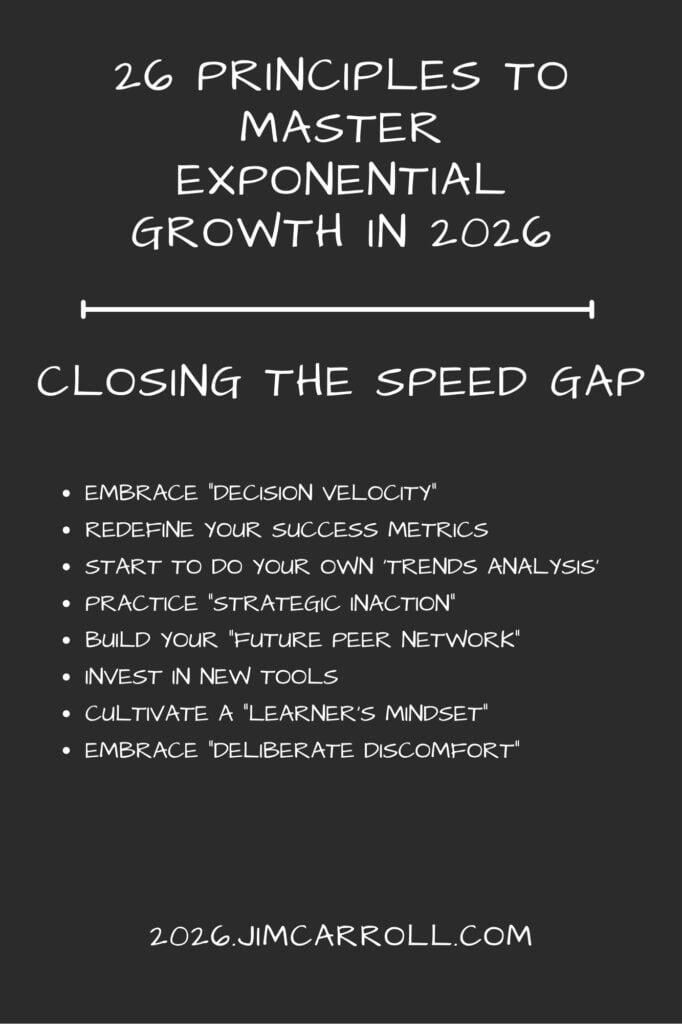
Here are the immediate actions you must take right now to stop the temporal lag:
Embrace “decision velocity“: adopt the rule of 70% certainty and 100% agility. Make decisions faster, assuming you will learn and correct rapidly.
Redefine your success metrics: shift from measuring past achievements to tracking future readiness.”
Start to do your own ‘trends analysis’ as part of your routine: dedicate regular, protected time (e.g., 2 hours every Friday) to actively research and experiment with emerging tools and concepts outside your immediate job description.
Practice “strategic inaction“: actively identify and eliminate low-value, linear tasks that consume your time but don’t contribute to exponential growth. Ask yourself – do I really need to do this?
Build your “future peer network”: actively seek out mentors and communities who operate at the leading edge of your field to challenge your linear biases. Join that LinkedIn group. Get involved in that future-oriented committee in your association. Heck, reach out to me!
Invest in new tools: continuously evaluate if you are using tools that deliver linear improvements when an exponential tool could deliver significantly greater impact, particularly so with AI.
Cultivate a “learner’s mindset”: approach every new challenge, every setback, and every unfamiliar technology with genuine curiosity, not fear. Master just-in-time knowledge
Embrace “deliberate discomfort”: intentionally seek out situations or learning experiences that push you beyond your current capabilities and comfort zone.
Everything above isn’t just a list of cool bullet points – these are the things you should start thinking about to get into a temporal shift. You are learning to speed up by examining what’s slowing you down.Take the list, print it out, stick it on your desk, and reflect on it regularly. Challenge yourself to think faster, act faster.Every day, pretend you’re in London – Mind the Gap – and close it by jumping on it.
Tomorrow? Principle #2 – New Skills Acquisition! And we’ll keep using the same frame – the key concept or principle, an honest self-assessment, your strategic solution, the immediate actions you need to take!
#2 - Strategic Self-Pruning
If you want to move fast tomorrow, you must unburden yourself from the anchor that is yesterday.
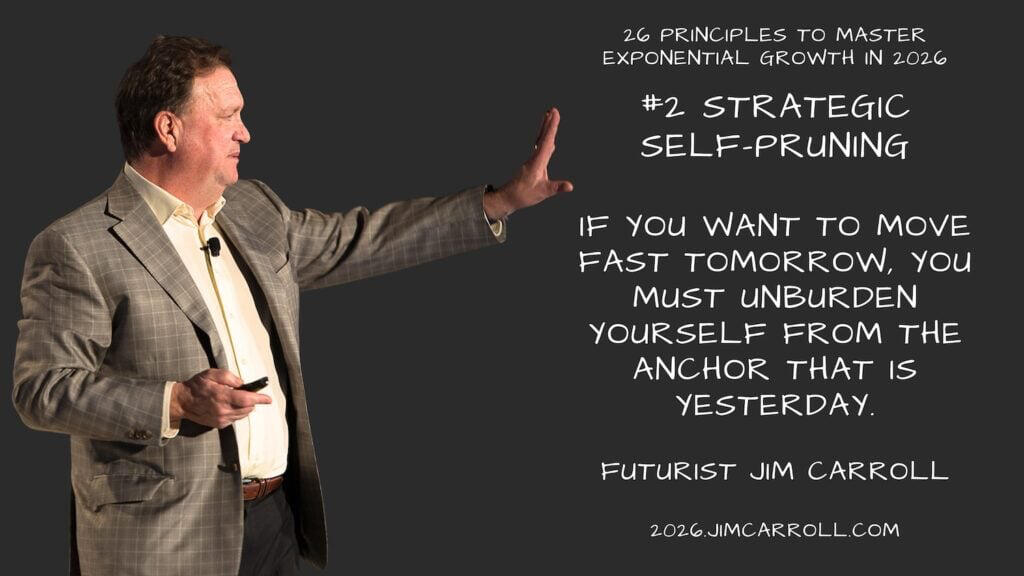
Day 2: It’s all about “Strategic Self-Pruning” – think of it as shedding your past to fuel your future speed.Let’s start here.Old habits die hard. In an exponential world old habits need to die faster.If Day 1 was about resetting your internal clock, Day 2 is about getting a new clock altogether.We live in an era where the half-life of a profitable business model, a valuable skill set, or a dominant market position is shrinking exponentially. Remember that line I often share? What used to last a career now lasts a decade; what lasted a decade now lasts a few years.That skill you had two months ago? It’s out of date already!How fast are things? As someone who lives for the future, I can barely keep up. Every day involves a flood of new ideas, new capabilities, crazy new concepts. Case in point? Google Gemini announced their latest image model yesterday. Moments ago, it took this very post and summarized it in about 10 seconds, like this. (This was before I made a few edits to the content along the way.)
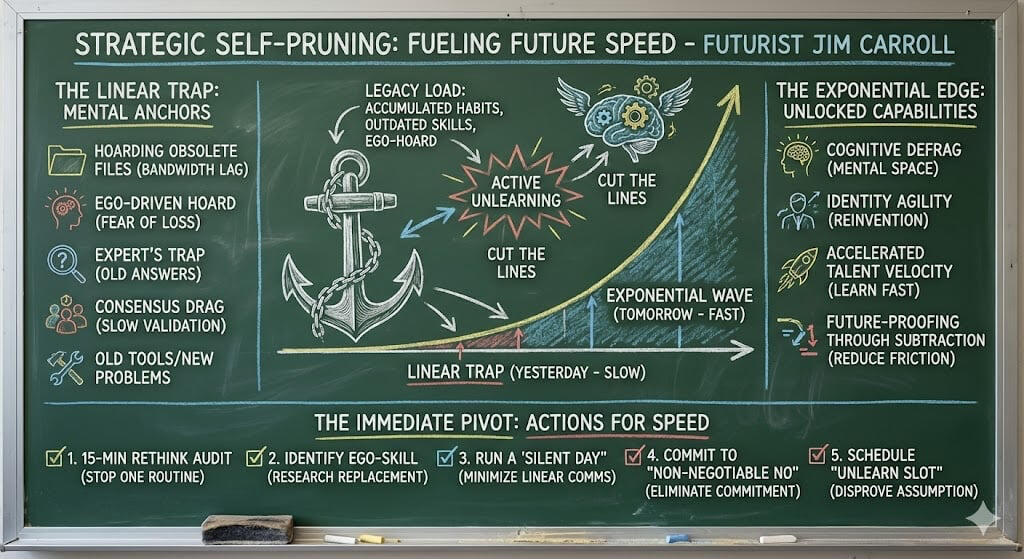
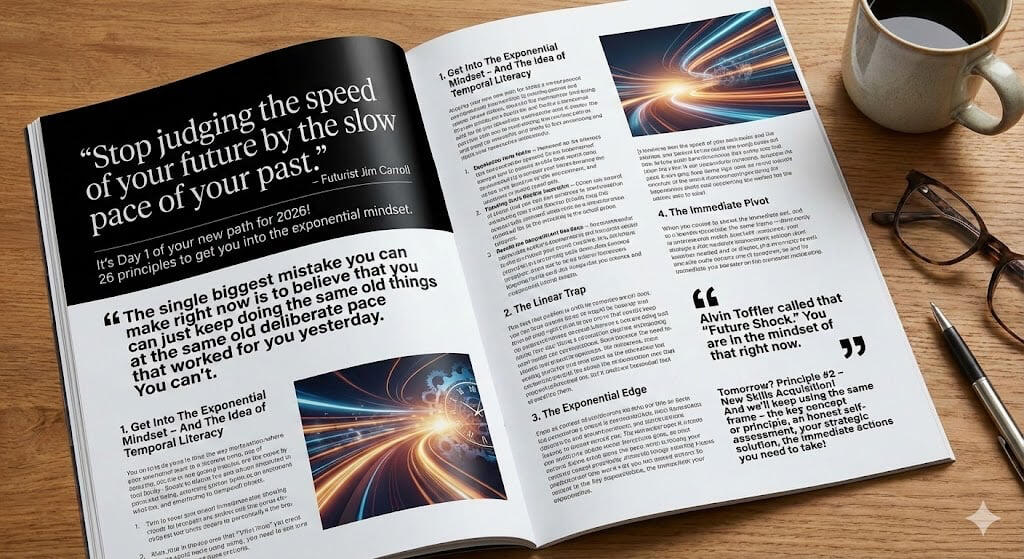
Or how about yesterday’s’ post as a magazine article? 10 seconds, start to finish.
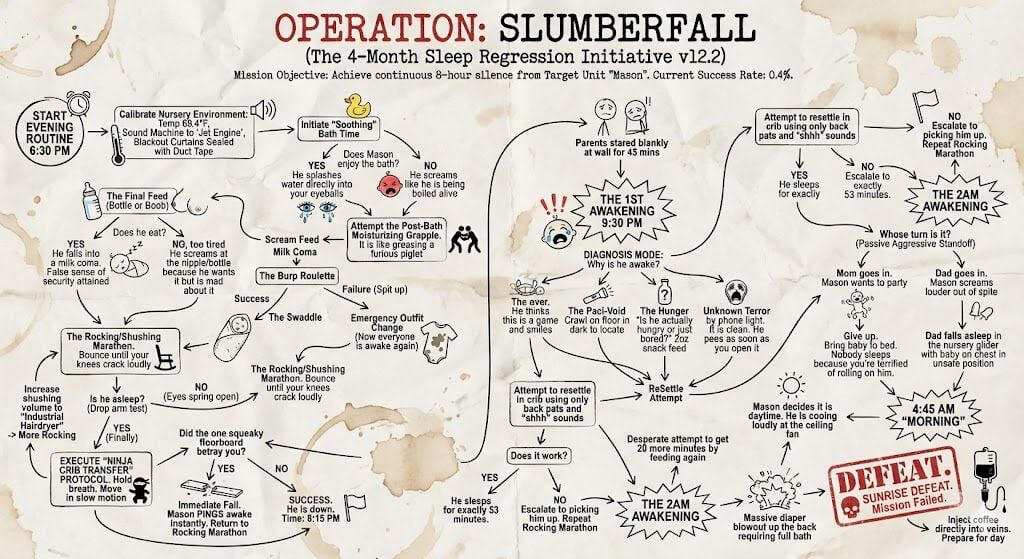
Or, Operation Slumberfall. I created this for my son and his wife, new parents with a 4 month old, asking it simply create, based on typical sleep patterns, what they are going through. They said it’s pretty accurate.
Is this just some weird new AI eye-candy toy skill, or valuable new knowledge? I have no clue – but if you spend any time on social media today, you’ll see everyone sharing all these weird new skills in real time. Next week? New things, new skills. Five years out? We won’t recognize who we are and what we can do.How do you possibly keep up in a world which is changing so crazy fast?By getting rid of your anchors! You need to learn how you can run free and figure out what the heck is going on, and what you need to do be a part of it. And to do that, you need new habits – to ingest new knowledge, learn new skills, scan new horizons, take new risks, and chart a new path forward.Look, I think you might be reading this series because you really want to figure out how to move forward in 2026. So here’s the thing – one of the most important things you need to do is get rid of your past habits, ideas and routines to build a different future.In my work with global organizations, I see the same pattern repeat: the greatest barrier to future velocity isn’t a lack of new ideas; it’s the crushing weight of old ones. Let’s call it the “Legacy Load”—the accumulated mental habits, comfortable routines, and once-valuable expertise that now act as an anchor in a tidal wave of change.To catch the exponential wave, you must stop hoarding the past.Let’s put this into perspective.1. The Exponential MindsetHere’s what you need to achieve – the ability for what I call “Strategic Self-Pruning”. It’s an intentional, continuous, and often uncomfortable act of active unlearning. It is recognizing that in an exponential world, your current knowledge base is depreciating faster than ever before. This discipline requires you to ruthlessly identify and eliminate obsolete mental models, successful but outdated skills, and personal routines to create the necessary mindset to absorb new stuff.You must prune the linear deadwood to fuel exponential growth.It means keeping an eye on all the crazy new developments that are redefining everything – such as an AI image generator that creates an accurate image of the challenge faced by new parents in but 10 seconds!2. The Linear TrapTo do this, you need to get out of the trap in which you are imprisoned. Your mindset prison. The attitudes and skills that are holding you back.Ask yourself if you are guilty of these habits. They are the mental anchors that chain you to yesterday’s pace, ensuring your personal growth remains linear while the world accelerates around you.
Hoarding obsolete mental files: Are you treating every past project, piece of knowledge, or established connection as an equally valuable resource that must be maintained. Are you wasting ridiculous amounts of time hoarding old knowledge, or revisiting it? This creates cognitive bandwidth lag, where your mind is too cluttered with linear data to rapidly process exponential opportunities.
Linking all your success to what you’ve done – not what you could do: Allowing your personal identity or sense of professional worth to be tied to a past achievement or skill set that the market is currently automating or obsolescing. You fear pruning it because it feels like a loss of self, rather than a necessary evolution.
Believing what you know is what you need to know: Believing that your deep experience in a specific domain protects you from disruption. In reality, when the underlying rules of an industry change exponentially, deep expertise in the old way becomes the fastest route to irrelevance when new ways are being invented at speed.
Chasing consensus constantly: Do you require broad internal agreement or validation from peers before testing a radical new idea or skill? This will just slow you down and prevent you from chasing the individual experimentation you need to keep up.
Solving a new problem with the same old tools: Failing to update your fundamental toolkit (software, methodology, or thought process) to match the problem’s complexity. You are using linear hand-tools in an exponential power-tool world!
It’s a cognitive defrag: Remember when we used to have to ‘defrag’ our hard drives (this will age you!) It’s almost the same type of thing – you free up vast amounts of mental space previously consumed by maintaining obsolete information, allowing you to focus entirely on complex, non-linear problem-solving.
Identity agility: You detach your professional worth from any specific, past skill, enabling continuous professional reinvention without the emotional cost of “loss.” This is huge, because you’ll take more risk and you become comfortable being a novice in a new, high-growth field!
Just-in-time knowledge: You shift your focus from knowing it all to learning it fast. You ensure your mental energy is dedicated to the most advanced skill acquisition, not the maintenance of comfortable, decaying expertise. I still think this is the most important skill you can develop!
3. The Exponential EdgeBy mastering Strategic Self-Pruning, you don’t just reduce friction; you unlock a powerful new set of capabilities adapted for speed:
4. The Immediate PivotSo what do you do? Decide the journey to an unburdened future begins right now. Here are the immediate actions you must take to start cutting the anchor:
Do a ‘thinking audit’: Identify one long-standing routine (a recurring meeting, a standard report, a habitual task) and write down the specific reason why it is no longer necessary in an AI-driven, accelerated world. Then stop doing it.
Identify Your “Ego-Skill”: Name the one professional skill you are most proud of but that you secretly suspect will be automated or marginalized in the next three years. Commit 30 minutes this week to researching its replacement skill.
Commit to One “Non-Negotiable No”: Eliminate one recurring commitment that consumes a lot of ‘linear’ time but yields no exponential return on your future goals.
Schedule a Mandatory “Unlearn Slot”: Block out an hour and dedicate it to actively disproving an assumption about your in industry that you have held for more than five years. Find the data that proves your old expertise is wrong.
Waste more time: Don’t worry about constant productivity – start to view unproductive time as investment time!
Play more: do frivolous things, viewing this as one of the most valuable ways to learn new stuff.
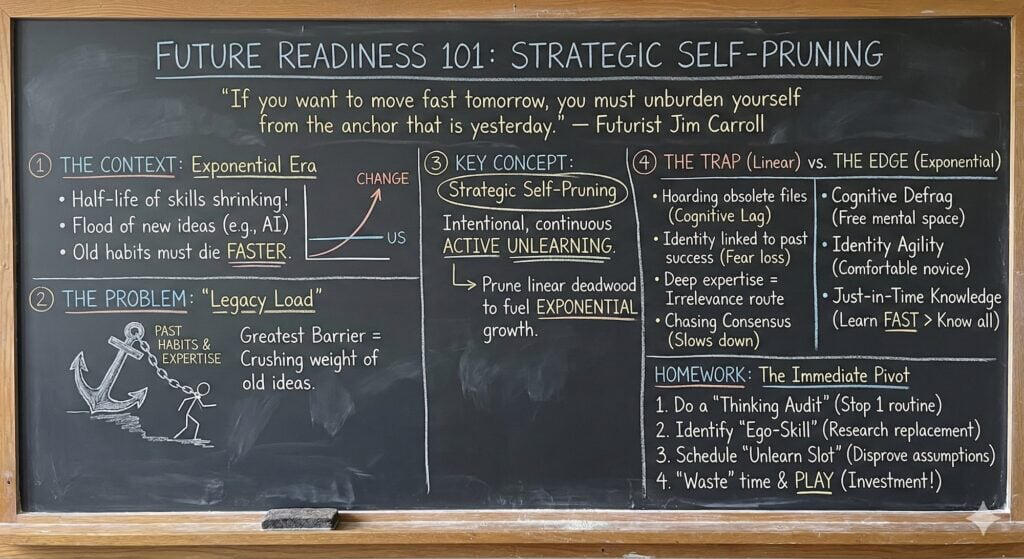
Ultimately, you cannot build tomorrow’s career on yesterday’s foundation.How about this for your go-to phrase: the future belongs to the unburdened—the people willing to do the hard, necessary work of letting go.So, take a hard look at the skills, habits, and assumptions you’re holding onto.Are they wings that will help you fly in this accelerating world, or are they anchors dragging you down?Oh, and by the way, here’s todays post, summarized!
Tomorrow? Principle #2 – New Skills Acquisition! And we’ll keep using the same frame – the key concept or principle, an honest self-assessment, your strategic solution, the immediate actions you need to take!
#3 Ambiguity Tolerance
Don’t try to be certain, be decisive.
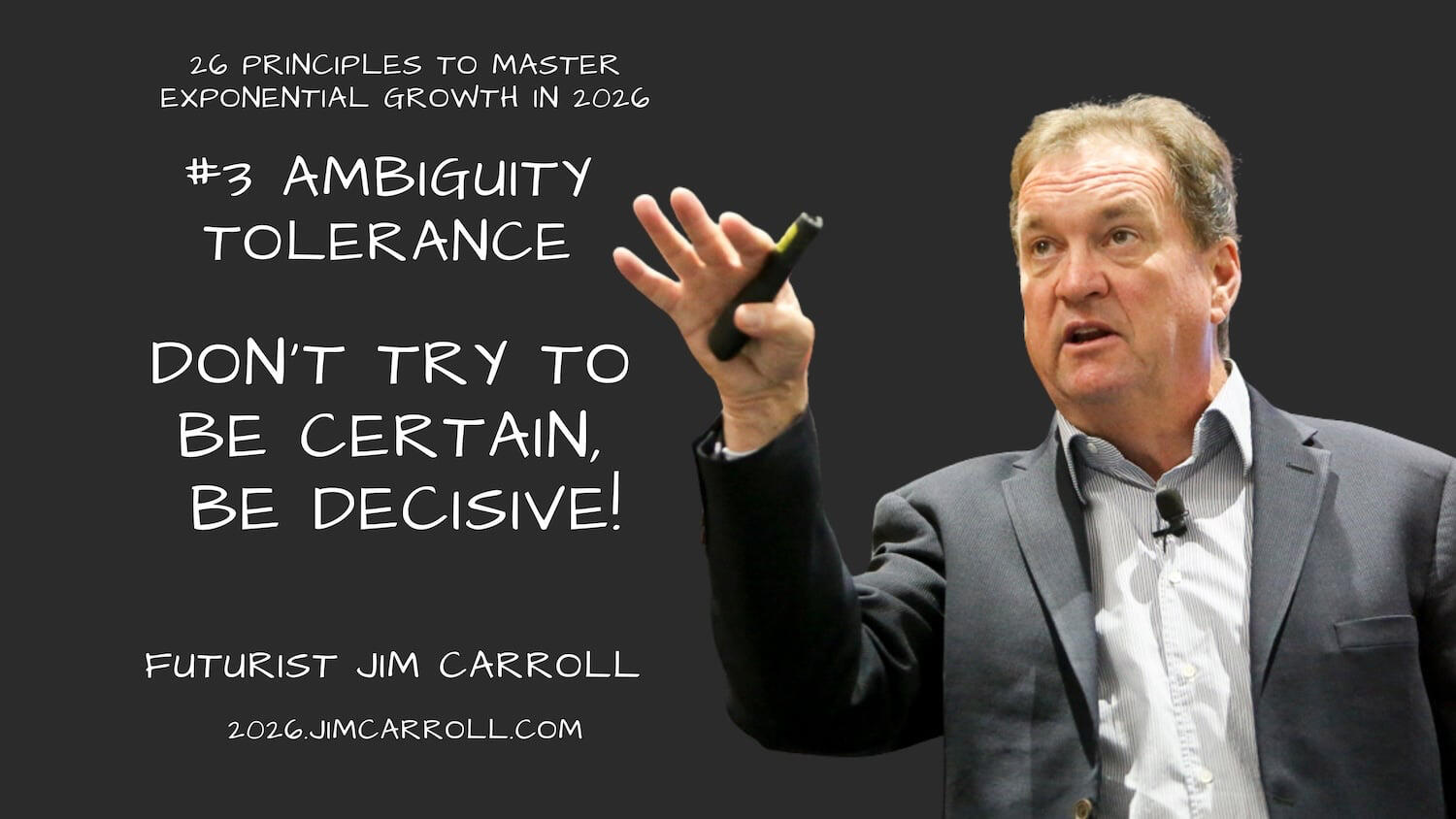
If Day 1 was about seeing the speed of the future, and Day 2 was about clearing the path, Day 3 is about finding the courage to walk it.Particularly when you don’t know what the hell is going on. Welcome to 2026!Here's your chalkboard summary!
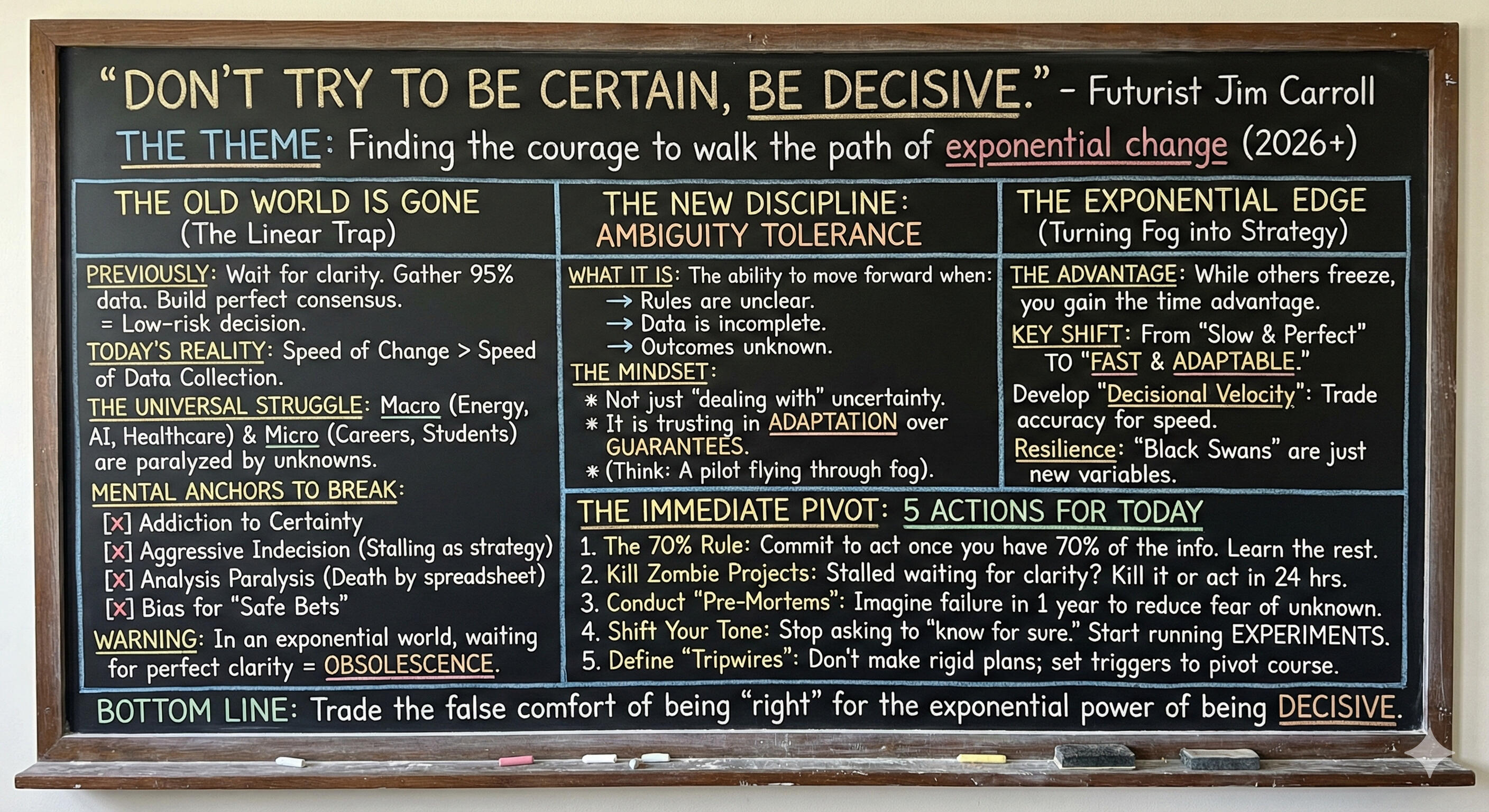
Here’s the thing about where we are today – in a linear world (aka “the olden days”, say, 2 or 3 years ago), you could wait for clarity. You could gather 95% of the data, build a perfect consensus, and then make a low-risk decision.That world is gone.Today, the speed of change outpaces the speed of data collection.You need to learn to make decisions despite a wild lack of clarity, a stunning amount of uncertainty, a scary amount of volatility, and a stainer degree of velocity.Think about just a few of the things that are going on in our exponential world at this very moment, at a macro-industry level:
Energy: Suddenly, tech giants need gigawatts of power right now for AI, but building transmission lines and capacity historically takes decades. Do you build a data center hoping the grid catches up, or do you bet on unproven mini-nuclear reactors? This was exactly the type of scenario I was addressing in a keynote for executives in the sector just a few weeks ago in Tucson.
Manufacturing: We know there are big opportunities in advanced robotics in ways that we can only begin to comprehend. Yet, should a factory invest millions in today’s robotics, only to potentially see the exponential development of humanoid robots render them obsolete in but a few years, long before the machinery is paid off? Do you automate now and risk obsolescence, or wait and risk uncompetitiveness?
Healthcare: AI diagnostics can spot diseases human doctors miss, but the legal frameworks for liability are years behind. Do you trust the AI and risk a lawsuit if it’s wrong, or ignore it and risk negligence if it’s right? Do you deploy now, or wait for things to catch up?
Now take these big, industry-scale trends which lead to ambiguity of decision making, and think about what is happening to you or the people around you on a daily basis.
The “Mid-Career” Crisis: A mid-career marketing professional knows AI is changing their field, but it’s unclear how fast and in what specific ways. Do they invest dozens of hours learning current AI tools (like Midjourney or ChatGPT) that might be obsolete in a year, or do they double down on “human” skills like strategy and relationship-building, hoping that’s enough to stay relevant? The ambiguity lies in not knowing which path leads to future employability versus wasted effort.
The “Student’s Dilemma“: A university student is in the midst of taking a major degree, say in accounting and finance. I just had this situation yesterday with a young fellow who sent me an inquiry on LinkedIn! They hear about AI automating coding, writing, and financial analysis. Do they pursue a traditional degree in finance, fearing their skills will be devalued by the time they graduate? Or do they choose a more “creative” or “interpersonal” field, with less clear career paths, hoping it’s more “AI-proof”? The lack of clarity about future job markets makes this fundamental life decision paralyzingly uncertain.
The “Freelancer’s Fear“: A freelance graphic designer sees AI generating impressive images in seconds. Do they lower their prices to compete with AI, try to pivot to a high-end “premium” service that emphasizes human touch and strategy, or attempt to become an “AI-augmented” designer? The volatility of client expectations and the velocity of tool development make it impossible to know if their current business model will exist in six months.
Take a look around – everyone is faced with big fast change, and don’t know what to do about it! We’ve become a society of deer in the headlights, staring at the bright lights of oncoming exponential change, and yet don’t know how to move out of the way – or jump right into it. (Weird metaphor, I know!)Here’s the thing – In every sector, the core uncertainty is the same: Trends are moving exponentially faster than our linear ability to regulate, build, or adapt to it.If you wait for perfect clarity in this environment, you are waiting for a moment that will never arrive!The discipline required to thrive here is Ambiguity Tolerance, and it looks like this.
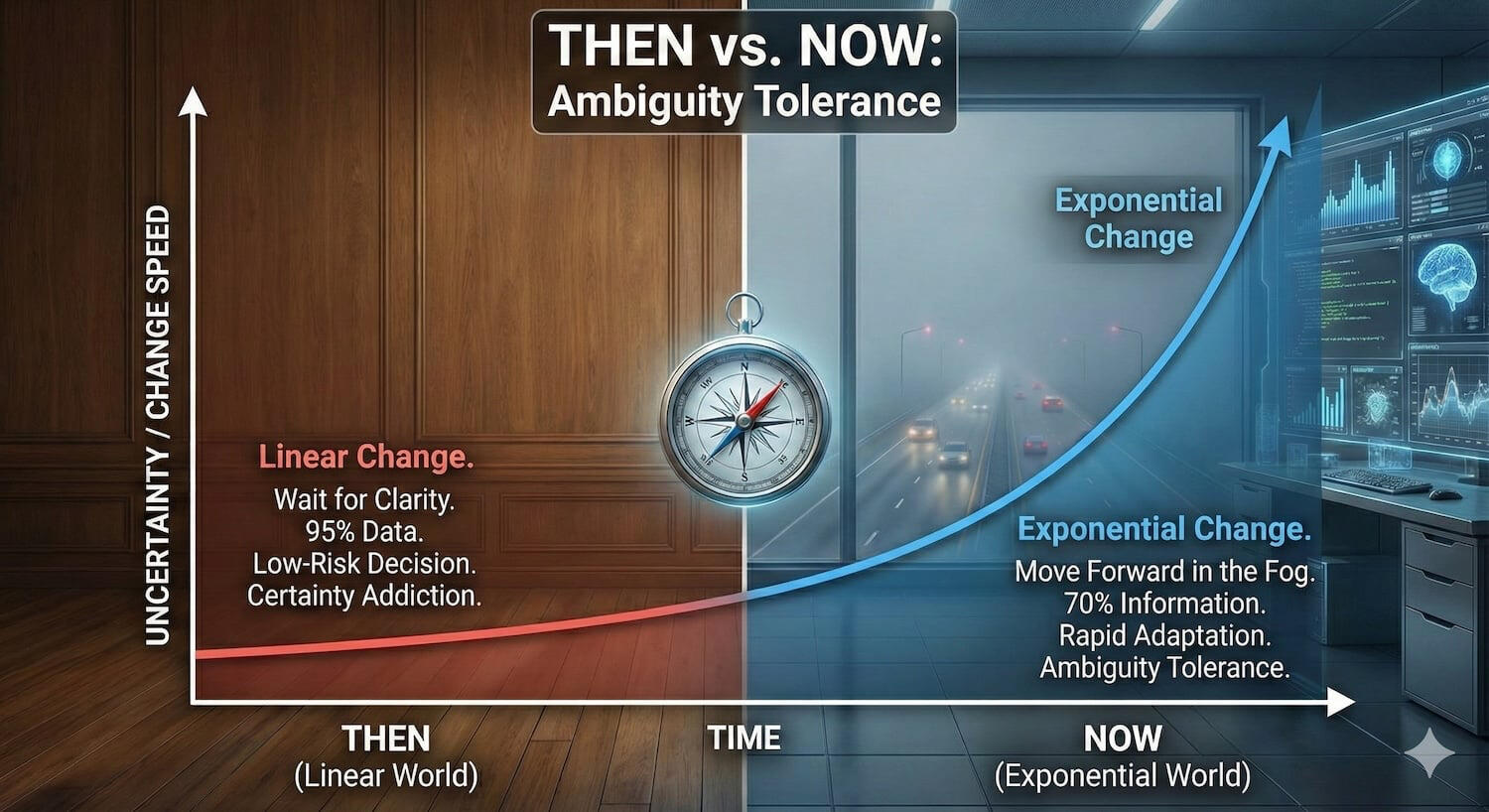
It’s about learning to live with the fact that there is no certainty, will never be any more clarity, and that you will be surrounded by ambiguity – and you decide to move forward with that being your new reality!In that context, I’m going to start using this format to summarize my posts – this capability didn’t exist a week ago, and here it is today!
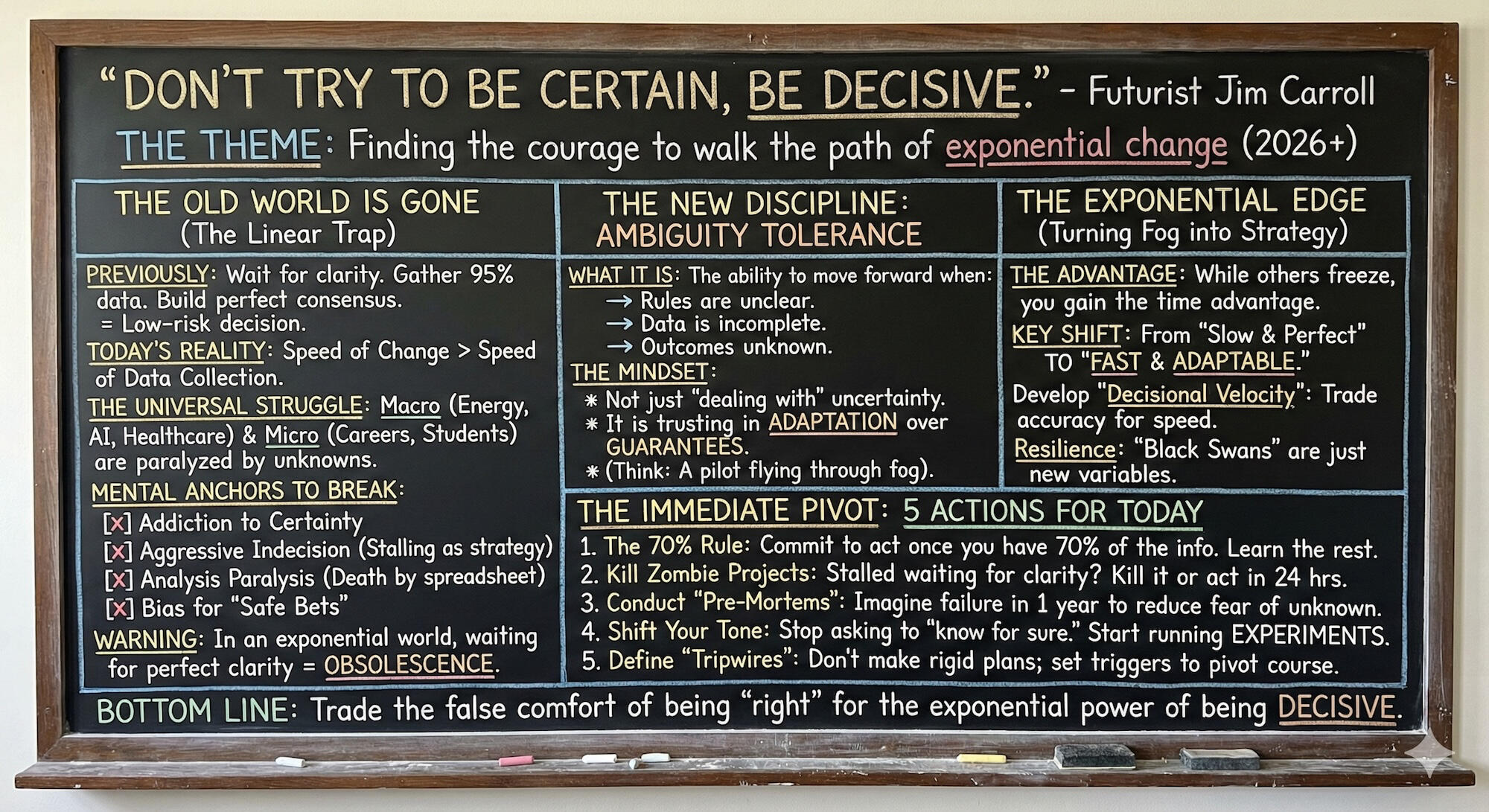
Let’s put this into the framework I’m using for this series.1. The Exponential MindsetAmbiguity Tolerance is not just about “dealing with uncertainty.”it’s a decision that you need to learn to deal in a world in which the rules are unclear, the data is incomplete, and the outcomes are unknown. It’s all about the fast volatility and wild uncertainty that will be 2026 and beyond – and a world in which the speed of disruptive trends are becoming faster.And in that context, it’s a mental mindset that it’s to be able to move forward simply based on a belief that it’s best to adapt and move, despite the absence of any data might guarantee of success. Think about it from a pilot’s perspective – it’s comfort with moving forward in the fog because you have an inherent trust in the things that will get you through it.2. The Linear TrapRight now, you probably seek too much certainty when trying to make decisions to go forward.Ask yourself if you are guilty of these habits. They are the mental anchors that chain you to yesterday’s pace, ensuring your personal growth remains linear while the world accelerates.
an addiction to ‘certainty’: You live by a paralyzing demand for complete data and guaranteed outcomes before making any sort of move. You are stuck where you are because you can’t go forward without any data to tell you how to go forward – and yet, you never get that data!
a mindset of aggressive indecision: This is a term I use to describe a particularly dangerous form of stalling and standing still. It’s when an organization or individual actively chooses to do nothing, hiding behind the excuse of “needing more study” or “waiting for the market to settle.” As I’ve written, “waiting until forced to change puts you behind.”
a tendency to analyze things to death: You’re addicted to the spreadsheet, live for the certainty of reports, and die while waiting for the clarity of consensus. You’ve come to believe that more data will inevitably lead to a better decision. You end up with a perfect analysis of a missed opportunity.
a bias towards the ‘safest bet’: You consistently choose the path with the lowest perceived risk, rather than the one with the highest potential reward. And yet, in an exponential world, the “safe” linear path is often the riskiest because it guarantees you will fall behind.
The problem with all this? In a fast-moving environment, the marginal value of additional data often decreases rapidly, while the opportunity cost of waiting increases exponentially!3. The Exponential EdgeThe key challenge with the exponential era is that there is a lot of ambiguity about what comes next, and how quickly it will happen. As I often like to say from the stage when it comes to many a trend – “We don’t know exactly where we are going, but we’re making great time!” It’s choosing to live, work, and move forward in that type of uncertain environment.That’s why changing to a different mindset – by choosing to master Ambiguity Tolerance – you don’t just survive uncertainty; you turn it into a strategic advantage:
moving forward, not back: While others around you are frozen by their certainty addiction, you are already running experiments, gathering real-world data, and building a lead. You gain the advantage of time.
developing decisional velocity: You develop the ability to make high-quality decisions faster. As I wrote in my new book Dancing in the Rain, the goal is to shift from a culture of “slow and perfect” to one of “fast and adaptable.” You learn to trade perfect accuracy for exponential speed.
learning resilience to the shock of fast change: Because you are already comfortable navigating the fog, you are less likely to panic when an unexpected “black swan” event occurs (like a sudden tariff change). You see it as just another variable to navigate, not a reason to stop.
agility and flexibility: Over the years, many of my clients have become well tuned to the idea of leadership agility. This is key! You are not wedded to a single, rigid plan based on a false sense of certainty. You are free to pivot rapidly as new information emerges because your initial commitment was to a direction, not a detailed roadmap.
4. The Immediate PivotSo how do you get there?By deciding to pivot!Maybe you should try a few immediate actions you must take to start building your ambiguity tolerance:
Adopt a “70% Rule”: For your next significant decision, commit to acting once you have 70% of the information you think you need. Accept that the remaining 30% will only be discovered through action.
Kill your “Zombie Projects“: Identify one project, thing or initiative you’ve been involved in that has been stalled for months waiting for “more clarity” or “better timing.” Either kill it today or define a concrete, low-risk next step to take within 24 hours.
Learn how to Conduct a “Pre-Mortem“: For a decision you are facing, spend 15 minutes imagining it has failed a year from now. Write down the likely reasons. This exercise reduces the fear of the unknown by making the potential downsides concrete and manageable.
Shift Your Tone: In your next meeting, replace the phrase “We need to know for sure” with “What experiment can we do simply to try to learn more?” Shift the focus from guaranteed outcomes to rapid learning.
Define Your “Tripwires”:Instead of a rigid plan, define clear tripwires—specific events or data points that will trigger a pre-decided change in course. This allows you to move forward without knowing the exact path, confident you have a mechanism to pivot!
Bottom line? In an exponential world, waiting for perfect clarity is a guaranteed path to obsolescence.The speed of change now outpaces our ability to gather complete data, making the old “wait and see” approach dangerously obsolete.Success in 2026 demands a fundamental shift: replacing a paralyzing need for certainty with the courage to be decisive amidst ambiguity.Think of it this way: the future belongs to those willing to trade the false comfort of being “right” for the exponential power of being decisive.
#4 Anticipatory Intelligence
Know that the future whispers before it shouts. Listen now.
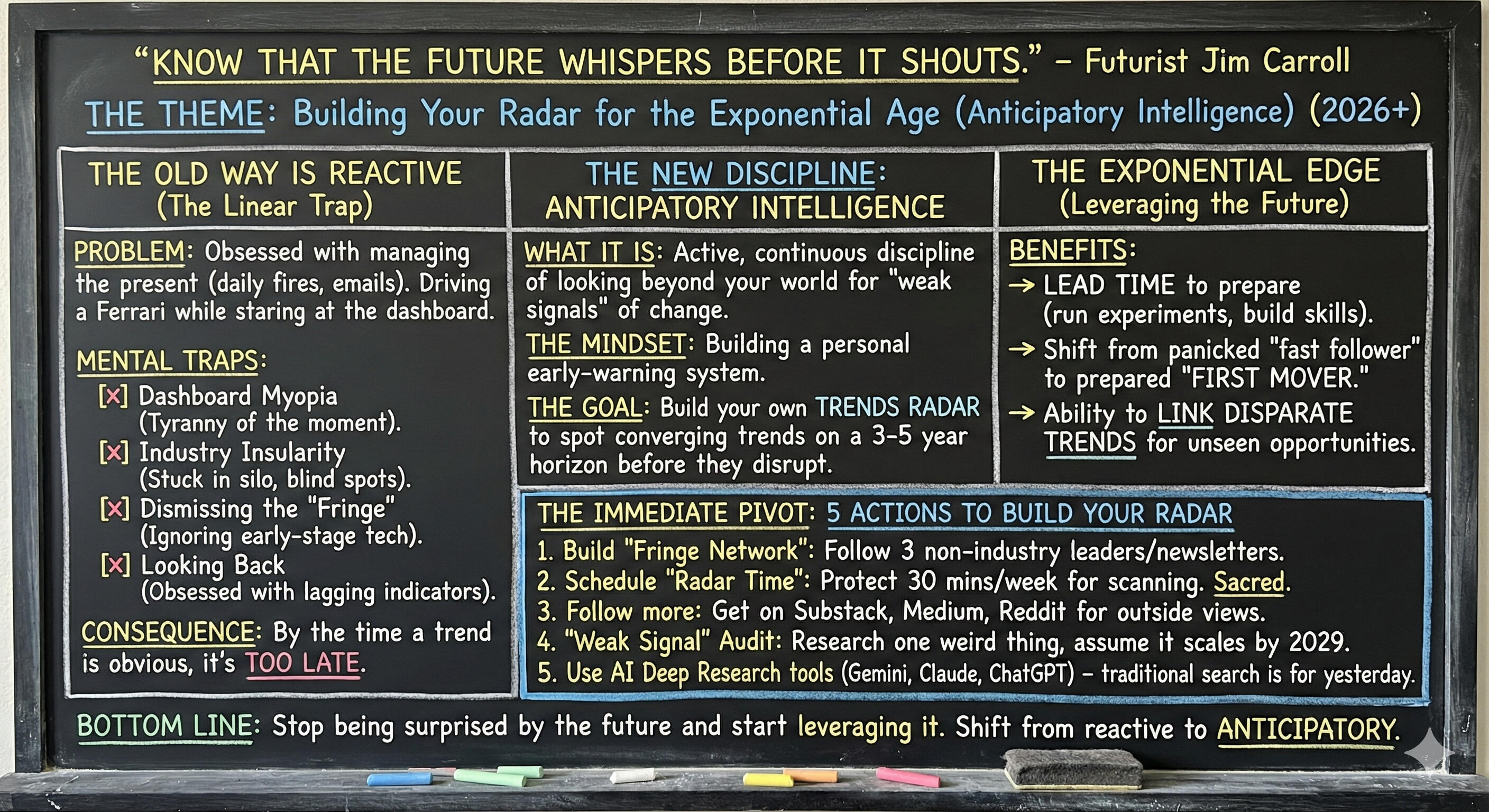
We are three days into resetting your mindset for 2026. You understand the speed of change (Temporal Literacy), you’ve started clearing the deadwood (Self-Pruning), and you’re building the courage to act without perfect clarity (Ambiguity Tolerance).Now, you need a radar system! Here is your chalkboard summary!
A radar system? It's one that allows you to do a better job of understanding what comes next, and what you need to know about it, long before you have to do anything about it! Way back in 2007, I wrote about the idea of this when I outlined my ‘Trends & Innovation’ Model.’ Right there, at the top of this iterative loop, is the ‘radar’. It’s what you do to find the signals through the noise.
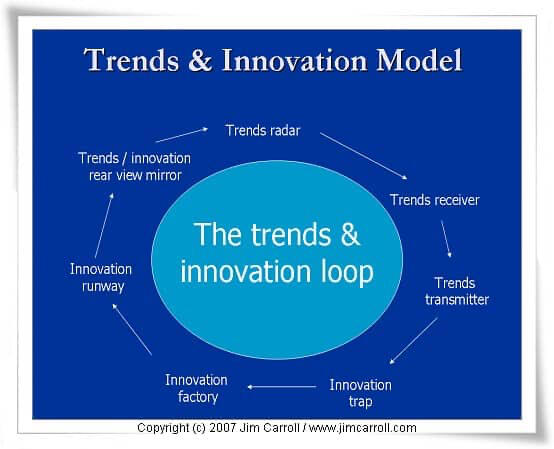
I’ll come back to this in a moment – for now, keep the idea in mind.Here’s how things have changed with the model. In a linear world, change happened slowly enough that you could afford to be reactive. You could wait until a trend became obvious, analyze it, and then adapt. In an exponential world, by the time a trend is obvious, it’s usually too late to leverage it.That means if you are reading about a disruptive technology on the front page of a mainstream business site, the exponential opportunity phase is likely already over. You are now in the reactive phase, playing catch-up against those who saw it coming three years ago. And that’s why the idea of Anticipatory Intelligence has become so important in 2026 – you need to work harder to stay ahead of the trends that might impact you, before the trends actually impact.This is a problem for most folks. The mistake most professionals make is that they are so obsessed with managing the present—the daily fires, the quarterly results, the immediate emails—that they never lift their heads to scan the horizon. They are driving a 200-mph Ferrari while staring intently at the dashboard indicators, oblivious to the cliff approaching up ahead.To lead in 2026, you need to shift from being reactive to being anticipatory. The discipline for this is Anticipatory Intelligence.How I Scan the Horizon: My Personal MethodologyPeople often ask me, “How do you see these things coming?” It’s not a crystal ball; it’s a rigorous, disciplined process of intelligence gathering. I don’t just wait for news and trends to find me; I find the news and trends.Here are ten specific things I do to build my own Anticipatory Intelligence, that might give you some inspiration as you focus on building/rebuilding your own.I’ve been doing some sort of ‘online research’ since 1984 (that’s not a typo), and so I’ve got some honed skills. In addition, the very nature of my job (keynotes for global organizations specific to industries) forces me to stay on top of and do deep research on various specific trends. Add to this the fact that I get to talk to a lot of CEOs and senior leadership executives about the trends they are worried about – which gives me even more insight into the trends we all should worry about!So what do I do? I aggregate a vast array of information using digital tools, deliberately focusing on specialized trade publications and “fringe” media to identify innovations before they reach the mainstream. I track global conference agendas to see which topics are moving to center stage.And then on top of this, the very act of writing forces me to connect the dots and categorize changes by their speed and impact. Ultimately, this structured method allows me to distinguish between slow-moving megatrends and the “weak signals” that serve as early warnings for major future shifts. Every once in a while, I clarify my thinking into a trends or innovation series, such as the recent 30 Megatrends series I wrote for this Daily Inspiration.
And now comes AI! I’m working fast to integrate AI research into my workflow to digest vast amounts of information, summarize lengthy reports, and help me spot patterns across large datasets that I couldn’t possibly process manually. I; ‘ve become a huge fan of Google’s set of AI tools, particularly Notebook LLM.I subscribe to the idea of what I often write about – just-in-time knowledge. I know how to get the right knowledge at the right time for the right purpose in order to learn the right thing at the right time.This isn’t just academic for me; it’s my job. But in 2026, it will need to become part of your job.1. The Exponential MindsetThat’s why you need to develop, hone, and enhance your skill of Anticipatory Intelligence.It’s deciding that you need an active, continuous discipline of looking beyond your immediate short-term world and outside your current industry silo to identify the “weak signals” of change that might spark something bigger. It is the practice of spotting emerging technologies, shifting societal behaviors, and converging trends on the 3-to-5-year horizon before they become mainstream disruptions.It’s about building a personal early-warning system to gather intelligence on the future.It’s about building your own Trends Radar.2. The Linear TrapTo start to do this better, ask yourself if you are guilty of “Dashboard Myopia.” This is the mental trap that keeps your gaze fixed on the present while the future runs you over.
The tyranny of the moment: You spend 99% of your time reacting to immediate demands (emails, meetings, crises) and 0% of your time proactively scanning for future shifts. You are too busy mopping the floor to turn off the faucet.
Industry insularity: You are stuck inside your own narrow world and rarely look outside it. You only read what everyone else in your industry reads; you only attend your own industry conferences; you only listen to the same old experts saying the same old thing. This creates a massive blind spot, as almost all disruptive change now comes from outside your industry (e.g., automaking disrupted by tech companies; finance disrupted by crypto/blockchain).
Dismissing the “fringe”: You ignore early-stage technologies or trends because they look like “toys,” are too expensive, or serve a niche market today. You don’t follow the weird and unique people who are inventing a very different future from the one we know (which is the focus of my still-upcoming book, Being Unique). You fail to apply exponential thinking to imagine what they will look like in three years when they are 10x better and 10x cheaper.
Looking back always: You navigate your career or business looking in the rearview mirror, obsessed with lagging indicators like past performance reports, rather than leading indicators of future shifts.
Think about this – what is it you are doing day-by-day that causes you to lose sight of what will come one day, but sooner?3. The Exponential EdgeWhen you master Anticipatory Intelligence, you stop being surprised by the future and start leveraging it. You gain:
lead time to get ready: The single most valuable commodity in an exponential world is time to prepare. Seeing a trend early gives you the runway to run small experiments, build new skills, and formulate a strategy before the panic sets in.
The ability to get in front of the trend: Instead of reacting to change inflicted upon you, you can position yourself to ride the wave. You shift from being a panicked “fast follower” to a prepared “first mover.”
The ability to link disparate trends: By scanning outside your silo, you begin to see how disparate trends—for example, how developments in AI might converge with biotech and an aging workforce—create massive, unseen opportunities that linear thinkers miss.
4. The Immediate PivotYou cannot build intelligence if your head is buried in your inbox.You must intentionally build the infrastructure for looking outward. You need to take your version 1 of the Trends & Innovation Model and take it to version 5.Here are your immediate actions:
Build Your “Fringe Network”: Right now, identify and follow three newsletters, podcasts, or thought leaders that have absolutely nothing to do with your current job but are at the bleeding edge of technology, science, or culture. (e.g., If you are in finance, follow a synthetic biology feed).
Schedule “Radar Time”: Protect 30 minutes on your calendar every Friday morning. Treat this time as sacred as a client meeting. Use it solely for reviewing your new fringe sources and asking, “What if this scales?”
Follow more stuff. Get out on Substack. Medium, Reddit, or elsewhere, to find and follow newsletters and reports that will take you beyond your world. Get into learning more, even if it seems irrelevant.
The “Weak Signal” Audit: Identify one weird, confusing, or seemingly silly thing you see happening in the market or society right now. Instead of dismissing it, spend 15 minutes researching it with the assumption: “This is an early signal of a major future trend. What does that trend look like in 2029?”
My biggest bit of advice? Sign up for a Pro account from Claude, ChatGPT, or Google Gemini, and immediately learn how to use their ‘deep research’ tools to change your entire methodology of doing Internet searches.Going to Google and typing in a search phrase is for yesterday; doing a deep dive via Gemini 3.0 will take you into a world of deep insight that you never knew existed. And yes, you need to do this to learn how to separate the accurate from the inaccurate.
#5 Knowledge Velocity
Learn faster than knowledge appears. It’s your only sustainable advantage.
We are three days into resetting your mindset for 2026.Day 5? It’s all about learning velocity, and the fact that you need to stop relying on your degree and start learning for your life!Here’s your chalkboard summary!
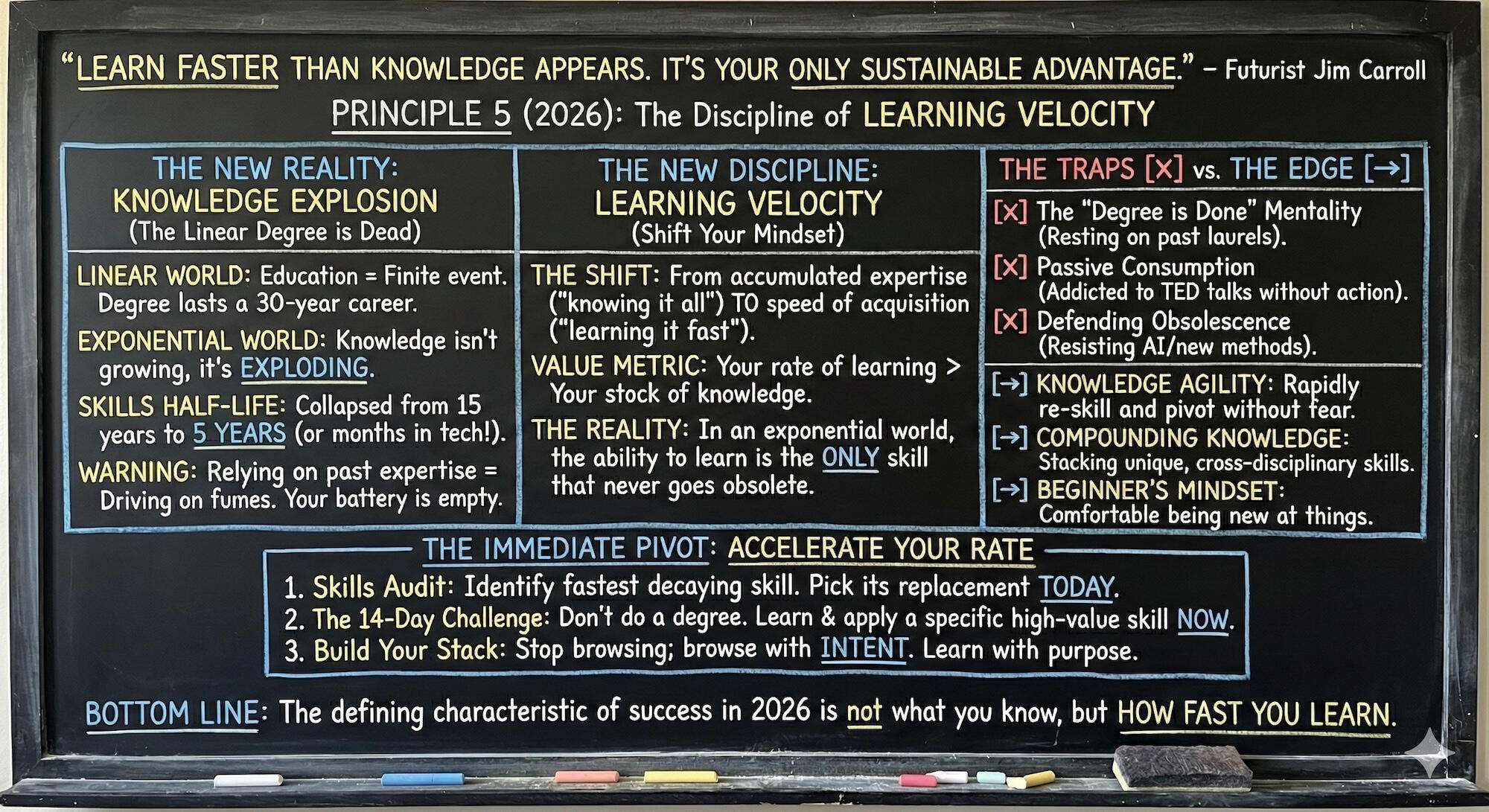
I want you to implant this idea firmly in your mind right now: skills decay. Add to that concept the idea of the half-life of knowledge. Layer on top of it my often-repeated phrase – the ability to master just-in-time knowledge is key.The former is happening faster because the latter is becoming smaller. Once you understand that, you need much of what you need to know for 2026 – your ability to align and realign to the new velocity of knowledge will be key to everything you do.Think about the change we are in the midst of. In a linear world, your education was a finite event. You went to college, got a degree, learned a trade, or got a set of professional skills, and that block of knowledge was something you could rely upon for a 30-year career with only minor maintenance.But in an exponential world, knowledge is not just growing; it’s exploding. I’ve written about this a lot, but it bears repeating. I often share on stage the fact that the average half-life of a professional skill has collapsed from 10-15 years to just 5 years today. Or the fact that it is said that half of what you know today will be obsolete in five years, if not sooner. In some high-tech fields, that timeline is compressed even further, with knowledge potentially doubling in a matter of months or even hours.This means that if you are relying on what you already know, i.e, with your past degree, your decade of experience, to carry you through 2026, you are driving on fumes. Your battery is empty, your mind is out of gas, and you’ll soon hit the limit of where you can go.Bottom line? The knowledge that got you here is decaying faster than you can replace it with linear learning methods.In that context, the defining characteristic of a successful professional in 2026 will not be their stock of knowledge, but their rate of learning.Principle 6? The discipline you must master is Learning Velocity.1. The Exponential MindsetLearning Velocity? It’s a shift from viewing education as something you did in the past to something you do all the time.It has you measuring your professional value not by your accumulated expertise (“knowing it all“), but by the speed at which you can acquire, integrate, and apply entirely new skills (“learning it fast”). It’s the recognition that in an exponential world, the ability to learn is the only skill that never goes obsolete.2. The Linear TrapAsk yourself if you are stuck in these common learning traps. They are the anchors keeping your skill set linear while the market demands exponential capability!
You’ve got a “degree is done” mentality: You tend to treat your formal education (college degree, certification) as something that gives you everything you need, rather than the foundational layer of a lifelong building project. You believe your past hard work exempts you from future hard learning. That type of thinking just won’t cut it anymore.
You rely on just-in-case learning: You spend way too much of your time learning things “just in case” you might need them someday, rather than focusing on Just-in-time knowledge – learning how to rapidly acquire new skills to solve an immediate problem.
You try to get by with ‘passive consumption’ masquerading as learning: You’re addicted to TED talks, leadership videos, motivational gurus, new podcasts, or scrolling LinkedIn, without actually trying to think about what you are trying to accomplish. Heck, do you read my stuff but never really act on it? True learning requires active practice, application, and the discomfort of being a beginner.
You rely too much on your past expertise: You resist most new methods or technologies because they threaten your established identity as an expert. You’re totally negative on AI because you are overwhelmed by what is going on, on you’re angry that it is sending some of your skills into the trash can.
With all of this, you need to ask a key question: Are you too busy defending your obsolescence rather than accelerating your reinvention?3. The Exponential EdgeTo get beyond all this, you need to move into the idea of exponential learning – and a world in which you are changing your relationship with the speed of knowledge change. These are the key things you are doing:
You develop a new ‘knowledge agility‘: You no longer fear technological disruption because you know you have the capacity to rapidly re-skill and pivot into new roles. Your career becomes flexible, evolving, and accelerating.
You’ve learned how to ‘compound your knowledge‘: By continuously stacking new skills on top of each other, you are learning h0w create unique, cross-disciplinary combinations (e.g., a marketer who learns Python, a lawyer who understands AI prompt engineering) that are highly valuable and difficult to automate.
You are ok with always being new at things: You become comfortable with the discomfort of being a beginner. This allows you to enter emerging fields early, where there are no experts yet, giving you a massive head start over those waiting for the ‘definitive textbook’ to be written.
Exponential knowledge? It has you involved in a new way of thinking, a new way of learning, and a new way of developing your skills.4. The Immediate PivotSo how do you do this?You cannot accelerate your learning without changing your daily habits. Think about a few of these ideas:
Conduct a ‘skills half-life” audit: list your top five professional skills. Honestly estimate how long until each is largely automated or obsolete, particularly in the context of what is happening with AI. Identify the one that is decaying fastest and pick its replacement skill today. Commit to trying to figure out that thing!
Just start learning new stuff: don’t sign up for a two-year degree. Find a specific, high-value skill (e.g., basic data visualisation, advanced AI prompting) and commit to learning enough to apply it within the next 14 days.
Build your ‘personal learning stack‘: put together a tight list of things you will use to learn faster. Pick specific YouTube channels, online course sources, and AI activities. Start to use these things to figure things out faster. Stop simply browsing – browse with intent!
A few years ago, your reality was that ‘what you know right now won’t get you through the next decade.’ Now, in the context of accelerating AI and other trends, what you know right now might not get you through the next few years.One of the most important pivots you need to make in 2026 is to pick up the pace – with our ability to learn new knowledge, master new skills, and learn new stuff.Get going!
#6 Iterative Obsession
Make more ‘better’ mistakes!
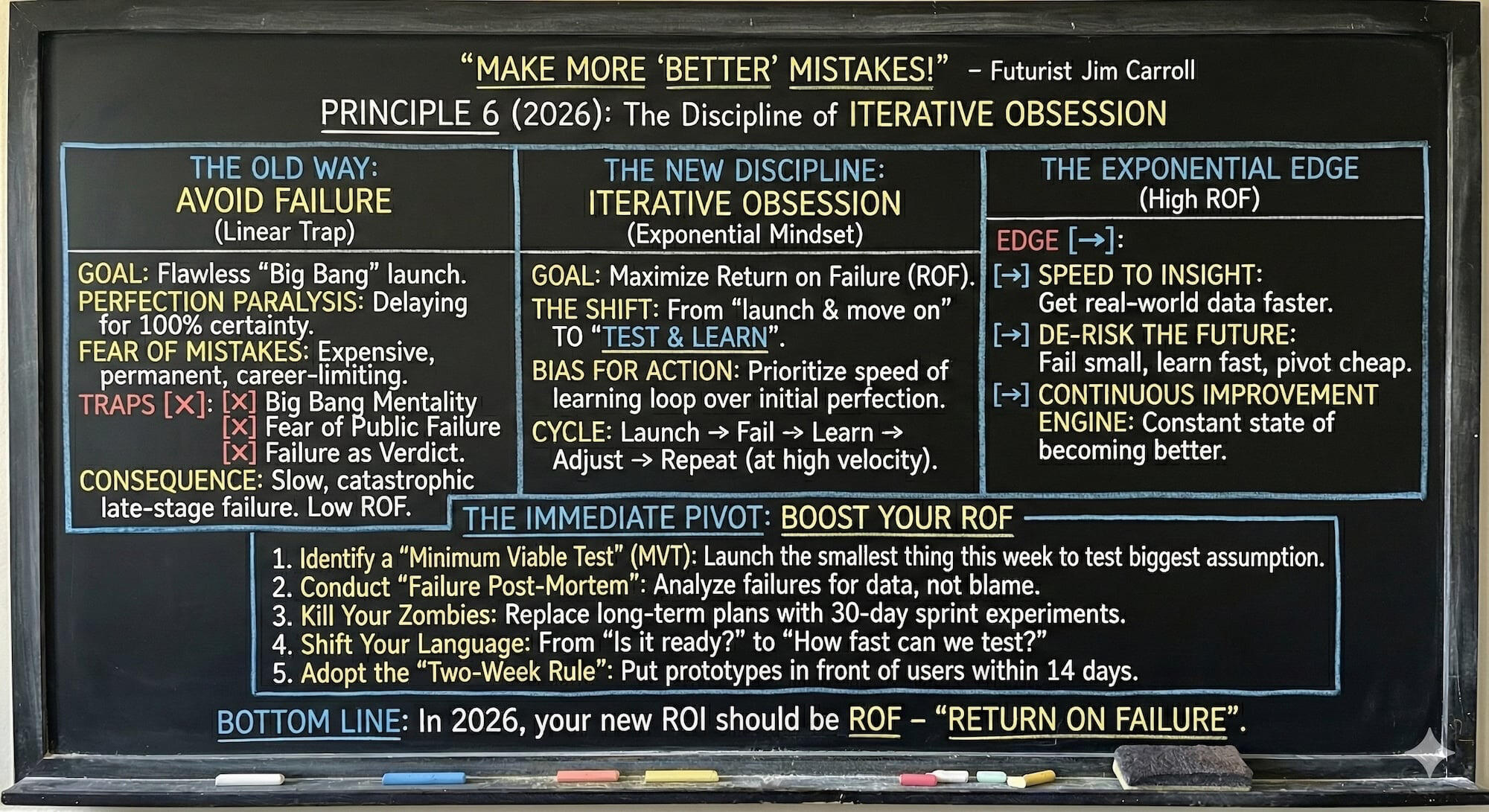
In 2026, your new ROI should be ROF – “Return on Failure”We are on Day 6. We’ve reset your clock, cleared the path, built your courage, turned on your radar, and accelerated your learning.Now, we need to completely rewire your relationship with failure.Why? Because, as the saying goes, in a fast world, innovators fail faster!Think about it. In a linear, slow-paced world, mistakes were expensive, permanent, and career-limiting. You spent years perfecting a product or strategy behind closed doors to ensure a flawless “Big Bang” launch. The ultimate metric was ROI—Return on Investment—and “failure” meant negative ROI.Those days are gone. In an exponential world, that math is backwards. The new reality is that not making mistakes fast enough is the biggest mistake of all.If you aren’t making mistakes, you aren’t moving fast enough. You aren’t testing the boundaries. You are operating on old assumptions while the world shifts beneath your feet.In that context, your goal isn’t to avoid failure; it’s to maximize what you learn from it to do it better the next time, right away. Every failure gives you invaluable data, insight, and lessons about speed. You need to make more mistakes, make them faster, and make them better, meaning they are small, calculated experiments designed to yield maximum learning, not sloppy errors born of carelessness.It’s all about this:
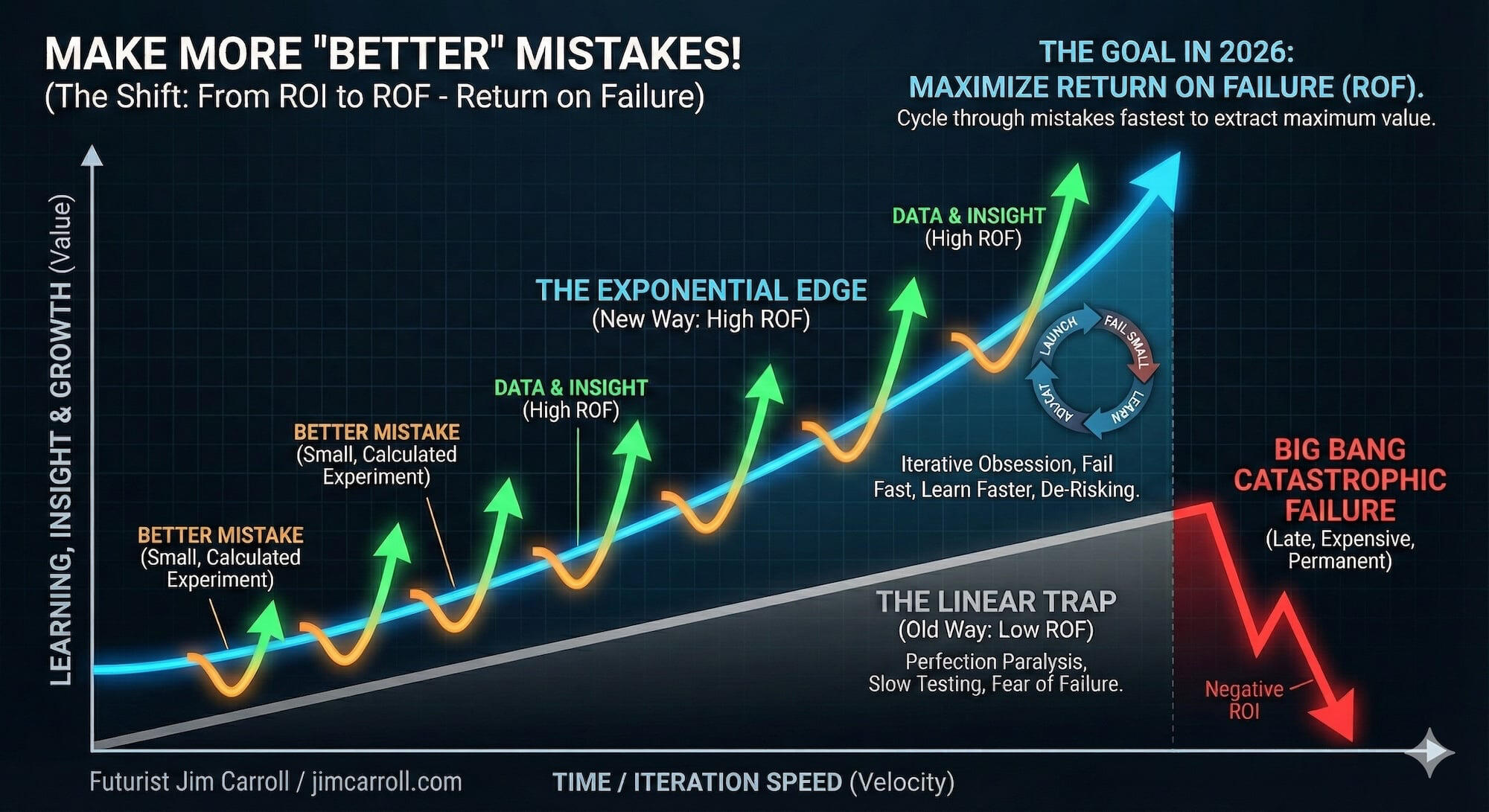
In other words, make more better mistakes!Here’s your chalkboard summary!
What I’ve coveredI’ve been speaking and writing about this new iterative world for years. Digging into some of my topics, here’s what I’ve covered.
Automotive industry
The old way: A car company avoids mistakes by spending five years designing a new model, building expensive physical prototypes, and testing them slowly on a track. The cost of a late-stage failure is catastrophic. Edsel, anyone?
The new way: An AI-driven manufacturer embraces virtually “breaking” things. They use “digital twins” to simulate thousands of design failures virtually before cutting a single piece of metal, massively accelerating the R&D cycle. Product designers use generative AI to generate hundreds of “wrong” concepts in minutes, rapidly filtering through failures to find the breakthrough idea.
using AI for rapid idea prototyping
The old way: slow, methodical, committee or collaborative design processes involving graphic design, product architecture managers, and copywriters. As the idea is developed, it is tested, refined, perfected, over a period of weeks, months, years….and the product is already obsolete by the time it gets to market.
The new way: Already, product designers are using AI image generators to create hundreds of variations of a product concept in minutes, allowing them to iterate on aesthetics and function at a speed previously impossible. Multiple variations of the product are brought to market as real-time customer feedback floods in.
predictive maintenance
The old way: a product breaks down. The customer brings it in. It’s fixed. Time is wasted. The key problem is that the system isn’t designed to provide any feedback up the chain that might help other customers solve the same problem.
The new way: A product is engineered to provide instant, up-to-date data on its operating condition. An AI “learns” from every machine failure, iteratively improving its predictive model across the entire fleet. We now know what is likely to break down and when, so we can alert the customer in advance. This fundamentally changes the nature and value of the product. Crazy idea? It’s already a reality in the automotive and aerospace sectors, where data from a single component failure is used to instantaneously update the maintenance schedules and design parameters for thousands of other units globally.
the “iterative supply chain”
The old way: Supply chains are designed to be rigid, planned systems to fluid, iterative networks that can’t react in real-time to disruptions. Tariffs and volatility happen. Oops!
The new way: AI algorithms iterate through thousands of potential shipping routes and supplier options every minute based on real-time data like weather, tariffs, and port congestion, constantly re-optimising the flow of goods. The company moves from just-in-time to just-in-case!
“iterative personalization” in the consumer goods industry
The old way: Mass production. Our assembly line builds hundreds, thousands, and millions of products that are all the same. Consumers become bored with the brand, tired of the product, wary of the investment.
The new way: Mass customization. Sophisticated analysis, 3d printing, rapid assembly line agility- we have now created products-of-one. We’re exploring doing this with personalized nutrition and skincare, where an AI analyses user data (e.g., biomarkers, feedback) and iteratively adjusts the product formulation for the next delivery, creating a continuously improving, personalized product loop.
Text
Here’s the key thing about all these disruptive examples: the fundamental change, like how things are ‘done’, provides an opportunity to learn from the mistakes that might have been made. This allows for changes, adjustments, improvements, and a new form of iterative development of the nature of the product or service. It shifts the entire business model from a Low ROF (“Return on Failure” to a High ROF. And that’s a fundamental and massive change!In that context, as we continue to go into this new world in 2026, the lesson is becoming clear – the market belongs to those who can cycle through their mistakes the fastest and extract the most value from them.In that context, the discipline you must master is Iterative Obsession – challenging yourself to pursue new methodologies in the same way as outlined above to learn from and improve upon, from your mistakes.And one important thing to realize – this iterative idea doesn’t just apply to products and services – it applies to your skills. The old way had you learning new knowledge and learning how to apply it. The new way? It has you learning new knowledge – applying it – learning what worked and what didn’t work – and going and getting new knowledge at a faster speed, to accelerate your skills faster. If you comprehend that, you comprehend the inherent value of an iterative obsession.1. The Exponential MindsetIterative Obsession?It’s the shift from a “launch and move on” mentality to a “test and learn” mentality.It’s a bias for action where you prioritize the speed of the learning loop over initial perfection. You view your first attempt not as a final product to be judged, but as a hypothesis to be tested—a deliberate attempt to generate data, often through failure.Silicon Valley has been doing this for years. Heck, my Tesla Model 3 is an iterative car – shipped with an original set of features, it keeps on getting software updates that improve upon things, add new features, and correct previous flaws.I wrote about this extensively, exploring the idea of iterative software platforms in my post, 11 Rules of IOT Architecture. Read it and learn from it.Bottom line? A relentless commitment to the cycle of Launch -> Fail -> Learn -> Adjust -> Repeat, executed at high velocity to maximize your ROF!2. The Linear TrapAre you stuck in a non-iterative world with what you do?Ask yourself if you are stuck in these common traps. They are the anchors keeping your execution linear while the market demands exponential speed.
Perfection paralysis: You keep delaying action until you have 100% certainty or a flawless product. You are terrified of the “mistake” of releasing something imperfect, not realizing that in an exponential world, “perfect and late” is the ultimate failure.
A “Big Bang” launch mentality: You are trapped in a world and mindset that has you believing that success comes from a single, massive, perfectly executed event. You spend all your resources on one giant bet, leaving no room for the necessary small mistakes and adaptations that actually lead to success.
Fear of public failure: You hide your work until it is “ready” because you are afraid of criticism. You forget that market feedback on an imperfect product is the most valuable data you can get!
Treating failure as a verdict, not data: When something goes wrong, you view it as a personal or professional indictment, rather than an objective data point that tells you what to do next.
Overall, you view failure as an enemy to be feared, not an ally you need to align with!3. The Exponential EdgeExponential thinkers flip this idea – failure is your best friend!When you master Iterative Obsession and start maximizing your Return on Failure, you transform your relationship with execution:
Speed to Insight: In this new model, you now get real-world data faster than your competitors. While they are still arguing in a conference room about what might work, you have already run three failed experiments and found the one thing that does work – and have modified your product or service accordingly. Customers are, like, ‘Wow! These guys rock!’ because they keep getting new versions of what they bought.
De-Risking the Future: By launching small, iterative experiments (making small mistakes early), you avoid the catastrophic risk of the massive “Big Bang” failure later. You fail small, learn fast, and pivot cheap.
Continuous Improvement Engine: You create a culture where improvement is constant because testing is constant. Your product, strategy, or career is never “done“; it is always in a state of becoming better through iteration.
Welcome to 2026 – a world of constant improvement at speed!Let’s bounce this back to the skills issue. Right now, I’m working at a furious pace to learn as much as I can about all the different aspects of AI, so I can determine what it means for my skill base. Last night, l I spent some leisure time by developing a new weather model. I have an AI that is going off and grabbing detailed weather insight from an online database for predictions 14 days out. I’m using what’s called API’s – application programming interfaces – to grab the data from a weather service.The data I get back looks like this:

I then feed it to Google Gemini (my current AI of choice) via an API and “Python” code, to have it develop a detailed narrative weather forecast for two weeks out – as well as a cool little image that summarizes the text.

I then feed it to Google Gemini (my current AI of choice) via an API and “Python” code, to have it develop a detailed narrative weather forecast for two weeks out – as well as a cool little image that summarizes the text.
Identify a “Minimum Viable Test” (MVT): Take a project you’ve been planning. What is the smallest, fastest thing you can launch this week to test your biggest assumption? Do it, expecting it might fail, and define what data you want to capture.
Learn to conduct “Failure Post-Mortem“: Take a recent failure or setback. Instead of burying it, spend 30 minutes analyzing it with your team. What was the hypothesis? Why was it wrong? How will that data change your next iteration? This is how you calculate your ROF.
Kill your zombies: Find a detailed, long-term project plan that is more than three months old. Tear it up. Replace it with a 30-day sprint plan focused on running a series of rapid experiments.
Shift your language: In your next meeting, replace the phrase “Is this ready?” with “What is the fastest way we can test the idea?” Shift the focus from perfection to experimentation.
Adopt the “two-week rule”: For any new initiative, commit to putting something tangible—a prototype, a pilot, a draft—in front of real users within two weeks to start gathering feedback data.
In 2026, the greatest risk isn’t failure; it’s stagnation.The exponential world won’t wait for your perfect plan. To thrive, you must trade the safety of slow and methodical – and perfect – for the velocity of iterative thinking. You need to embrace the cycle of rapid testing, honest failure, and quick adaptation as your new operating system.Always think about this – what you really want to do is maximize your Return on Failure (ROF) as your new success metric! You don’t just de-risk your future—you accelerate it, ensuring that your skills, products, and strategies evolve at the speed of the market itself.
#7 Relentless Reinvention
Remember – in an exponential world, the static become extinct.
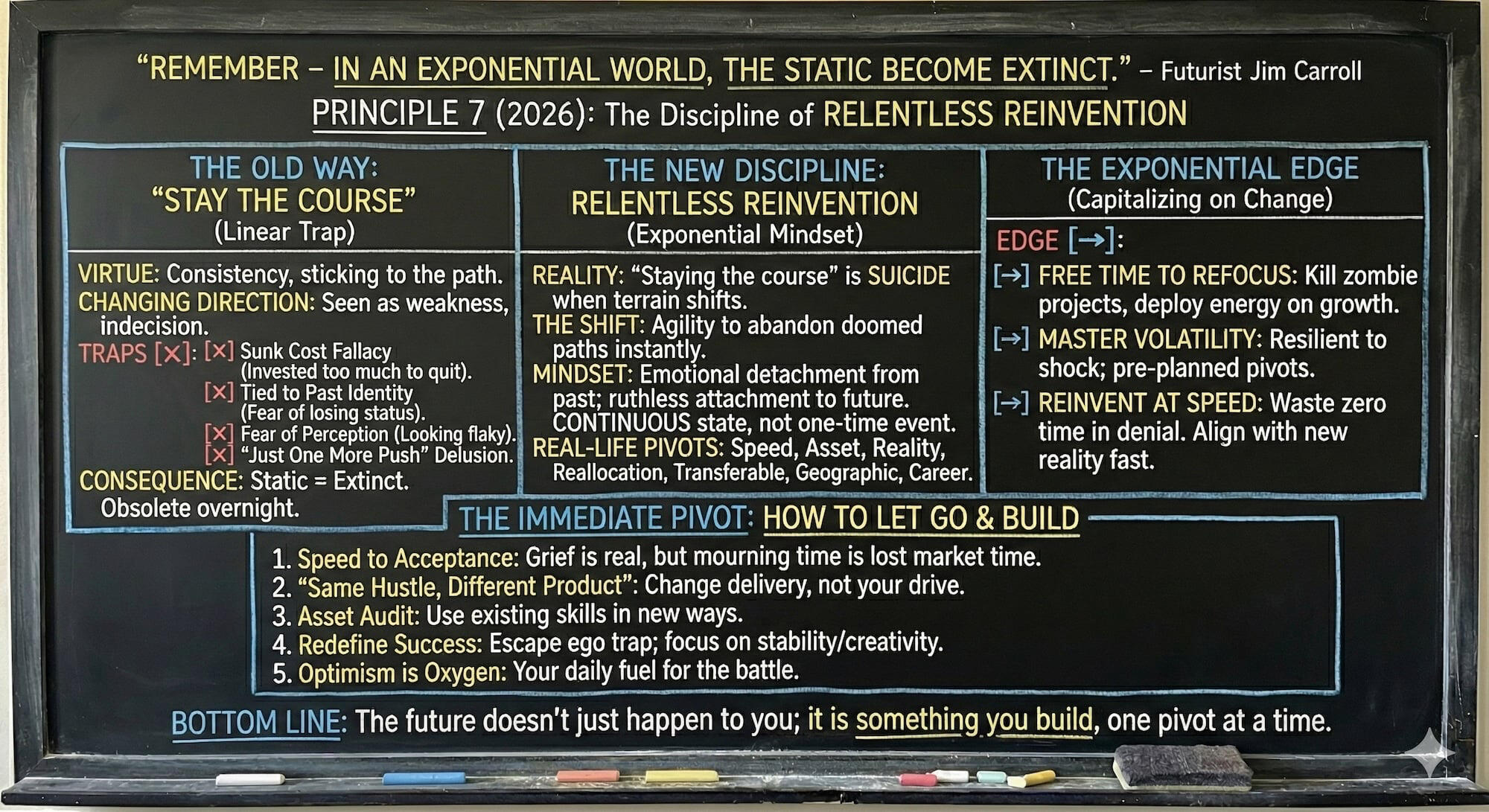
Day 7? Let’s focus on Relentless Reinvention, and why “staying the course” is the most dangerous strategy of allDays 1 to 6? We’ve reset your clock, cleared your path, built your courage, turned on your radar, accelerated your learning, and embraced rapid mistakes.Now, we arrive at the hardest emotional discipline of them all: knowing when to change – and doing the change.In our old, slow-moving linear world, “staying the course” was a supreme virtue. Once you set a career path or a long-term leadership strategy, you stick to it. Changing direction mid-stream was seen as a sign of weakness, indecision, or flakiness.But in an exponential world, “staying the course” when the terrain is fundamentally shifting beneath your feet isn’t grit; it’s suicide.Here’s your chalkboard summary!
Day 7? Let’s focus on Relentless Reinvention, and why “staying the course” is the most dangerous strategy of allDays 1 to 6? We’ve reset your clock, cleared your path, built your courage, turned on your radar, accelerated your learning, and embraced rapid mistakes.Now, we arrive at the hardest emotional discipline of them all: knowing when to change – and doing the change.In our old, slow-moving linear world, “staying the course” was a supreme virtue. Once you set a career path or a long-term leadership strategy, you stick to it. Changing direction mid-stream was seen as a sign of weakness, indecision, or flakiness.But in an exponential world, “staying the course” when the terrain is fundamentally shifting beneath your feet isn’t grit; it’s suicide.Here’s your chalkboard summary!
You aren’t able to get away from what you’ve invested in your past. You’ve got a paralyzing belief that you must continue down a failing career path or project simply because of the time, money, or education you have already invested in it. You throw good years after bad to avoid admitting the initial investment is gone.
You are far too tied to your past success, not your future one: You have tied your professional identity or reputation to a specific title, role, or industry. Killing that previous version of yourself feels like a loss. You’d rather go down with the ship than admit you were the captain who steered it wrong.
You worry about perception. You worry that changing your career direction or leadership style makes you look indecisive or unreliable to your peers. You prioritize the appearance of consistency over the reality of market alignment.
You get into the “just one more push” delusion: The mistaken linear belief that if you just try a little harder at the old way of doing things, the exponential tide will turn back in your favor.
3. The Exponential EdgeWhen you master the idea of relentless reinvention, you stop investing your personal energy in dead ends and start capitalizing on change. You gain:
more free time to refocus. By rapidly killing zombie projects, outdated roles, and failing strategies, you instantly free up your mental energy, time, and talent to deploy on high-growth opportunities. You stop feeding your past to starve your future.
You get better at mastering volatility. You become resilient to shock. When an unexpected market shift happens (a new technology renders your role obsolete), it doesn’t break you; it simply triggers a pre-planned pivot. Your career is built to bend, not break.
You can reinvent at speed. While peers are holding endless meetings trying to “save” a dying approach, you have already aligned your skills and focus with the new reality of the world around us. You waste zero time in denial.
4. The Immediate PivotReinvention requires emotional courage and a systematic approach to letting go.How do you get there? Let’s go back to the powerful reinvention stories in my Now What? book.
Speed to acceptance is your greatest competitive advantage: The “grief” of losing a career or business model is real, but the time you spend mourning is time lost to the market. Move through shock, denial, and anger to acceptance in record time. I talk about this A LOT!
“Same hustle, different product”: That’s the key lesson from Randy. You do not need to change who you are, only what you deliver. Your internal motivation, your personal drive, is your greatest asset. Don’t kill the hustle; just change it to a different future.
Use what you have (the asset audit): Don’t delay pivoting because you think you need new, foreign skills. Usually, you just need to use your existing toolkit in a new way.
Redefine success to escape the ego trap: If you cling to your old title, you will sink with the ship. Redefine success not as “fame” or “past status,” but as stability and creativity in the new reality.
Passion can be re-purposed: Your pivot doesn’t have to be a cold business decision. Stack two seemingly unrelated passions to create a niche of one.
Crisis removes boundaries: When the world shuts down locally, it opens up globally. A pivot often allows you to trade a world of small opportunities for bigger ones.
Know that ‘serendipity’ is a strategy!: The best pivots are often zig-zags. Don’t worry if your pivot doesn’t make sense on a traditional résumé. If it aligns with the reality of the market, it is the right move.
Optimism is oxygen: Reinvention is a daily battle. Without a core reserve of optimism, aka the “vitamin D of the future,” you will run out of energy before you complete the turn.
I’ve learned all these things – and write about it in the book (as well as in these daily posts. When my world of live events crashed, I didn’t wait for someone to “fix” my future. I realized that “no one is in charge of your future, except for you.” I became a broadcaster, producer, and technician overnight. I had to accept that my old life was gone and that “optimism is the energy that lets us do what needs to be done.”Bottom line?The future doesn’t just happen to you; it is something you build, one pivot at a time!That’s the thinking you need as we go into 2026.
#8 Velocity Alignment
The greatest risk today isn’t the speed of change: it’s your failure to pick up your pace.
We are on Day 8. You’ve committed to the pivot (Day 7). Now, you have to run.That’s why the principle you need to align to is “Velocity Alignment.”What is it? Matching your internal pace with external reality. Here’s your chalkboard summary!
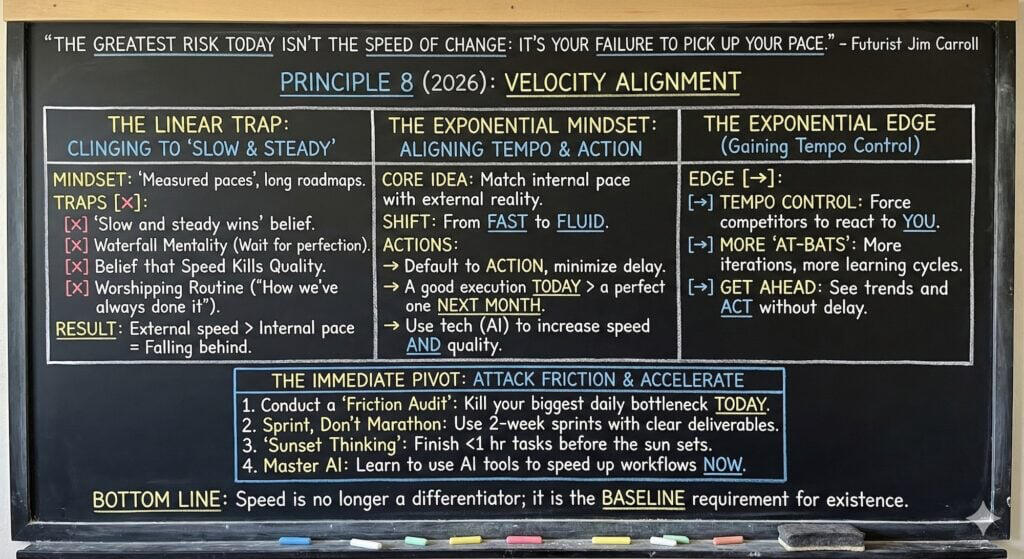
In a linear world, speed was a differentiator – the future belonged to the fast! Being faster than your competitor was a real advantage – if you mastered speed, you had what you needed to stay out in front in a competitive world. Speed wasn’t a mad rush, though – you had the luxury of “measured paces,” long development cycles, and five-year roadmaps.
Five-year roadmaps! As they say, LOL to that! In our faster world, you can barely plan for next month!The sad truth is that in our new exponential world, speed is no longer a differentiator; it is the baseline requirement for existence. The external environment is accelerating so rapidly that if you don’t do the minimum to keep up, you are guaranteed to not just fall behind – but perhaps, become rapidly irrelevant. our personal workflow, your team’s processes, your organisational cadence—are still running on linear time, you are falling behind every single hour.The interesting thing for me, as we head into 2026 in the context of the issue of speed, is that perhaps my book of 2012 is now out of date. The future no longer belongs to those who are fast – it belongs to those who are fluid!Here’s the key thing you need to ponder – the disconnect between external velocity and internal friction is where companies die, and careers stall.The Evidence: 10 Ways Speed is the New CurrencyThroughout my blog posts and keynotes, I have documented how the fundamental metrics of success have shifted toward velocity. CEOs have brought me in to talk to their teams to help them understand the reality of speed and the necessity for corporate velocity. The things I talk and write about aren’t theoretical; it is the new operating reality across every sector.Here are 10 examples from my analysis of how speed is now the primary metric:
Shrinking product lifecycles: Everything is becoming something from the ‘olden days’ faster, and it often happens before our very eyes. The example I share most often goes back years 60% of Apple’s revenue comes from products that didn’t exist four years ago. The window to earn back R&D investment is collapsing. Apple’s edge case is becoming the baseline.
R&D compression: The automotive industry has moved from 5-to-7-year development cycles to a software-defined reality where features are deployed instantly over-the-air. My Tesla isn’t a car – it’s an iPad with wheels that gets constant updates that add new features.
The collapse of adoption curves: It took radio 38 years to reach 50 million users. It took ChatGPT two months to reach 100 million. New competitors achieve scale almost instantly. You have no time to plan – only time to act.
Knowledge velocity: As Buckminster Fuller suggested and modern data confirms, human knowledge is now doubling every 12 hours. Your ability to ingest new information must match this pace. It’s all about just-in-time knowledge – it’s no longer about what you know, but what you can come to know.
Skill obsolescence: The half-life of professional skills has dropped from 15 years to 5 years or less. Speed of re-skilling is now more important than existing expertise. College degrees are becoming obsolete by the time someone graduates.
Manufacturing speed (digital twins): We have moved from physical prototyping of products, which can take months and years, to AI-driven “digital twins” prototyping. Combined with 3d printing and other sophisticated methodologies, it allows for thousands of design iterations in hours rather than months.
Supply chain agility: It’s no longer about just-in-time inventory – in our world of crazy volatility, it’s about just-in-case. The metric has shifted from lowest-cost routing to fastest reconfiguration speed in the face of disruption (tariffs, weather, pandemics).
Rapid competitor emergence: Traditional industry barriers have dissolved. A tech company can become a major automotive player (Tesla, BYD) in a fraction of the time it took legacy players to build their dominance.
Customer expectation for immediacy: Customers expect everyone to operate at the same level of excellence as the world’s best. The “Amazon Effect” has retrained B2B and B2C customers to expect instant gratification, compressing service-level-agreement timelines. If you don’t have world-class customer infrastructure, you can no longer compete.
Pharma/biotech acceleration: The COVID-19 vaccine development proved that 10-year timelines could be compressed into 10 months through parallel processing and new tech (mRNA), resetting expectations for all drug development. That’s but one industry – most other industries are seeing similar increases in velocity.
If the world is moving at this speed, you cannot afford to move at yours.The discipline you need to master is Velocity Alignment.1. The Exponential MindsetVelocity Alignment?It’s not just about “working harder” or “rushing“, or deciding to be faster.It is aligning your internal operational tempo with the external speed of the world around you. It involves personal habits that default to action, minimise delay, and move at or ahead of the speed of change, rather than falling behind. It’s coming to understand that time is the most perishable resource in an exponential environment, and that a good execution today is exponentially better than a perfect execution next month!2. The Linear TrapAsk yourself what is slowing you down. It’s usually clinging to linear processes in an exponential world.Think about these things – is this your mindset?
The trap of the slow pace. You are defined by an outdated belief that “slow and steady wins the race.” In an exponential world, those who are slow and steady get lapped before they even realise the race has started.
A waterfall mentality. Do you get into a mindset where step B cannot start until step A is perfectly complete? This creates massive bottlenecks compared to living, acting and thinking faster – and acting.
Believing that quality trumps speed. Do you have a mistaken belief that moving fast inherently means that you have to sacrifice quality? You can break that link – exponential leaders use technology (like AI and automation) to increase speed and quality simultaneously.
You worship at the altar of routine. You are chained to a world in which you follow procedures because “that’s how we’ve always done it,” even when the process takes longer than the actual work itself. You are still being killed by the innovation killers I defined many years ago.
I could go on, but you get the point. You are stuck in a slow pace in an extremely fast world!3. The Exponential EdgeSo what happens when you change your thinking and master velocity alignment?You stop chasing the future and instead become a part of it. In effect, here’s what you gain:
Tempo control: By executing faster, you force competitors to react to your moves, putting them permanently on the defensive. From a career and personal perspective, you’ve got a leg up on those competing for a new job or new contract position, because you clearly demonstrate that you can bring the core skill of agility to the table.
More chances “at-bat”: Remember the previous core principle – iterative thinking! Because you’ve learned to pick up the pace, you get to run more experiments, launch more iterations, and learn more lessons in the same amount of time as a slower competitor.
Getting in front of the future: if you really do things right, you can ‘get ahead of the curve’ instead of always falling behind. You see the trends at the sme time that others do – but you’ve learned to act on them without delay!
To do all these things, you need to act now.4. The Immediate PivotTo increase your velocity, you must attack the friction points in your daily work. Here are some ideas to get you going.
Conduct a “friction audit“: Identify one thing you do every day that, in the context of what I am writing about here, feels devastatingly slow. Do what you can to kill that single biggest bottleneck today!
Learn to race a sprint, not a marathon: Stop planning in quarters or years. Break your current major project into two-week sprints with clear deliverables at the end of each. Force yourself to be faster. Learn from what you are doing.
Get into sunset thinking! For any task that takes less than an hour, institute a rule: if it hits your desk before noon, it must be finished before the sun sets today. Stop the pile-up.
Start to learn how to use AI to speed things up. Like it or not, it’s here to stay. Careers are changing, knowledge is evolving, and structures are collapsing. AI is having a profound impact on the whole issue of speed, and learning how to master it is no longer optional – it’s rapidly becoming a baseline.
In an exponential world, speed is no longer just an advantage but the absolute baseline for survival.You must immediately align your personal pace with this accelerating reality to avoid falling behind. That’s the essence of Principle #8 – velocity alignment!
#9 Aim Higher
Know this: if your goals feel ‘realistic,’ you are thinking too small.
We are on Day 9. You’ve committed to the pivot (Day 7), and you are increasing your execution velocity (Day 8). You are moving faster.But are you aiming high enough?In an exponential world, you can’t just think big – you need to think bigger!And so day 9 is all about aiming higher and achieving the moonshot mentality. Here’s your key thought: in 2026 and beyond, the idea of being just 10% better is dead, and being 10x better is critical.Here’s your chalkboard summary!
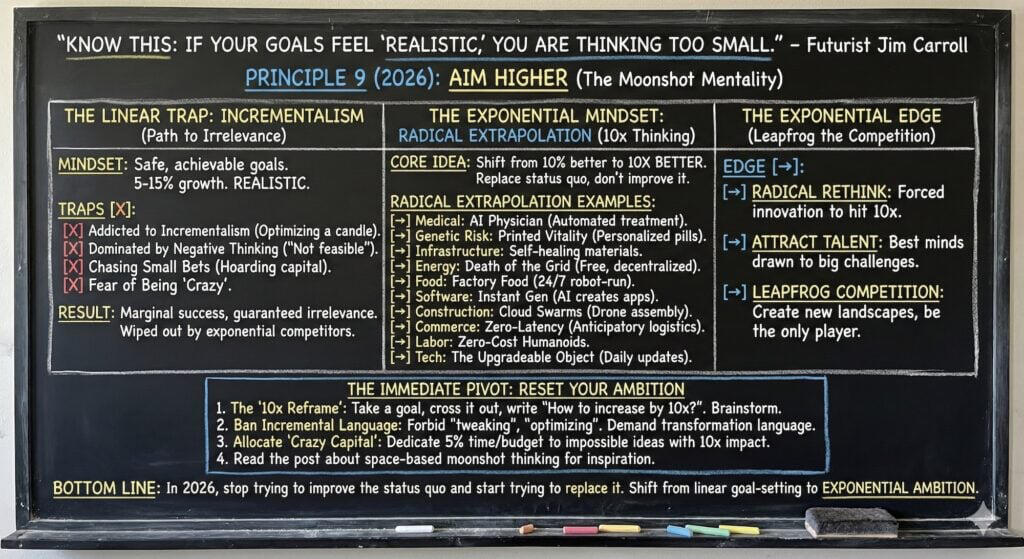
Think about it: in a linear world, success was defined by incrementalism. Growing sales by 5%, cutting costs by 10%, or improving efficiency by 15% year-over-year was considered a victory. You achieved this by working a little harder, squeezing a little more out of things, and making safe, small, “feasible” bets.Realistic things.Things you know you could accomplish.In an exponential world, incrementalism is the path to irrelevance. Small steps won’t work. Thinking small is a guarantee for marginal success. While you are striving for 10% growth, an exponential competitor – maybe someone leveraging AI, developing a new business model, or developing new skills – is aiming for 10x growth and will wipe you out before your five-year plan is halfway done.To survive in 2026, you must stop trying to improve the status quo and start trying to replace it. You need to shift from linear goal-setting to exponential ambition.Moonshot thinking!

The discipline is Aiming Higher!As Sly and the Family Stone said – I want to take you higher! To understand the scale of ambition required for 2026, you first need to see where the trends are actually going. You cannot plan for 2030 using 2025 thinking. If you take today’s shifts and extrapolate them to their 10x conclusion, the future looks radically different.So let me take you into my world of “Radical Extrapolation” – I’ll take some trends I’ve covered and take them higher. I’m Sly. You’re the family. Let’s get high!
From “Information Overload” to “The AI Physician”Trend: Medical knowledge doubling every 78 days.The Moonshot: By 2035, human doctors cease to be the primary diagnostic engine. The sheer volume of data means only AI can track the billions of variables. Your “checkup” becomes a continuous, real-time data stream from wearables, and treatment is automated before you even feel a symptom. Your iPhone data has already given the doctor much of what they need to know about your situation.From “Genetic Risk” to “Printed Vitality”Trend: Genomic sequencing costs are collapsing below $200.The Moonshot: Medicine shifts from “generalized” to “hyper-personalized.” We stop treating the average human – we treat a patient of one. You wake up, a sensor reads your blood biomarkers, and a 3D printer on your counter presses a pill with the exact molecular mix your body needs for that specific day. Crazy? Not at all!From “New Materials” to “Immortal Infrastructure”Trend: Material discovery is compressing from 20 years to 2 years.The Moonshot: We stop fixing potholes and rust. Instead, concrete, asphalt, and steel are all engineered with biological properties to heal themselves. Infrastructure becomes “living,” repairing its own cracks and adapting to weather stresses without human intervention. I wrote about this very trend in my recent Megatrends series.From “Electric Cars” to “The Death of the Grid”Trend: Battery costs dropping below $100/kWh.The Moonshot: Energy becomes so cheap and storage so dense that the centralized utility grid becomes obsolete. Homes and businesses disconnect entirely, relying on painted-on solar skins and localized storage. Energy becomes a “free” resource like air. Your car is now a key part of the electrical grid, storing and sharing energy from its battery as needed.From “Ag-Tech” to “Factory Food”Trend: Autonomous farming and robotic harvesting.The Moonshot: The idea of farming only when the sun is up is gone, as agricultural robots come to dominate production. Agriculture decouples from nature. Farming moves entirely indoors to vertical, sterile, 24/7 robot-run factories located in city centers. Weather, pests, seasons, and transport costs are eliminated from the food supply equation.From “Coding Tools” to “Instant Software Generation”Trend: AI training costs dropping 99%.The Moonshot: The “App Store” model dies. You don’t download apps; you describe a problem to your AI, and it generates a custom software solution or app for you in seconds. Every individual has the power of a 100-person dev team in their pocket. Imagine your world without your iPhone as it was in 2006, and compare it to today. Now imagine what happens with ‘AI apps.‘From “Drones” to “Construction by Cloud”Trend: Micro-autonomous swarms.The Moonshot: Rapid assembly, modular construction, new methodologies. We retire the crane and the bulldozer. Swarms of thousands of coordinated drones 3D print and assemble skyscrapers in days, moving like a fluid rather than machinery. Construction becomes a 24-hour, silent, autonomous process.From “Fast Shipping” to “Zero-Latency Commerce”Trend: Anticipatory logistics.The Moonshot: The concept of “ordering” a product disappears. Predictive AI calculates that you need detergent, a replacement part, or fresh produce before you know it. The supply chain becomes a synchronized pulse where goods arrive at your door exactly as the need arises. Ya, this idea has been shared since the late 90s as e-commerce invaded our lives, but some components of it will become real.From “Helpful Robots” to “Zero-Cost Labor”Trend: Humanoid robots dropping to the price of a motorcycle ($16k).The Moonshot: They’ll be all around us. Manual labor costs collapse to near zero. General-purpose humanoids handle all stocking, cleaning, and basic assembly. “Labor shortage” ceases to be a phrase in business; the workforce is infinite, scalable, and downloadable. (Humanoid robots is perhaps one of the most far-fetched ideas for us to accept, but the technology in 2025 started moving crazy fast. We’ll see what happens now that it has hit exponential velocity.)From “Obsolete Tech” to “The Upgradeable Object”Trend: Product lifecycles are collapsing to near zero.The Moonshot: Everything we buy has some element of tech in it. It’s upgradeable, changeable, and feature addition capable. Take a look at my 11 Rules of IoT Architecture, and ask yourself what happens when every device is unlocked, changed, or completely repurposed purely by software updates, or physical goods are designed to be dissolved and reprinted annually. The idea of the “model year” is replaced by the “daily update.“
If those examples felt “unrealistic” to you, you are trapped in a linear world, dominated by your linear thinking.For 2026 and beyond, you need to break free of marginal thinking.1. The Exponential MindsetIt’s all about a shift in your goal-setting.Aim higher! Think bigger! Be bold. Those sound like generic motivational pap, but they’re not. Check the article I share at the end of the post – a fellow in the nascent, small Canadian space industry, with a brilliant post that captures the whole idea of thinking bigger.Take this thinking, and apply it to your world. That’s what it’s all about!2. Why We Fail to See ItAsk yourself if your ambition is trapped by linear thinking. Ask yourself if you are trapped in a mindset that has you thinking small, all the time, with all the things around you.
You are addicted to incrementalism. You find the comfort of setting safe, achievable goals based on last year’s performance to seductive You don’t have to work too hard. Do the right things, and you’ll get your bonus or a great score on your appraisal. Here’s a question to ask: Are you merely optimizing a candle instead of inventing a lightbulb?
You are dominated by negative thinking. You are killing bold ideas immediately because they aren’t currently “feasible,” cost-effective, or fit into the model “how we do things here.” This shows your mind is centred on negativity rather than opportunity, and also ignores the reality that exponential tech makes the impossible feasible very quickly!
You only chase the small bets. You keep all your innovation capital hoarded, since you always look for the safest bets. The result is that you’ll never take a higher-risk, higher-reward moonshot.
You fear being labelled as ‘crazy’: You hesitate to propose a 10x idea because you fear looking foolish or unrealistic to your peers, who are stuck in linear thinking. WRONG! And in fact, being crazy is one of the core themes in my upcoming book, Being Unique!
3. The Exponential EdgeWhen you master the idea of aiming higher, you change the fundamental trajectory of your future:
You undergo a radical rethink: A 10x goal forces you to abandon legacy processes that are holding you back. You can’t get to 10x by tweaking what you have; you are forced to innovate.
You hang with like-minded. The best minds aren’t interested in working on 5% improvements. They are drawn to big, audacious challenges. Moonshots attract exponentially better talent and energy.
You start to leapfrog the competition: While competitors are fighting over market share points in the existing landscape, you are creating an entirely new landscape where you are the only player.
4. The Immediate PivotSo what do you do?First and foremost, change your goals. Challenge your thinking. Reset your ambition. Here’s a few immediate actions to think about:
The “10x Reframe” Exercise: Take one major goal currently on your plate (e.g., “increase sales by 15%”). Cross it out. Write down: “How could we increase sales by 10x?” Spend 30 minutes brainstorming only solutions that could hit the new number.
Ban “Incremental Language“: For one week, forbid phrases like “tweaking,” “optimizing,” “slightly improving,” or “realistic growth” in your strategy meetings. Demand language focused on transformation and breakthrough. Take my Innovation Killer list, print it, and tape it to the wall.
Allocate some “crazy capital“: This is perhaps the best idea! Carve out a small percentage of your time or budget (even 5%) that is exclusively dedicated to testing ideas that seem currently impossible but would have a 10x impact if they worked.
Whatever you do, get going. Get inspired. Start thinking, and start acting.To do that, read this post – this is EXACTLY what it’s all about. I saw this on LinkedIn just as I was pulling this post together, and thought it was perfect!Based outside Toronto, Canada, I know that our nation has suddenly been plunged into the need to Aim Higher because of some crazy global volatility. Aaron’s ideas are the perfect idea of how to aim higher – and the fact that it involves some real space-based moonshot thinking is exactly the type of example I needed for this post.
Listen Up, Space Nerds: Canada’s Space Market Is About to Change
Aaron Topple
December 1, 2025
For decades, Canada’s space community has been a small, tight-knit circle. Everyone knows everyone. The people in it are brilliant engineers, scientists, program managers and operators. The kind of people who can launch things into orbit using nothing but math, ingenuity, and caffeine.But here’s the truth no one wants to say out loud: Brilliance alone won’t build Canada’s space future.And unless this community adapts quickly, it is going to be overtaken by a new wave of players who understand business, capital, and commercialization far better than they understand delta-v.I am not in a position to criticize… It’s just a wake-up call.The shift is already happening…The Era of Public-Sector Space Is EndingFor most of Canada’s history in space, everything was publicly funded. It had to be. The entire world treated space the same way.When public money drives the agenda, progress moves at the speed of government priorities which, let’s be honest, are usually things like social programs, healthcare and infrastructure.Space exploration rank somewhere below… “fix that pothole on Main Street.”So… innovation crawled.But globally, the world has shifted. Space is leaving the public sector. Space is becoming private and the growth curve is no longer linear, it’s exponential.Look at the companies driving global progress today:SpaceX: Privately led
Blue Origin: Privately led
Rocket Lab: Privately led
Relativity: Privately led
Firefly: Privately led
Axiom: Privately led
These companies didn’t succeed because they were the best engineers in a government agency. They succeeded because they were the best fundraisers, storytellers, strategists, and business builders who capitalized on the opportunity to work in space.Canada has finally acknowledged this reality.Canada Wants “Sovereign Launch Capability,” Not Government RocketsThis is key.The Government of Canada does not want to own a rocket. It does not want to run a rocket program. It does not want a space equivalent of the Navy or the Air Force.What it does want is:A responsive, domestic, private launch capability.Meaning:If something needs to reach orbit quickly, the government wants to pick up the phone, call a Canadian company, and say:“We need a launch… go.”Not in Florida. Not in Alaska. Not in New Zealand.Here. At home. On Canadian soil.To prepare for this, DND and DRDC have already begun the groundwork:Inflection Point 2025
Capstone 40
DRDC’s RFP for 2-3 responsive launch companiesThese aren’t theoretical strategy documents. They’re explicit signals that Canada is restructuring its defence and industrial posture toward privately operated, rapid launch capabilities.This is the opportunity of a generation.And not everyone is ready for it.Canada’s Technical Talent Is World-Class; But Commercialization Is the Blind SpotThe problem is not intelligence. Canada’s space engineers, scientists, and operators are world-class.The problem is commercialization literacy.Most of the current space founders in Canada are technical wizards who:know thermodynamics
know orbital mechanics
know propulsion models
know manufacturing
know space systems
know how to get hardware to survive vacuum, radiation, and re-entry
But they don’t know:how to raise capital
how equity structures work
how to negotiate valuation
how to pitch a private investor
how to structure a business model
how to build a growth plan investors trust
how to scale a company with real money at stake
And this is no one’s fault.These skills were never needed in a purely government-funded space economy. But in the new era?They are essential.And here’s the uncomfortable truth:Without private capital, you don’t get private launch capability. Without private launch capability, you don’t win the DRDC RFPs. And without winning those, you’re out of the game… permanently.Some of The World’s Most Successful Space Companies Were Not Built by “Space People”Let’s look again:Elon Musk
Jeff Bezos
Tim Ellis
Max HaotThese people were not aerospace insiders. They weren’t “space community” people. They didn’t grow up inside government programs. They weren’t career engineers at space agencies.They were:entrepreneurs
capital allocators
tech executives
business builders
And because they understood capital, they could hire the people who understood space things.This is the inversion Canada hasn’t internalized yet.If you’re a Canadian rocket scientist or space engineer who wants to build something meaningful, you must understand:Your technical skill is not enough. Your passion is not enough. Your credentials are not enough.
You need capital.
And to get capital, you need to trade something for it.
That “something” is equity.
Equity Is Not the Enemy, It’s the FuelCanadian space entrepreneurs often cling to ownership like its oxygen.But here’s the truth: 100% of nothing is still nothing.It is better to own:30% of a launch company that gets contracts,
20% of a spacecraft manufacturer that flies, or
10% of a space systems company that scales,
,,,,than 100% of a “company” that is still a PowerPoint pitch five years later.You cannot hold onto equity and expect to build a world-class aerospace company at the same time.You need investors. Investors need upside. Upside requires equity.This is the trade-off. This is the game. And this is the part of the game the Canadian space community must embrace.The Flood Is ComingRight now, the Canadian space community is small, brilliant, and comfortable.But give it 12-24 months?It will be flooded.Flooded with:MBAs
finance bros
private equity groups
international investors
commercialization experts
operators who know how to take a product to market
“not real space people”
They will come because the opportunity is big.They will come because DRDC and DND are signalling billions in long-term spending.They will come because global capital is now hunting for space investments with real sovereign value.And when they come, the ecosystem will change forever.That tight-knit, engineer-first Canadian space club will vanish. A more competitive, commercial, capital-driven ecosystem will replace it.You cannot stop this. You should not want to stop this. You can only get ahead of it.This Is the Moment: Set Aside the Ego, Take the Capital, Build Something RealIf you’re a Canadian engineer, scientist, founder, or aspiring founder:Stop worrying about dilution. Stop worrying about maintaining perfect control. Stop worrying about who is “doing it right.”Let go of the purity test.Take the capital. Scale the company. Build the rocket. Launch the payload. Get the contract. Create the capability Canada needs.Your ideas deserve to fly, not sit in a lab, a binder, or a conference expo booth.Canada is giving you the window. The market is hungry. The documents are published. The RFPs are live. The transition has begun.Listen up, Space Nerds: the future is here.Don’t miss your shot because you held onto your teddy bear too tight.
#10 Collaborative Velocity
Don’t protect your knowledge; connect it.
“If I have an idea and you have an idea, we have two ideas. If we share those ideas, we have a movement!” That’s what I wrote some years ago here in my Daily Inspiration, in a post talking about the power of collaborative insight.In a collaborative world, the size, scope and reach of your ‘idea movement’ becomes even more important, and that’s why you need to think about connecting your knowledge with other knowledge – rather than hoarding it.We are on Day 10. You have set a Moonshot goal (Day 9) to grow 10x. Now you need the collaborative velocity to achieve it – you realise that more than likely, your internal ‘brain trust’ is too limited and too slow to gather and obtain the knowledge it needs to move forward.Here’s your chalkboard summary!
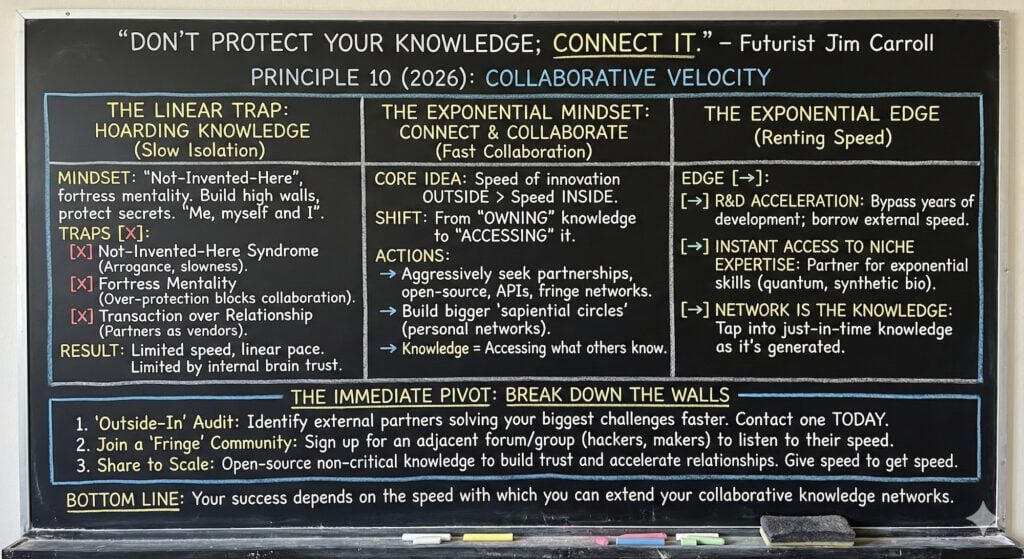
Take a look around your current organisation or your personal network. Do you honestly believe the resources, knowledge, and talent currently within your four walls are sufficient to achieve that 10x goal?Of course they aren’t! They were assembled to achieve yesterday’s 10% goals – not a 10x goal!And therein lies the difference. In a linear world, power came from hoarding knowledge. You built high walls around your R&D lab, protected your trade secrets, and tried to hire the best people to work exclusively for you. Your internal capabilities defined your speed.But in an exponential world, the speed of innovation outside your organisation will always exceed the speed of innovation inside it. There are more smart people outside your company than inside it. If you work on your own or in a small team, know that your knowledge is now, and will forever be, limited. There are more breakthrough startups working in your field than you have R&D teams; there are other teams who are working faster, smarter and better than you.And in that context, you need to learn how to connect with them!If you try to build everything yourself, you move at a linear pace. To move at an exponential pace, you must shift from “owning” knowledge to “accessing” it through rapid partnership.It’s going from this to this!

From the Archives: A History of Collaborative SpeedI have been obsessed with this shift from “slow isolation” to “fast collaboration” for years. It is not just about working together; it is about how fast you can form the connection to solve the problem. Take a look at some of my posts through the years:
Resilience requires a rapid connection
On April 30, 2025, in “In an uncertain economy, resilience isn’t built alone. It’s built together,” I argued that when the world moves fast, you cannot survive in a silo. I noted that “ideas are currency,” and the organizations that survive volatility are the ones that can instantly plug into external networks to crowdsource solutions rather than trying to figure it out alone.
Collective wisdom accelerates results
On December 4, 2024, in “Build better sapiential circles,” I defined these circles as the ultimate tool for speed. I wrote that “there is a massive power in collaborative online research,” where the collective velocity of a group processing information far outstrips what any solitary genius can achieve. This is where I emphasized that sharing ideas creates a movement, not just a meeting.
Hoarding creates drag
On February 22, 2017, in “The Best Ideas are Shared Ideas,” I looked at the cultural friction caused by internal secrecy. I wrote that organizations that move fast are those that “create a culture in which ideas float freely,” removing the internal barriers that slow down the transfer of knowledge.
The edge always moves faster than the core
On December 14, 2023, in “Keep an eye on the edges,” I warned that if you only look at the centre of your industry, you are seeing the past. I wrote that the future is “created out in the crowd” by open-source communities and data sharers who innovate at a pace corporate R&D can’t match.
The collapse of slow, isolated R&D
Way back in February 2009, in “The Hollowing Out of Corporate R&D,” I predicted the death of the slow, closed lab. I wrote about the shift to “open-sourced ideas” and “innovation-transfer partners,” arguing that the complexity of modern discovery is so vast that you must “tap into the global idea cycle” just to keep up.
Renting speed vs. building it
On August 6, 2025, in “The Great R&D Capital Reallocation,” I detailed how money is chasing velocity. I wrote that the dominant model is now “Open Innovation,” where you don’t build; you partner. It is a “distributed, collaborative ecosystem” where you rent speed from startups and universities rather than building it from scratch.
Fluid teams outpace hierarchies
On January 31, 2025, in “Innovation thrives in the building of sandcastles!” I used the metaphor of beach construction to describe fluid, fast teams. I wrote that “Experience doesn’t cloud insight” in these structures, allowing the “combined insight of several different generations” to solve problems faster than a rigid org chart ever could.
Plugging into the “global machine”
On January 14, 2020, in “Accelerate Your Ideas!,” I explicitly linked collaboration to acceleration. I wrote that to create new revenue streams quickly, you must align your internal teams with the “big global idea machine” to “tap into the big global knowledge network that surrounds us.”
Instant verification via the crowd
On January 3, 2025, in “Crowd thinking has replaced most forms of peer research,” I highlighted how science is accelerating. I wrote that we have moved from months-long peer reviews to “instant crowd thinking,” where you can “summon a crowd of vetted, quality specialists” to validate or debunk a concept in real-time.
Diversity drives faster breakthroughs
On September 19, 2025, in “Collaborate with People Who Have Different Skills,” I wrote that sameness is slow. I argued that “breakthroughs often come from this type of cross-disciplinary collaboration” because colliding two different skill sets produces a spark faster than refining a single one.
My message is consistent – your success comes from the reach of your collaborative knowledge networks.In an exponential economy, it now depends on the speed with which you can extend them and reach new ones.In that context, the discipline you must master is Collaborative Velocity.1. The Exponential MindsetCollaborative velocity?It’s a recognition that your speed of innovation depends not on what you own, but on the speed at which you can connect with external knowledge, partners, and ecosystems.It involves shifting from a “protect and defend” stance around your knowledge silos to a “connect and collaborate” stance. It involves aggressively seeking partnerships, open-source communities, API-driven platforms, and “fringe” networks to leverage external speed for your own growth.At a personal level, it involves building bigger ‘sapiential circles’ – expanding and growing your personal networks to accelerate what you can know, and how you can know it.Fundamentally, knowledge is no longer just what you know. It’s how to access what others know!2. The Linear TrapThink about this question: Why do we try to do everything ourselves?Our old world taught us that we had to be self-sufficient with knowledge – we had to develop a base set of skills, and perhaps develop and enhance that over time. Knowledge and skills were a solo voyage – something we did on our own. As Taylor Swift sings in The Fate of Ophelia, it’s all about “me, myself and I.”And the fact is, that’s a closed-minded mentality, leading to these issues:
The “Not-Invented-Here” Syndrome: The arrogant, linear belief that if an idea or technology didn’t originate inside your own team, it has no value or can’t be trusted. This breeds insularity and catastrophic slowness.
The Fortress Mentality: Over-prioritising IP protection and secrecy to the point where lawyers and compliance block valuable external collaborations that could speed up your growth. You protect your current IP so well that you miss the next wave entirely.
Transaction over Relationship: Viewing external partners merely as vendors to be squeezed on price, rather than strategic allies who can provide exponential leverage.
3. The Exponential EdgeWhen you master Collaborative Velocity, you stop being limited by your own internal headcount and budget. You gain:
R&D Acceleration: By tapping into external platforms, startups, or university research, you can bypass years of internal development time. You “borrow” their speed. Much of the future is happening out there in millions of collaborative networks, particularly through the Internet and open-source communities. If you learn how to better tap into them, you learn to operate at exponential speed.
Instant Access to Niche Expertise: No one can know everything there is to know – all knowledge is becoming niche knowledge. That means, in this new world, trying to hire and train for a new exponential skill (e.g., quantum computing or synthetic biology) will take far too long. You need to partner with a firm or individual that has already mastered it.
The Network is Now the Knowledge: In a world in which knowledge is growing at an explosive rate, it’s now out of date as soon as it is generated. You can’t master new knowledge – you can only tap into it at the moment it is generated, understand it, and watch it morph into something new.
I don’t want to hammer home the point, but I can’t emphasise it enough – it’s all about just-in-time knowledge. YYour success now comes from your ability to generate the right knowledge, at the right time, for the right purpose, from the right individual, through the right network.Understand that, and you understand the importance and power of collaborative velocity.4. The Immediate PivotHow do you do this?You need to break down the walls of your organisation (or your personal career silo) today. Here are your immediate actions:
The “outside-In” audit: Look at your three biggest current challenges related to your Moonshot goal or other big projects. For each one, identify an external partner, startup, or research group that is already solving it faster or better than you are. Contact one of them today.
Join a “fringe” community: Sign up for a forum, LinkedIn group, association or something adjacent to your industry but populated by people very different from you (e.g., hackers, makers, academics in a different field). Just listen to the speed of their conversation.
Share to scale: Learn how to collaborate better. Identify one piece of non-critical internal knowledge or data that you could open-source or share with a partner today to build trust and accelerate a relationship. Give speed to get speed.
Here is the reality: if you want to hit that massive 10x “Moonshot” goal we’ve been talking about, you simply can’t do it alone. Your internal team was built for yesterday’s slow, linear world, not today’s fast-paced, exponential reality.I call this collaborative velocity.You need to stop hoarding your knowledge and start connecting it, tapping into the massive global networks and external “brain trusts” that are innovating faster than you ever could on your own. Success today isn’t about what you own; it’s about how fast you can access what others know to accelerate your speed and turn a simple idea into a movement!
#11 Radical Subtraction
To move fast, you don’t need more gas. You need less drag.
Get rid of the anchors that are keeping you back. The weights that are holding you down. The chains that bind you to yesterday. The barriers that block your way.And the things that are slowing you down.We are on Day 11. You’ve committed to connecting externally for speed (Day 10). Now you must look inside and confront the greatest enemy of internal velocity: complexity.Your future depends on the idea of Radical Subtraction. It might not make sense, but to move faster in our exponential world, you need to stop adding things and take things away. Here’s your chalkboard summary!
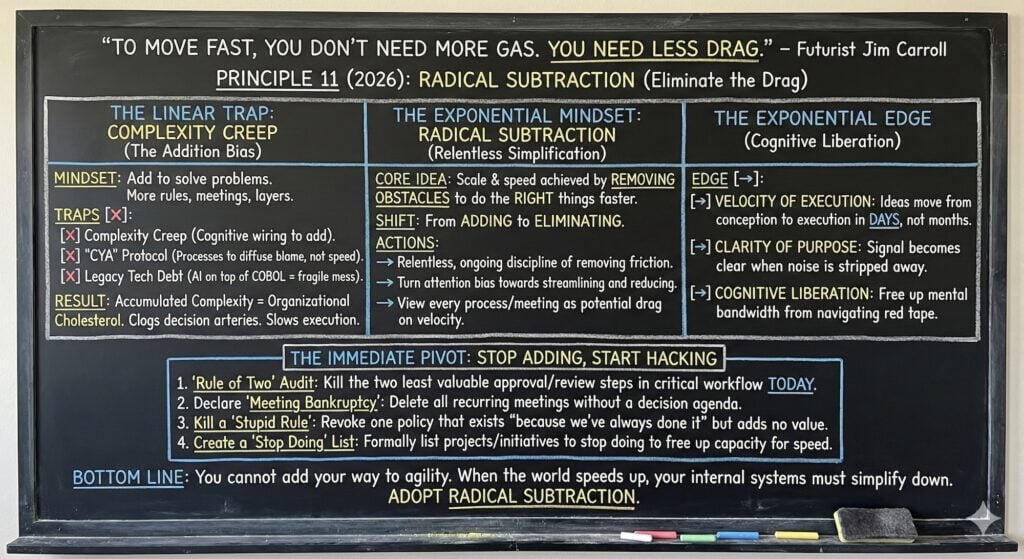
In our old, slow, linear world, we solved problems by adding. If there was a risk, we added a compliance step. If there was miscommunication, we added a meeting to fix it. If there was a new opportunity, we added a committee. If there were a disruption, we would develop a strategy to deal with it. Over time, this addition was seen as sophistication and control.We added things to try to deal with the complexity the world was throwing at us.But here’s the thing – in an exponential world, this accumulated complexity is organizational cholesterol. It clogs the arteries of decision-making. Every extra approval layer, every redundant report, and every “alignment meeting” slows down your Execution Velocity (Day 8) and makes it impossible to achieve a Moonshot (Day 9).I’ve long talked about this from the stage as the accumulation of ‘organizational sclerosis.’
It’s clogging up your future, slowing you down, killing your initiative. What is it? It’s the condition where your arteries of creativity and initiative become clogged because everyone keeps doing things – even though no one remembers why they are doing them. It’s not just annoying; it’s a health hazard for your business that blocks the flow of new ideas.And here’s the thing – you cannot add your way to agility. When the world speeds up, your internal systems must simplify.Adopting Radical Subtraction.I’ve covered the idea of reducing friction as a key component of success in a faster world. For example, in my blog posts and through my keynotes, I’ve suggested that you need to:
Adopt the mindset that “Complexity kills momentum.” In my 101 Principles of Leadership, I observed that simplicity scales while complexity stalls growth. I shared the story of a healthcare client who cut their onboarding process from 22 steps down to eight, dramatically increasing satisfaction. In that same list, I warned that “Bureaucracy Is Just Fear Wearing an Official Badge,” and that if you strip away the layers, you often just find fear of decision-making. I also urged you to “Kill the Meeting” to start doing—replacing weekly discussions with weekly prototypes—and to Kill “Sacred Cows,” those legacy procedures that exist only because “we’ve always done it that way.”
Build “Frictionless Ecosystems.” In my analysis of Temporal Commerce, I noted that the winners in the future economy will be those who ruthlessly eliminate “transactional pauses.” The goal is to reduce the time cost for everyone who interacts with you. Make it easy in a faster world, not harder!
Banish “Innovation Killers.” I have repeatedly warned against the specific phrases that act as friction points in meetings—statements like “It won’t work,” “We don’t have the budget,” or “That’s the dumbest thing I’ve ever heard.” You must remove this verbal drag to clear the path for velocity.
Eliminate Internal Friction. I’ve observed that the companies that successfully grow during economic downturns are those that use the time to remove bloat. They strip away clunky systems and rebuild for speed and simplicity while everyone else is paralyzed. There are multiple points in my new book, Dancing in the Rain: How Bold Leaders Grow Stronger in Stormy Times, where I suggest that speed of action in the face of uncertainty is critical – and you won’t get there with old ideas and old, slow thinking.
Then there’s what I explored in my twin books, Embracing Mediocrity and Escaping Mediocrity! Throughout, I explored the issue of friction. One book satirizes the habits that create drag, while the other provides the roadmap to velocity.
Here are a few specific nuggets from those works that highlight exactly what you need to subtract:
Subtract “Process Bloat”: In Embracing Mediocrity, Rule #14 satirically advises that to stay average, you should “Ignore Efficiency” and intentionally “prolong processes“. To move fast, you must identify where you are doing this and stop it immediately.
Create a “Stop Doing” List. In Embracing Mediocrity, I satirically pointed out that to stay average, you should keep doing useless things. To move fast, you must do the opposite: explicitly list the habits, projects, and initiatives you will stop doing to free up capacity for speed.
Subtract “Analysis Paralysis”: Rule #36 in the satire suggests you “Overthink Everything” to paralyze yourself with indecision. In Escaping Mediocrity, I counter this with Rule #36, “Act Decisively,” noting that “analysis breeds paralysis” while “doers change the world“. You must subtract the need for perfect certainty before acting.
Subtract the “Clutter”: Embracing Mediocrity Rule #50 tells you to “Maintain Clutter” and “let chaos dominate spaces”. Real velocity requires the “Radical Subtraction” of this physical and digital noise to clear the path.
Subtract the “Routine”: The satire of Rule #123 is to “Stick to Routine” and “keep doing the same thing over and over”. Escaping Mediocrity Rule #8 demands the opposite: “Defy Predictability” and “shatter your routines” because “comfort zones are desolate places where nothing grows“.
Subtract the “Distractions”: Escaping Mediocrity Rule #43 is to “Eliminate Distractions” and “guard attention fiercely”. This is the essence of removing the drag on your mental bandwidth so you can focus on the signal, not the noise.
Have you ever thought about the issue of speed this way? You should. Think of it this way!
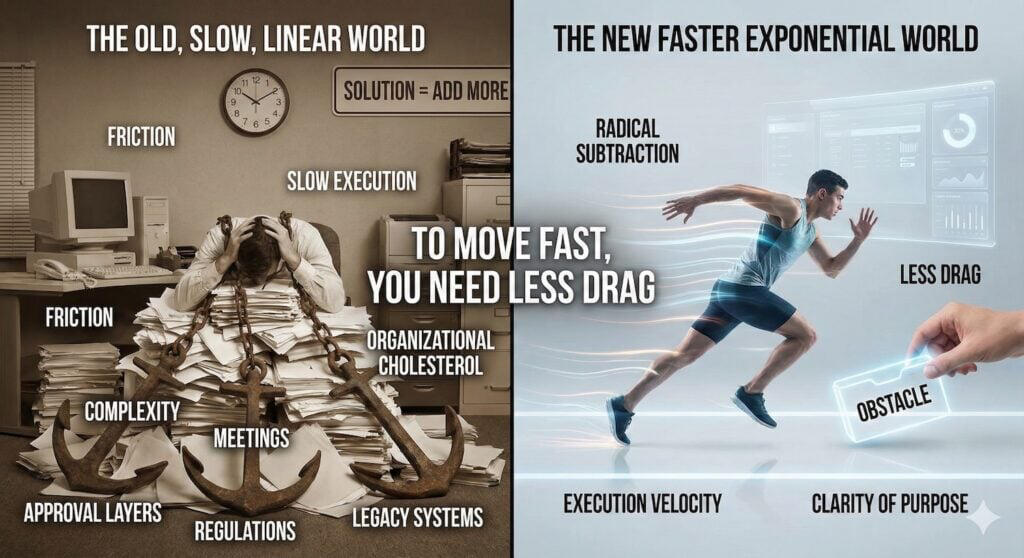
That there are things that are slowing you down, and that in a world that keeps spinning faster, you need to take them away – not add more of them!1. The Exponential MindsetSo that’s where the idea of Radical Subtraction comes from.It’s the relentless, ongoing discipline of removing friction.It is the understanding that scale and speed are achieved not by doing more things, but by removing the obstacles to doing the right things faster.Ponder that – remove the obstacles so that you can do the right things faster.It’s coming to the decision that you are going to turn your attention bias toward elimination, streamlining, and reducing. It involves taking the view that every process, every step, every meeting, every committee, every study, and every rule is are drag on velocity that will slow you down – and make your future harder!2. The Linear TrapWhy is subtraction so hard? Because addition feels safe, and subtraction feels risky!We seem to be geared towards adding things to deal with change, rather than taking them away. Think about these issues that cause us challenges:
Complexity Creep (The Addition Bias): Humans are cognitively wired to solve problems by adding new elements rather than subtracting existing ones. We add a new rule for every exception, creating an unmanageable rulebook. Organizational and personal inertia rule because we are weighted down!
The “CYA” (Cover Your A**) Protocol: We put in place processes and rules that are not designed \for speed, but to spread responsibility around. Why? That way, we can ensure no single person gets blamed if things go wrong. This paralyzes decisive action – and meanwhile, the world speeds up around us!
Legacy Tech Debt: We start layering new exponential technologies (like AI) on top of old, brittle linear systems, creating a complex, fragile mess that requires constant maintenance instead of driving speed. Half the world runs on COBOL. AI on top of COBOL is, well, just plain weird! Right now, companies are placing a rocket ship on top of a Model-T. Yikes!
3. The Exponential EdgeBut here’s the thing – once you start eliminating the things that slow you down, you do actually speed up! When you master Radical Subtraction, you stop fighting your own infrastructure:
Velocity of execution: By physically removing friction points and approval layers, ideas move from conception to execution in days, not months.
Clarity of purpose: When you strip away the noise of complex bureaucracy, the signal becomes clear, and the trends become easy to understand. Everyone understands the goal, leading to faster alignment.
Cognitive liberation: You free up massive amounts of mental bandwidth for your team when they stop spending 40% of their week navigating internal red tape.
4. The Immediate PivotThe whole issue of removing friction doesn’t need to be complex – because in and of itself, it involves taking the complexity away!You don’t need a six-month consulting study to simplify. You just need to start hacking away at the unessential stuff today. Take some small steps:
The “Rule of Two” audit: Look at your most critical current workflow. Identify the two approval steps or review meetings that add the least value. Kill them today. (If you can’t kill them, make them optional “FYI” steps).
Declare “meeting bankruptcy“: Look at your recurring meetings. Delete every single one that doesn’t have a clear decision-making agenda. Tell the attendees that if it’s truly vital, they can reschedule it with a stated purpose. Watch how many never come back.
Kill a “stupid rule” right now: Find one policy or procedure that exists “because we’ve always done it that way,” but frustrates everyone and adds no customer value. Revoke it publicly. Share my video on organizational sclerosis with your team.
The “Stop Doing” list: In your next strategy session, don’t just list what you will start doing. Create a formal list of projects and initiatives you will completely stop doing to free up capacity for speed.
In our fast-moving, exponential world, you can’t just step on the gas to get ahead; you have to cut the things that are holding you back.Here’s what I know: too many organizations and too many people try to fix problems by adding more meetings, rules, and complexity, but all that does is clog up your innovation arteries like organizational cholesterol.To achieve real velocity, you need to stop adding layers and start removing the “drag”—the fear, the useless routines, and the bureaucracy—so you can clear the path for the future.Think about starting that today!
#12 Strategic Humility
The hubris of experience guarantees failure.
We are on Day 12.We’ve spent the last two weeks stripping away the internal barriers to speed—the fear, the linear forecasting, the lack of collaboration, and the organizational complexity (Day 11).Now, we face the final, most formidable internal enemy. It’s not out there in the market. It’s looking back at you in the mirror.It’s you.It is the ego of the successful leader. To really get ahead in 2026, you need to understand the trap of hubris and why your past success can be your biggest future liability. Here’s your chalkboard summary!
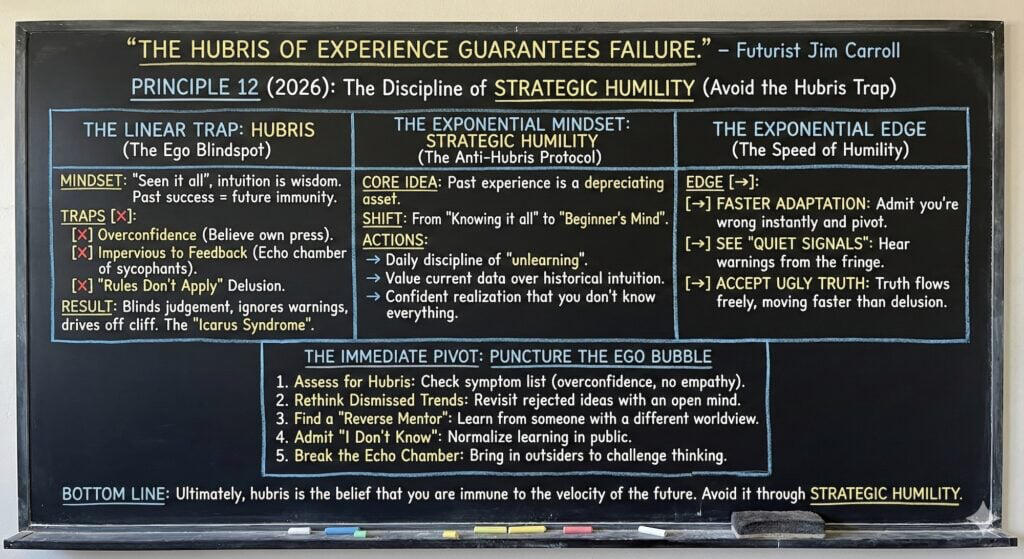
What do you need to think about? The challenge of successful experience and why it can get in your way.In a linear, slow-moving world, 30 years of continued success was your most valuable asset. It proved you knew the formula. You had “seen it all.” Your intuition was unimpeachable wisdom. You knew exactly what to do, when it needed to be done, and how to do it.Those days are gone.In an exponential world, where entire industries are being reinvented every few years, that same 30 years of experience can become a catastrophic liability. Why? Because it can get in the way. It blinds you. It clouds your judgment. It can bring to light your lack of skills in how to respond to the profound changes that are underway. It conditions you to believe that the future will behave like the past.It locks you into old pattern recognition for entirely new patterns!When you combine a track record of linear success with an exponential shift in reality, you get a dangerous psychological condition I have written about extensively, and that’s the trap of hubris.It’s the arrogance that says, “I know better than anyone else.” It’s the belief that your past wins grant you immunity from future disruption. It is the ultimate drag on velocity because a leader or individual blinded by hubris will drive full speed off a cliff, ignoring every warning sign along the way because they are convinced their internal map is better than the external terrain.The discipline you must master to avoid this fate is Strategic Humility.To understand why this discipline is so critical, we must first perform a forensic autopsy on the mindset it replaces. We need to talk about hubris.The Arrogant Damage of HubrisHubris always ultimately kills.And it happens a lot.I wrote about it extensively in a blog post that today can be found at, where else, hubris.jimcarroll.com.
I wrote it when Elon Musk bought Twitter, and he began to spiral into his descent into what some believe is madness. To many, he has become the modern-day Howard Hughes – although brilliant, he seems to be lost inside the recesses of his increasingly volatile mind. It’s worthwhile to go back and read the past – it was pulled together after I carefully studied 40 years’ worth of leadership failure that was directly tied to the disease of hubris.But here’s the key thing: today, in an exponential world, the damage from hubris happens faster. Think of it this way.
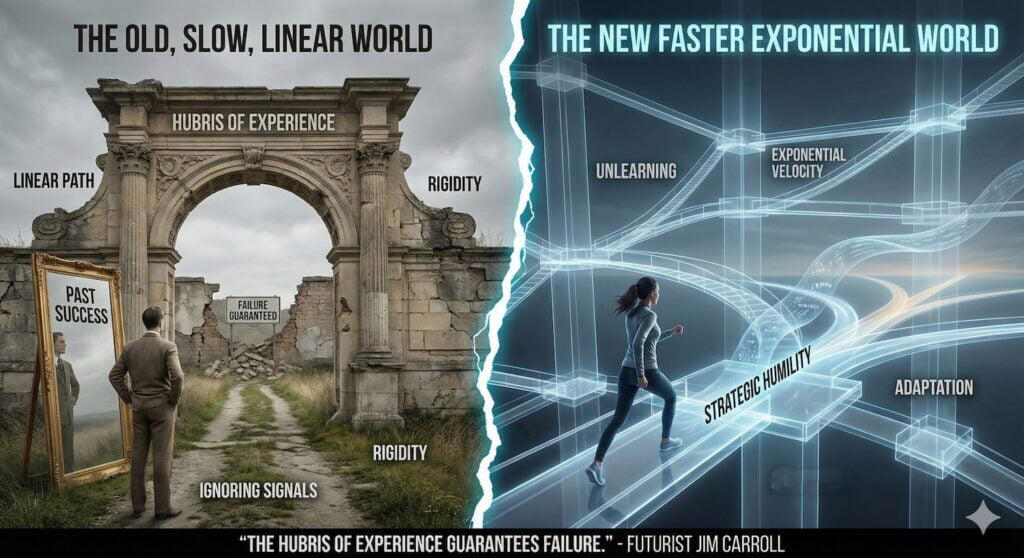
In the olden days—10 or 20 years ago—it took decades to watch organizations like Sears, Kodak, and Blockbuster implode. They died a slow, agonizing death of a thousand cuts.Now, in the era of hyper-connectivity and AI, you can watch CEO arrogance destroy value in real-time. You are watching the “Icarus Show” live.In organizations, the Icarus Syndrome characterizes leaders who initiate overly ambitious projects that come to naught, causing harm to themselves and others. Fuelled by excitement and let loose by the adulation, particularly so in the swirl of social media, they display the classic symptoms I’ve tracked for decades: a harbouring of feelings of omnipotence, a reckless restlessness, and a fatal contempt for the advice and criticism of others.Take a look at the list I prepared based on my research:
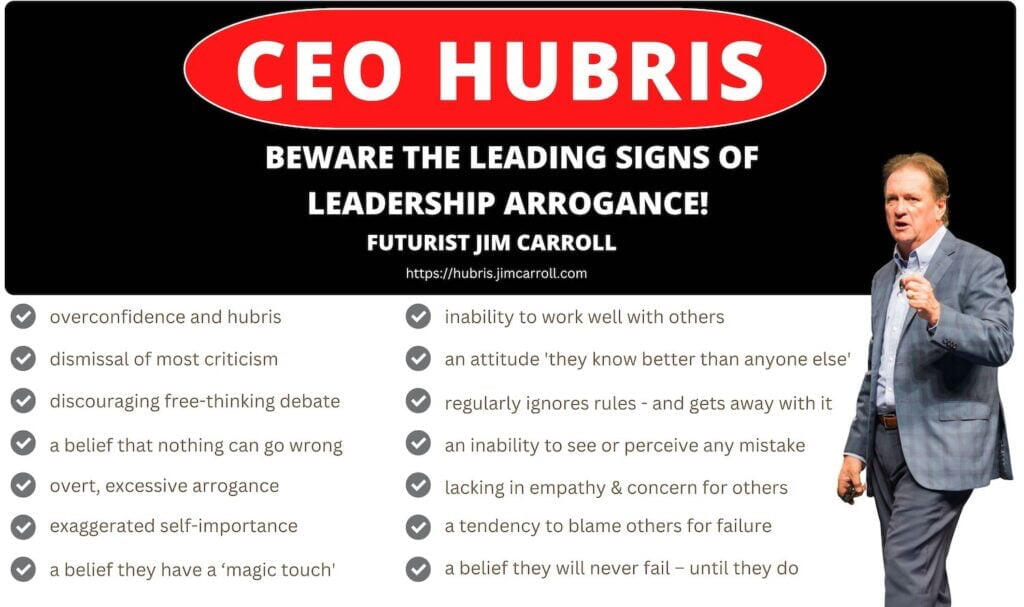
Are you guilty of any of those issues?I’ve seen hubris up close. My home office is just 23 km from the former headquarters of Research In Motion (RIM) in Waterloo, Ontario, Canada. I watched the makers of the Blackberry—the device that once owned the world—spectacularly implode. Why? Because of the hubris and arrogance of its founders. I knew Jim Balsillie; I spoke at dinners where he was an eager participant. But I also know he was blind to the future in the face of a staggering onslaught of disruptive innovation from Apple. He believed his own press. He believed the “invincibility myth“—that nothing would ever come along to challenge their success because they had the “magic touch.”Oops! That didn’t go well!When hubris settles in, the results are deadly. The CEO fails to see that customers are changing, R&D is stagnating, and the product line is wildly out of date. They suffer from “risk perception bias”—a belief that they can modify and lower risk simply by willing it so. They surround themselves with sycophants who feed them the addictive drug of constant praise, creating a reality distortion field where bad news is taboo and disagreement triggers contempt.This leads to what I call the “Reign of Error.” It is the period where a leader’s past success convinces them they can do no wrong, even as they are actively destroying the future. They drift from their core mission, like Jim attempting to buy an NHL team while the iPhone was eating his lunch. They believe they alone can fix a fractious world while their own house burns!It never ends well.The arrogant leader doesn’t just fall; they destroy others on the way down. The lack of empathy drives a knife-edge of cruelty into the lives of employees who are the first to be hammered, bruised, and beaten by the collapse.Ultimately, hubris is the belief that you are immune to the velocity of the future. It is the delusion that you can dictate reality rather than adapt to it.And this is what you need to avoid in 2026 and beyond.1. The Exponential MindsetStrategic humility? Think of it as an anti-hubris protocol!!This is not about being meek or unsure.It is the profound, confident realization that in a rapidly changing world, your experience is a depreciating asset.It is the active, daily discipline of “unlearning” what used to be true to make space for what is currently true.It involves cultivating a “beginner’s mind,” consciously seeking out evidence that contradicts your deeply held beliefs, and valuing current data over historical intuition.It is coming to understand that the moment you think you have it all figured out is the precise moment you have started to lose.2. The Linear TrapYou need to figure out if you are trapped inside a cycle of hubris, even if you don’t think so.Drawing from my analysis of collapsed companies and fallen leaders, these are a few of the stages of the Hubris Trap.I wrote about this in my Hubris post some time back. Everything I read in the 120 pages of articles and research papers I pulled down is neatly summarized into these characteristics. This is what happens to people who fall into the trap of a destructive ego.
overconfidence – they can do no wrong
belief in the praise that surrounds them
dismissal of criticism
discouragement of free-thinking debate
lack of pushback by self-assembled sycophants
your reality is impacted by excessive laudatory PR
a belief that nothing can go wrong
exaggerated self-importance
a belief that they have a unique ‘magic touch
overt, excessive arrogance
inability to work well with others
a belief that they are truly accurate in predicting the future
lacking in empathy, demonstrated by not caring for others
an excessive pride is driven by previous success
countless histories of not following the rules and getting away with it
overconfidence in their judgment
a belief that they know better than anyone else
a belief that they will do better than anyone else
suffer from ‘risk perception bias’ – a belief that they can easily modify and lower risk and thereby act accordingly
a tendency to blame others for failure – it’s ‘not their fault.’
a belief they will never fail – until they do
It’s a pretty stunning list. Ask yourself – does this sound like anyone you know today? Do you recognize any of them in yourself or your organization? Here are some other risks and warning signs to think about:
Mistaking luck for genius: You attribute all your past success to your own brilliance and foresight, ignoring the role of favorable market conditions or timing. This leads to a belief in your own infallibility.
The competency trap: You become so good at the old way of doing things that you cannot conceive of a new way. You double down on the obsolete model because it’s where you feel most masterful.
Imperviousness to feedback: As I wrote in my post on hubris, the successful leader begins to tune out dissenting voices. Anyone who questions the dominant logic is seen as “not getting it” or being “negative.” You construct an echo chamber of sycophants who only validate your existing worldview. (Sound like anyone you know in politics today?)
The “rules don’t apply” delusion: A belief that because of your size, history, or past dominance, the fundamental laws of market economics or technological disruption won’t affect you. You believe you can dictate reality rather than adapt to it.
Are you guilty?3. The Exponential EdgeNow that you know more about hubris, here’s what you need to know when you learn how to shed it: you gain a massive speed advantage:
You learn more about the speed of adaptation: Because you aren’t fighting to defend your past decisions, you can admit you were wrong instantly and pivot to the new reality faster than an arrogant competitor.
You get better at seeing the “quiet signals”: Hubris is loud; it drowns out the weak signals of coming disruption. Humility is quiet; it allows you to hear the warnings from the fringe of your organization before it’s too late.
You learn to accept the ugly truth, even when it hurts: When people know you won’t “shoot the messenger,” they bring you the hard, ugly truths about your business faster. An organization where truth flows freely moves exponentially faster than one living in a delusion.
Overall, once you become conscious of the dangers that come with hubris, you learn to recognize it, watch for it, guard against it – and how to avoid the awful path it can take you down!4. The Immediate PivotSo how do you get there?It’s about acceptance – and knowing that puncturing your own ego bubble is painful but necessary. Here are some things you should think about as you wrap your mind around this principle
Assess whether you are guilty of hubris: Go through the list above – I put a lot of time into it. Are you guilty of any of that type of thinking?
Rethink a trend you dismissed. Find something that you rejected because of your hubris. Visit it again with an open mind.
Find a “reverse mentor”: Identify a bright, young employee, confidant, or partner who grew up with technologies and worldviews you don’t fully understand. Have coffee with them with one rule: You are only allowed to ask questions; you are not allowed to teach or explain anything. Your job is to learn what you don’t know. Consider this to be a ‘hubris-cleanse!’ Practice this regularly!
Be prepared to admit you don’t know – in public! In your next major meeting, when asked a difficult question about the future, resist the urge to bluff with an answer based on experience. Be prepared to say, “I don’t know the answer to that yet, because the rules have changed. Let’s find out together.” Normalize the state of learning – and admitting that you don’t know!
Ask yourself if you have surrounded yourself with an echo chamber. Look at the 5 people you trust most for advice. Do they all look like you, think like you, and have similar backgrounds? If so, fire your “cabinet” and deliberately bring in an outsider with a radically different perspective to challenge your thinking!
The bottom line for Day 12 is simple: in an era of high-velocity change, your ego is the heaviest anchor you carry.To survive the journey to 2026, you must realize that what got you here won’t get you there.You need to trade the “hubris of experience” for the discipline of “Strategic Humility.”By admitting you don’t have all the answers and actively unlearning the past, you stop defending your history and start inventing your future.Don’t let your past success become your future failure!
#13 Wisdom Inversion
Know when to get your age out of the way.
We are on Day 13. We just spent Day 12 dismantling your personal hubris – getting your ego out of the way. One of the most important aspects of that? Showing your wisdom the door!We need to dismantle the collective, generational delusion of your organizational hierarchy!We need to talk about age.Yup.Sorry.Depending on who you are while reading this, there might be a major reality you need to consider – it might very well be the case that your grey hair is now a strategic liability.The unique nature of our times? I call it “The Wisdom Inversion!” Here’s your chalkboard summary!
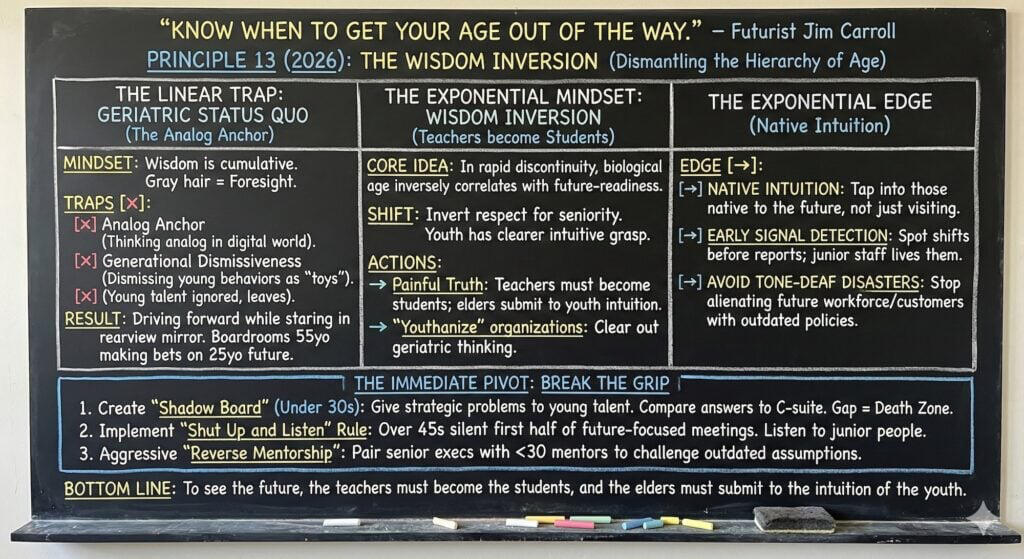
Think about where we are at this moment in time.In a slow-moving, linear world, wisdom was cumulative. Grey hair was a proxy for foresight. The people at the top of the pyramid had seen the most, so they knew the most. You paid your dues, waited your turn, and eventually, you got to hold the steering wheel.In an exponential world, that model is completely broken.When technology, culture, and consumer behaviour shift radically every 36 months, your 30 years of experience isn’t just irrelevant; it’s often a dangerous anchor to an obsolete past. You might have earned your way to the top, but by the time you get there, your experience, insight, and wisdom are probably wildly out of date.The result?Right now, in boardrooms across the world, rooms full of 55-year-olds are making massive strategic bets on a future built by, and for, 25-year-olds.They are trying to interpret TikTok dynamics through a PowerPoint lens. It’s this, right here. That’s our reality right now!
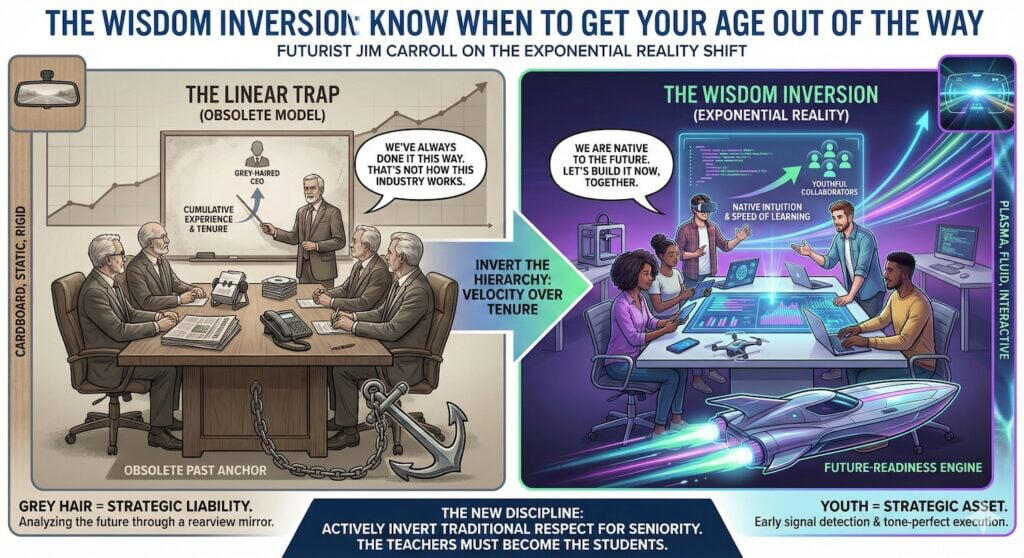
Need an example? They are analyzing decentralized finance business models – weird things involved crypto and blockchain and stuff like that – using banking models from 1995.And your younger employees? They are rolling their eyes. They are quietly laughing. They are sitting in the back of the room, biting their tongues, watching leadership steer the ship toward an iceberg they spotted five miles back. They are frustrated because they are native to the future that senior leadership is only visiting as tourists.If your strategy is being dictated solely by the oldest people in the building, you are driving forward while staring into the rearview mirror.That’s why a discipline you must master in 2026, and beyond, is Wisdom Inversion.This is not a new topic to think about. In my case, I have been covering the issue of generational dynamics for quite some time in my posts and in my keynotes. In fact, if I look back at the keynotes of the last 25 years, I’ve been hammering this home as one of the most significant trends of our time – because it is.Here is what I emphasized—the key points I’ve observed, the implications of what these stories represent, and what it means in terms of our exponential world going forward:1. The “Cardboard” vs. “Plasma” Leadership Gap
The Observation: After speaking at a conference in the advertising and promotion industry, I wrote about the distinction between “Cardboard People” and “Plasma People.” I noted that the older generation of leadership was “cardboard”—static, fixed, one-dimensional, and structurally rigid. In contrast, the incoming generation was a “plasma“—fluid, high-definition, interactive, and constantly changing state. The event at which I witnessed the dynamic actually had older folks promoting innovative new ideas involving cardboard display cases, while the younger generation was busy building a future built on innovative new in-store screen technology. The dichotomy in thinking was real – and stark!
The Implication: You cannot run a “plasma” organization with “cardboard” management techniques. When rigid leaders try to force fluid talent into static org charts, the talent evaporates.
The Exponential Reality: The point I started emphasizing from that moment? Innovation today requires “generational collaborative capability.” If your leadership style is low-resolution and static, you are invisible to the high-definition workforce you are trying to lead.
2. The Velocity of Obsolescence: “The Olden Days.“
The Observation: I have told the story countless times of my children asking me, regarding technology that was only a few years old (like 35mm film or TV knobs), “Daddy, is that from the olden days?” I began to emphasize that in our lives, everything has become but a fleeting thing – business models, technologies, products, ideas, and concepts. We are living in a time in which something can seem new and exciting, powerful and relevant, and then – wham! It’s from the olden days! That means we need to pick up the pace, align to speed, and elevate our velocity.
The Implication: This wasn’t just a cute story which was a crowd pleaser from the stage (it was and it is!); it was a strategic warning. It proved that for digital natives, the “modern” world of the 50-year-old executive is actually an archaeological dig. My emphasis was that these digital natives knew that everything around them was fleeting and adapted accordingly; older generations needed to.
The Exponential Reality: You need to come to grips wth the fact that your “experience” is often just a deep familiarity with things that no longer matter. If you are proud of a process that your junior staff views as an artifact, your organization is already a museum.
3. The “Powder” Principle: Values over Ladders
The Observation: I chronicled the story of a brilliant engineering grad who rejected a prestigious corporate job offer because it interfered with his skiing lifestyle. The CEO was baffled, but the kid’s logic was simple: “Don’t mess with my powder, dude.” This was an early harbinger of what happened with the pandemic and the shift to working from home. I still believe that in this unique global economy, we have an entire generation of highly skilled workers who refuse to accept the idea of ‘return to work’ and the need to go into an office. It’s not just that – the next generation doesn’t just define success on titles and the traditional career path – lifestyle matters!
The Implication: The “career ladder” is a broken incentive model. This generation does not want tenure; they want a portfolio of experiences. They get bored easily and need to be challenged. They are “transactional” in their career approach—they work to live, they do not live to work. And if they have highly specialized skills that you need, they’ll dictate the terms of how and where they will work – not you.
The Exponential Reality: In a talent-scarce future, you cannot bribe people with status. You can’t force them into increasingly obsolete office structures. If you try to force them into a 20th-century “pay your dues” model, they will simply leave for the gig economy or a competitor who offers flexibility.
4. The Death of the “Float” and The Emergence of Instant Finance
The Observation: In my banking keynotes, I warned that “Gen-Connect” (my term for the hyper-connected generation) does not believe in “the float.” The balance they see on their phone is the money they have. A bank executive once told me, “They don’t reconcile chequebooks… for them, the balance is the balance.” They live in the era of instant finance – auto loan approvals in 45 seconds or less on their mobile phone, insurance quotes that bind them moments before undertaking something new, and real-time updates with anything that has to do with the financial aspects of their lives.
The Implication: They rely on real-time data, not institutional processing time. They are living in a fast world built on slow COBOL platforms. Furthermore, they trust “peer-to-peer authority” (social proof) more than they trust institutional advice. Brands built for an old financial world bear little relevance in a new one.
The Exponential Reality: If your business model relies on information asymmetry or processing delays (the float), you are dead. This generation demands radical transparency and immediacy.
5. The Origin of Reverse Mentorship: “Surviving the Information Age.”
The Observation: In my book Surviving the Information Age, I identified that the Baby Boomers were the first generation in history forced to rely on their children to explain the tools of the trade (computers, internet connectivity). Think about it – how many parents do you still see who have their kids fix the technology in their lives?
The Implication: This flipped the historical flow of wisdom. For the first time, the “elders” were the novices and the “children” were the experts.
The Exponential Reality: This book was the birth and realization of my idea of “Wisdom Inversion.” It established that in a tech-driven world, tenure is no longer a proxy for competence; speed of learning is.
6. The “Nintendo” Governance Clash
The Observation: As early as 2006, I predicted a massive friction point when the “Nintendo Generation” (gamers, collaborative, global) collided with a political and corporate class that “couldn’t manage their iPhone.” The younger generation had a brain and mind wired for speed, while those in charge were building a future based on business models and ideas from the 60s, 70s, and 80s. That lasts to this day – much of our political dysfunction comes from 70, 80, and 90-year-old politicians who won’t let go.
The Implication: We are seeing a clash of generations, with extreme frustration by young people with our current reality., Expect continued seismic earthquakes in our not-too-distant future.
The Exponential Reality: We must “Youthanize” our organizations, companies, and political institutions. This isn’t a slur; it’s a strategy. We need to clear out the “geriatric by design” thinking that clogs our arteries and replace it with the collaborative speed of the gaming generation.
7. The “Uber-ization” of Authority (Healthcare)
The Observation: In healthcare, I noted that while man’s best friend was the dog, “the Millennial’s best friend is the mobile phone.” They pushed for “Shared Medical Appointments” and “Open Notes,” viewing the doctor as a partner, not a god. My tag-line? The “centuries-old” relationship between doctor and patient is changing, and the implications for the health care system (and virtually every other industry) are profound.
The Implication: They reject authority figures who hoard information. They expect a “negotiation” based on data they’ve already Googled. All relationships going forward – with finance executives, insurance sales executives, doctors, and construction managers – need to be collaborative, not one-way. This trend will only become more profound as future generations are weaned on AI and have an information empowerment model that we probably barely understand!
The Exponential Reality: The hierarchy of expertise has collapsed. Whether you are a doctor, a CEO, or a consultant, your title commands no respect unless it is backed by real-time value and transparency – and the same in-depth information that they have!
8. The Intra-Generational Fracture
The Observation: By 2017, I was warning that technology moves so fast that we can no longer even speak of “generations” like Gen Z or Millennials as monolithic blocks. The difference between a 25-year-old and a 15-year-old is now massive, defined by the platform they “grew up” on (e.g., Facebook vs. Snapchat). My 34 and 32-year-old sons sometimes seem generations apart, even though there is only a 2-year age difference. Today’s 10-year-old, already using ChatGPT, is in a world that we no longer understand.
The Implication: Broad generalizations fail. We are moving into an era of micro-generations where the “culture” changes every 3 to 5 years, if not faster.
The Exponential Reality: You need a strategy that adapts and aligns to multiple different age categories, and categories within those categories. If your HR policies or marketing strategies are built for a “generation” that spans 15 years, you are missing 80% of the target.
1. The Exponential MindsetThe Wisdom Inversion?It’s an aggressive realization that in an era of rapid discontinuity, biological age often inversely correlates with future-readiness. Let me be blunt – increasingly, old people don’t get it, and young people do. I say that with a straight face – I’m 66 as I write this.It is the discipline of actively inverting the traditional respect for seniority, recognizing that your newest, youngest employees often possess a clearer, intuitive grasp of emerging behaviours than the C-suite.It means accepting a painful truth: to see the future, the teachers must become the students, and the elders must submit to the intuition of the youth.2. The Linear TrapWhy is this generational divide paralyzing companies? Ego and dismissal. Hubris – the very thing I covered in the last post.Think about what’s happening out there – take a look around and you’ll it everywhere.
The “analog anchor”: People are still thinking analog in a digital world. They’re stuck in a world of CDs and LP records in a Spotify era! Some senior leaders are psychologically incapable of letting go of the business models that defined their careers. They view new behaviours through an analog filter, forcing square digital pegs into round legacy holes.
Generational dismissiveness: Generational arrogance knows no bounds. There is a wild tendency of older leaders to dismiss the behaviours of younger generations (gaming, crypto, the creator economy) as “toys,” fads, or wastes of time, failing to recognize them as the early signals of massive economic shifts.
The frustration feedback loop: Young talent offers an insight, gets patted on the head by a senior leader, and is told, “That’s not how this industry works.” Well, actually, that is how things work NOW! The young talent stops offering insights, disengages, and eventually leaves for a company that gets it.
3. The Exponential EdgeThis new world demands a dramatic shift – because when trends exponentiate, wisdom becomes irrelevant – and young experience matters. When you execute The Wisdom Inversion and stop letting seniority dictate strategy, you gain an immediate advantage. One of my fundamental beliefs as a futurist is that the younger generation has better insight into the trends that define tomorrow than older generations do. This leads to some pretty significant changes!
Native intuition vs. acquired analysis: When you ‘get young,‘ you tap into people who live in the future rather than just read executive summaries about it. They don’t need to analyze the shift; they are native to it.
Early signal detection: You spot cultural shifts years before they show up in a McKinsey report, because your junior staff is already living those shifts. They’re already there, and they’ve been trying to tell you about it. Start listening!
Avoiding tone-deaf disasters: You stop launching marketing campaigns, products, and HR policies designed by Boomers and Gen X that completely alienate the Millennials and Gen Z workforce and customer base that actually drive future growth.
4. The Immediate PivotYou need to forcibly break the grip of the geriatric status quo. Here are your immediate actions:
Create a “shadow board” (under 30s only): Select 8-10 high-potential employees under the age of 30. Give them the same strategic problems the senior executive team is wrestling with. Ask for their unvarnished recommendations. Compare their answers to the C-suite’s answers. The gap between those two documents is your organization’s death zone.
Implement a “shut up and listen” rule: In your next strategy meeting on a future-focused topic (AI, new demographics, etc.), implement a rule: No one over age 45 is allowed to speak for the first half of the meeting. They must sit on their hands and listen to the junior people in the room.
Practice aggressive “reverse mentorship: Flip the traditional mentorship model on its head. Pair every senior executive with a “mentor” under 30. The mandate isn’t a polite coffee chat. The mandate is for the junior mentor to aggressively challenge the senior leader’s outdated assumptions about technology, culture, and work. If the senior leader isn’t uncomfortable, it’s not working.
Quite simply, in today’s rapidly changing world, decades of experience are a disadvantage – because they are using old methods to solve modern problems.Get your ego out of the way. Forget wisdom – think generational collaboration instead!
#14 - Hype Immunity
Leadership today isn’t about what you chase. It’s about what you ignore.
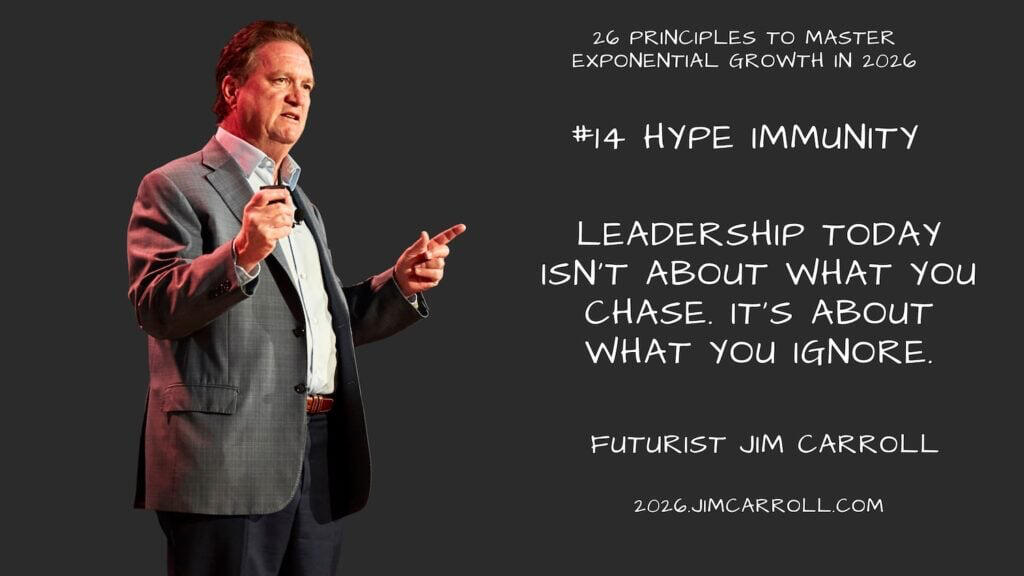
We are on Day 14 of my 26 Principles for 2026 – guidance to guide you through a world of exponential change. If you don’t remember why this is so critical, go back and read the intro!Recently,? You’ve humbled your ego (Day 12) and opened your ears to the young (Day 13).You are ready to listen to the future.But suddenly, you have a new problem. You can’t hear anything but noise. Have you noticed how much hype is out there these days?Separating reality from hype has always been a challenge – I’ve certainly been covering that issue for a long time. You can’t speak and write about the future without giving people advice and guidance about what’s going on out there, and separating the real from the noise.But there is more hype than ever before – and so on Day 14, I want you to think about the importance of developing what I call Hype Immunity – aka the discipline of ignoring almost everything. Here’s your chalkboard summary!
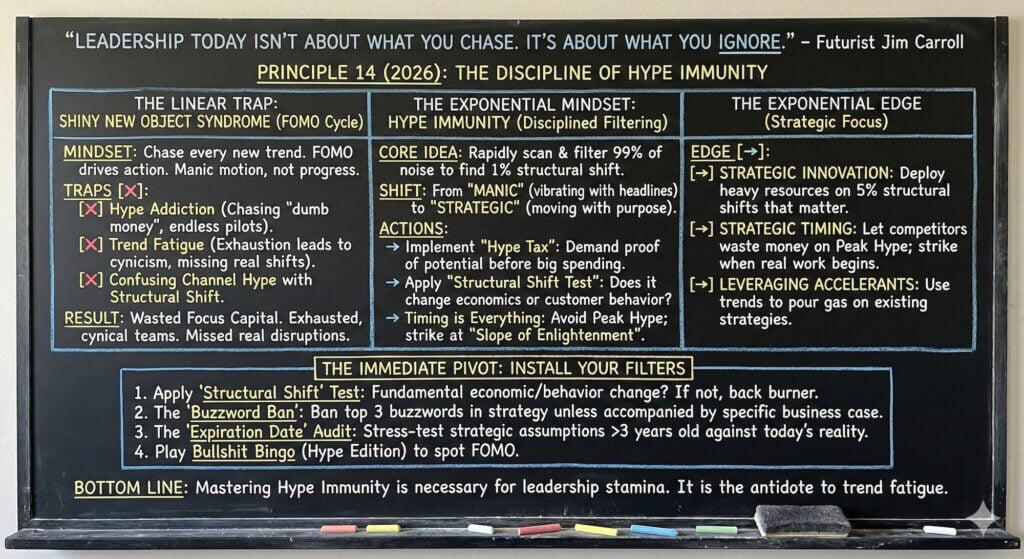
Think about it. In our old, slow, linear world, change happened slowly enough that you could evaluate new technologies, disruptive trends, new products, and new innovation opportunities, one at a time. You had the luxury of waiting to see what settled, what was real, and what you really needed to worry about.That luxury of time is gone. Forever. In an exponential world, you are bombarded daily with “game-changing” breakthroughs. There is just so much to keep track of! AI agents today, spatial computing tomorrow, quantum adoption next week. Not to mention stuff not yet invented or imagined.Did I mention that this has become one of the main images shared at the start of most of my recent keynotes? Think about what it represents: “Companies that do not yet exist will build products not yet conceived using ideas not yet in existence with methodologies yet to be defined with ideas yet to be imagined.”
Some of these products and ideas could be challenging, new, disruptive, and competitive threats; others will fizzle and fail and can be safely ignored.The art for you is figuring out which ones!Shiny New Object Syndrome!For a long time, folks like me have been talking about the tendency of people to chase ‘shiny new objects.”Remember the ‘metaverse ‘? Wasn’t it the hottest thing on the planet just a few years ago – before AI came along? It was just reported that Facebook lost almost $100 billion in its ill-fated efforts to drag everyone into some weird new virtual world. Companies that followed the shiny object that it represented probably wasted just as much.Here’s the thing – If you chase every shiny object, you will exhaust your organization and achieve nothing. That’s why the critical leadership skill in 2026 is no longer just spotting trends—that’s easy. The critical skill is rapidly filtering the 99% marketing hype to find the 1% structural shift that actually matters to your business model.You need to develop an organizational immune system against the noise. The discipline you must master is Hype Immunity.Cutting Through the HypeI have been covering the issue of cutting through hype and focusing on trends that matter for decades in my posts and keynotes. Looking back at my archive, I’ve been hammering home the need for disciplined filtering for a long time. Like, a really long time. I think it’s one of the most important things I do from the stage, even if I’ve burst some bubbles along the way!Remember the hysteria over dot. coms? Back in 1999, a year before the entire industry imploded, I was on a national TV show, warning of what was coming. I took a lot of abuse for that – but as a futurist, I had already learned to differentiate between what was real and what was not!Over the years, I’ve repeated that fine art – take a look at the key observations I’ve made, the implications of those stories, and what it means in terms of our exponential world going forward:The “Shiny New Object” Syndrome
The Observation: At a basic level, I have written multiple times about the deeply ingrained organizational tendency to chase the “shiny new object.” This is the failure to distinguish between a new, intriguing product/service and a true structural shift, causing organizations to pivot wildly based on fear and headlines.
The Implication: When you are busy reacting to every new trend, you burn up a really precious resource – let’s call it “Focus capital.” The cost isn’t just the pilot programs that go nowhere, but the creation of cynical, fatigued teams that refuse to engage when a real trend arrives.
The Exponential Reality: That’s why one of your most important decisions today is to choose what to ignore. You must implement a “Hype Tax” on every new suggestion, forcing the individual or team proposing the idea related to the trend to demonstrate its potential reality before authorizing any resource expenditure. Note – this shouldn’t go against the idea that it’s critical to play, investigate, and explore new trends – but to do so on a limited budget and on a limited scale. (The ‘small’ part of my Think Big, Start Small, Scale Fast mantra!)
The Hype Cycle Curve (Timing is Everything)
The Observation: In my analysis of innovation, I frequently reference the inevitable “Peak of Inflated Expectations” that accompanies every major trend. Everyone rushes in at the peak of the noise, right before the inevitable crash into the “Trough of Disillusionment.”
The Implication: Investment driven by the excitement at the peak is almost guaranteed to be wasteful. This is investment driven by FOMO (fear of missing out), not by strategic foresight. FOMO is one of the most dangerous activities you can undertake – I’ve seen far too many companies get involved in some fast emerging trend simply because everyone else is – without any real understanding of what they are doing and why.
The Exponential Reality: Mastering Hype Immunity means understanding the timing of innovation. Strategic investment should usually be reserved for when the noise dies down, and the real, boring work of integration begins—what we call the “Slope of Enlightenment.” That doesn’t mean you can’t get involved in front – indeed, you should be carefully exploring the trend actively through the trigger, peak and trough periods – but in a limited way.
You need to take this image and tape it to your wall – and stare at it EVERY SINGLE DAY.
You need to take this image and tape it to your wall – and stare at it EVERY SINGLE DAY.
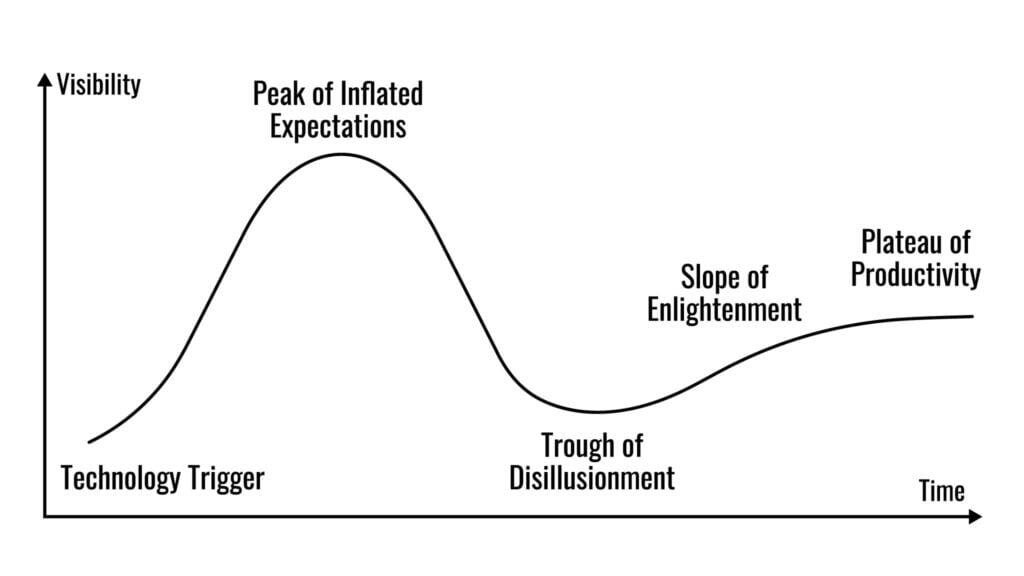
Ignoring the Channel Hype (The “Thing” vs. The “Shift”)
The Observation: In my trend reports over the years (such as on the future of health), I noted leaders focusing obsessively on the new device (e.g., the iPhone or a new app) while missing the underlying structural shift (e.g., the quantified self ecosystem and remote diagnostics).
The Implication: The new channel or device is often just the hype; the fundamental change in customer behaviour and the ecosystem it enables is the signal.
The Exponential Reality: Before committing resources, you must apply the Structural Shift Test: Does this technology fundamentally change the economics of how we create value, or the fundamental behaviour of our customer? If it’s just a new channel or a faster horse, put it on the back burner.
The “Manic vs. Strategic” DistinctionLet’s talk about the fact that many companies or teams within them often go into a ‘manic’ phase, where everyone is rushing about exploring and working with. new trend – driven by the speed of their FOMO – without any real strategic plan. The result? A lot of wasted energy!
The Observation: I often contrast organizations that are moving fast with organizations that are merely manic. Manic organizations vibrate with energy but don’t go anywhere because they change direction with every new headline. They’re like the dog Doug in the movie Up! Squirrel!
The Implication: Motion is not progress. A manic organization confuses busyness with strategic action, exhausting its talent on “innovation theatre.”
The Exponential Reality: Hype Immunity requires the discipline to stand still while everyone else is running in circles, only moving when you have identified a clear, straight line to exponential value.

The “Dumb Money” WarningHype causes companies to place good money into dumb money faster, because everyone else is spending dumb money!
The Observation: I have repeatedly warned in keynotes during boom times (dot-com, crypto, pre-2008) that when “dumb money” pours into a sector—when investment is driven by FOMO rather than fundamentals—it is a massive noise signal. Follow the dumb money – don’t do what it does!
The Implication: Remember this key idea: The volume of venture capital flying around a buzzword is often inversely proportional to the actual strategic value of the trend at that moment. The more money pouring into a trend, the further it is up the Peak of Inflated Expectations. (This is a really interesting observation in light of what is going on with AI right now!)
The Exponential Reality: Be a contrarian filter. Think about doing the opposite of whatever everyone else is doing. Just because everyone is investing in it doesn’t mean it’s real; in fact, massive hype is often your signal to wait on the sidelines until the inevitable shakeout occurs.
Just a few years ago, I was on a call with a client who wanted a keynote around their blockchain and crypto strategy. I kindly suggested that, given their industry and the timing of the trend, they were far too soon. I didn’t get the gig. That hurt – but I was right. Ouch.The “Trend Fatigue” RealityLast but not least, getting into a mindset where too much of a hype filter can cause you to miss important trends that really matter. You stop doing anything because you can’t make out what’s real with everything!
The Observation: I write frequently about the sheer exhaustion leaders feel from being told everything is about to change every five minutes. Some choose to ignore things, stop investing, and start waiting. This is often worse than investments and actions taken in the context of FOMO, because then you start to fall behind.
The Implication: The implication? This exhaustion leads to cynicism, where leaders eventually tune out everything, including the real signals that will eventually disrupt them. They become numb to the future. That’s not good!
The Exponential Reality: Hype Immunity isn’t just a good strategy; it’s necessary for leadership stamina. It is the antidote to trend fatigue, allowing you to remain curious without becoming exhausted. It’s helping you allocate your precious innovation capital into the things that really matter!
So, where does this leave us? With a good structure for thinking about how to deal with hype in an exponential world.
1. The Exponential MindsetIt’s all about learning the fine of hype Immunity.It’s the disciplined way to rapidly scan the horizon and immediately discard the vast majority of incoming information about fast-moving trends as “noise.”It is developing the understanding that “new” does not always mean “important.”It is learning the difference between being Manic (vibrating with every new headline, FOMO thinking!) and being Strategic (moving with purpose only when the signal is clear).A leader with Hype Immunity is joyfully cynical about every new trend, but deeply curious about the ones that really matter.2. The Linear TrapWithout this immunity, organizations burn through their precious innovation capital by falling into a destructive cycle:
Hype addiction (The FOMO cycle): Driven by the fear of missing out and seeing “dumb money” chasing a trend, leadership teams suddenly pivot to chase the “shiny new object.” They mistake motion for progress, launching endless pilots that go nowhere. The result is that people feel like there is no success – because there isn’t, particularly when the trend fizzles out!
Trend fatigue (The cynicism cycle): The impact of this manic phase? After chasing hypes that don’t pan out, the organization becomes exhausted. When a real structural shift arrives, leadership dismisses it as “just more hype” because they are too tired to differentiate.
When you think about it, this is often the essence of what happens with disruptive business models – too many companies miss the important trends that forever change their business model and market, because they’ve become too tired of chasing every new thing, with the result that they miss the most important thing!3, The Exponential EdgeNow, in a world in which trends come at us faster than ever before – and keep on accelerating – moving into the right exponential mindset is critical!That’s why developing Hype Immunity is so important!
Strategic, realistic innovation: By ignoring 95% of the noise, you deploy heavy resources against the 5% structural shifts that matter, achieving scale while competitors are still dabbling in “innovation theatre.“
Strategic timing: You let competitors exhaust themselves and waste money during the “Peak of Inflated Expectations.” While they are investing heavily, you are merely playing. The result? You preserve your capital and strike when the technology hits the “Slope of Enlightenment.” That’s hitting the trend when the hype dies down, and the real work begins.
Leveraging Accelerants: You don’t waste time building new strategies for trends that are just “accelerants.” Instead, you use those shifts to pour gas on the strategies you already have in place.
4. The Immediate PivotStart learning how to apply this trend today. Want an example? AI agents!I cringe when I see posts like this:
It wasn’t too long ago that we were talking about fridges that would order your groceries automatically! Right now, all the talk and buzz is about these agents – but IMHO, the reality of this opportunity is years and years away.Cringe!That’s why you need to install filters today. Here are some immediate actions to start thinking about:
Apply a “structural shift” test: Before authorising any resources for a trend, force it to pass a simple test: Does this technology fundamentally change the economics of how we create value, or the fundamental behaviour of our customer? If it’s just a new channel for an old idea, put it on the back burner.
The “buzzword ban”: For your next strategy session, ban the current top 3 buzzwords (e.g., “AI,” “Platform,” “Ecosystem“) unless they are accompanied by a specific, measurable business case. Force the team to describe the value without using the label.
The “expiration date” audit: Look at your company’s three biggest strategic assumptions. If they were formed more than three years ago, assume they are now internal “noise”, blinding you to new signals. Stress-test them against today’s reality, not yesterday’s comfort.
Maybe what you really need to do today is play more Bullshit Bingo, but create a bingo card that is based on FOMO and hype!
So play this at your next meeting!
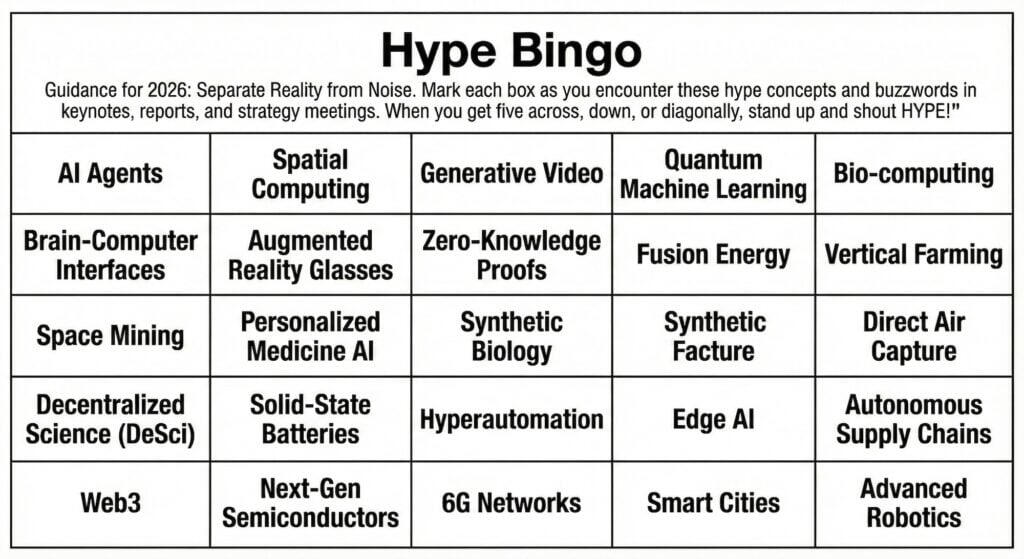
But here’s the thing – some of these trends are real, and others are not.Can you tell the difference?You should, because that’s a key principle that you really need to focus on in 2026 and beyond.Update: Minutes after finishing and distributing this post, an article floated across my feed.You need to read it.

We have all been debating whether we are in the midst of an AI bubble or not.This article outlines, in my mind,exactly what is going to unfold, and should be required reading – and it fits into the entire hype thoughts outlined above!You can find the article here.The other one you want to look at is the discussion between a fellow named Paul Kedrosky – a fellow Canadian who relocated to Silicon Valley years ago – and the economist Paul Krugman.
If you want to think about the risks emerging in the AI economy, this is the article you need RIGHT NOW!
#15 Escape Velocity
Scale immediately or fail slowly. There is no middle ground
We are on Day 15!You’ve listened to the edge (Day 13) and filtered out the hype to find a real structural signal (Day 14).You have identified a real trend!Now, you face the moment where most legacy organizations fail.People often talk about something called “pilot purgatory,” and the fact that people and organizations get stuck there. It’s the tendency to test or trial a new idea – and then get stuck there, never moving beyond the testing or ‘pilot’ phase. Yup, it’s a form of purgatory!Here’s your chalkboard summary!
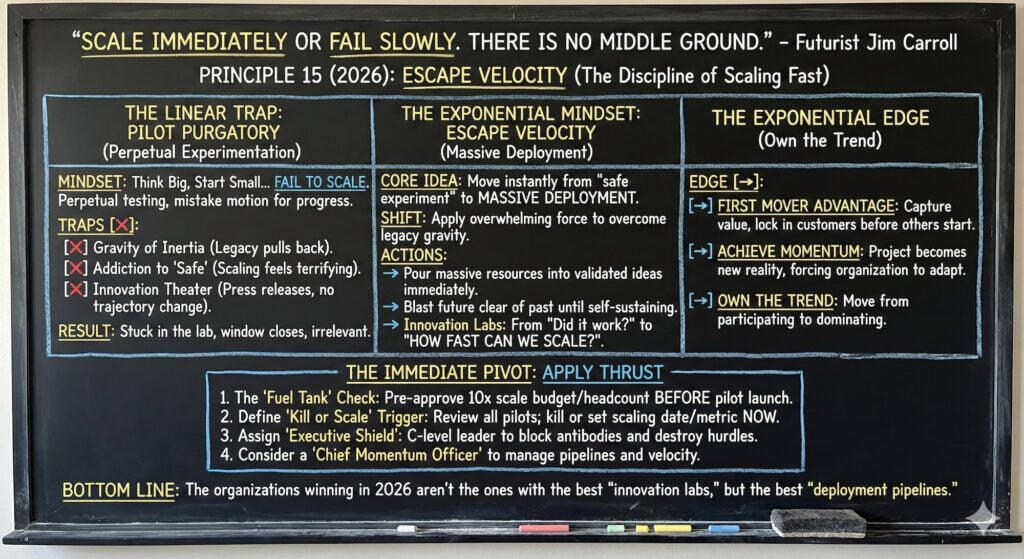
© Jim Carroll All rights reserved.
Maybe what you really need to do today is play more Bullshit Bingo, but create a bingo card that is based on FOMO and hype!
Let’s put the challenge in context. For years, I have advised leaders to follow a simple, powerful mantra for innovation in a fast world: Think Big, Start Small, Scale Fast.Most organizations are pretty good at the first two. They “think big” in strategy sessions. They “start small” with innovation labs and proofs-of-concept.But they completely fail at the third and most critical step: scale fast. They end in a state of perpetual experimentation where they run dozens of small, safe tests that generate interesting things – but never make it out of the starting gate. And in doing so, they mistake motion for progress – they believe that the mere fact that they are testing a bunch of things means they are making progress.They aren’t.Here’s the problem – in a linear world, you could slowly roll out a new initiative over two or three years. You had the luxury of all the time in the world.But in an exponential world, that doesn’t work. You are surrounded by the problem of legacy – existing processes, IT systems, organizational sclerosis, and bureaucratic inertia designed to keep doing things the same way. That means to move fast, you need more effort than ever before – because in this new fast world, you need to move instantly from a “safe experiment” to “massive deployment.”The discipline to do that? Let’s call it! Escape Velocity.I have been covering the issue of velocity and scale for years. When I look back through my own archive of blog posts, keynotes, and Daily Inspirations, I see a clear pattern of organizations that understood how to achieve this momentum. But some did.1. The $200 Million Pouch (StarKist)Oh, I love this story! And in fact, it’s one of the most trafficked videos on my site!
The Observation: For 110 years, StarKist sold tuna in tin cans. Then someone finally asked: “What if we didn’t do it this way?“, referring to tests of a new, resealable plastic tuna pouch. And yet, they launched it into not just a few stores; they scaled it instantly for wide distribution.
The Scale: A simple shift in packaging format generated $200 million in additional revenue in year one alone.
The Exponential Reality: Ask yourself this – what’s your ‘tin can ‘? What legacy object, idea or process is holding you back? In 2026, the most massive scaling opportunities often hide in the most mundane “legacy” objects. Scaling fast doesn’t always mean inventing a new technology; often, it means applying a new form factor to an old asset, or a new idea to an old concept. It involves going from a tin can to a reusable tuna pouch!
2. Cannibalizing the Cash Cow (Apple)
The Observation: Apple has certainly been (maybe up until now) one of the most interesting, innovative companies out there. I’ve long shared the statistic that for a time, 60% of their revenue comes from products that didn’t exist 5 years ago. (I don’t know if that is still true) Part of that involves continuous product reinvention – I’ve often highlighted how Apple dared to cannibalize its own massive iPod business to create the iPhone. They got rid of one product – quickly – to move up the chain of innovation. While others protected their legacy revenue, Apple realized that if they didn’t kill their own product, someone else would. Self-cannibalization, as it were.
The Scale: They didn’t “test” the iPhone as a niche accessory for iPod owners; they bet the entire future of the company on it, shifting resources aggressively. Think about the day a new iPhone comes out – it’s fast scaling at a national and global level.
The Exponential Reality: True scaling requires “letting go of the past.” You cannot achieve escape velocity if you are tethered to the safety of your declining legacy revenue. The winner is always the company willing to destroy its primary revenue stream today to own the platform of tomorrow.
3. The Logistics Pivot (Walmart & Target)
The Observation: By 2018, analysts predicted Amazon would devastate traditional retail. They simply had too much momentum going. Instead, Walmart and Target achieved massive e-commerce growth by taking a liability—expensive physical real estate—and reimagining their thousands of stores as mini fulfillment centers. They built the software, infrastructure, and systems to support home delivery, taking on the behemoth on the block.
The Scale: Walmart used this strategy to fuel 40% e-commerce growth and turn its physical footprint into a rapid-delivery network that rivalled Amazon’s. By the time the pandemic hit, they were well-positioned to survive – and thrive!
The Exponential Reality: Scale is often about “asset flipping.” You don’t always need to build new infrastructure to scale; you need to re-code the purpose of what you already have. In an exponential world, a physical store is just a node in a logistics network.
4. Speed as an Operational Asset (Honda)
The Observation: In the world of manufacturing, scale is critical. For years, I shared the story of how Honda industrialized flexibility, developing the ability to switch manufacturing models in just 10 days while competitors took months. Much of this was pioneered at a plant in Graz, Austria – a facility that turned out to be the model test case for manufacturing flexibility.
The Scale: This wasn’t a one-time project; it was an architectural shift that allowed them to scale production of popular models instantly in response to demand. That began to lead to a fundamental shift in the automotive industry, and the concepts continue to this day throughout the world of manufacturing.
The Exponential Reality: Speed is not a project; it is an architecture. You cannot “scale fast” if your underlying infrastructure is hard-coded. In 2026, your physical operations must be as fluid as software. If retooling takes months, you are already dead.
5. The Process Pivot (Kitchen Cabinet Manufacturer)
The Observation: From 2004 to 2007, the global software powerhouse SAP booked me to headline dozens of events, where I would combine a keynote with a discussion with key customers (CIOs of major companies). One organization I spoke to had put in the hard work of a massive IT upgrade to automate inefficient manual processes in their back office. The result? They were able to move faster from the idea of mass production of product to mass customization, which today, almost 20 years later, is one of the core concepts taking hold throughout the manufacturing industry.
The Scale: They moved 3.5 people from order processing to custom sales. Moving them from being a direct cost to folks who were adding real value. The result? A 40% increase in sales and a 60% increase in profits within one year.
The Exponential Reality: Scaling isn’t always about “more technology”—sometimes it’s about shifting human talent. By automating the “boring,” you unleash the “exponential.” You scale by moving human intelligence from the back office to the front line.
Text
In all of these cases, the organization had an idea, tested it, and then managed to get beyond pilot purgatory into implementation reality.That’s one of the most critical skills you need to learn for 2026 and beyond.The External Reality: 10 Examples of “Escape Velocity” in 2025But those are stories from the recent past. What does “Escape Velocity” look like right now, in the AI-fueled reality of 2025 and 2026?The fact is, it is happening. Here are some real-world examples.
Mercari’s Agentic Scale (500% ROI): While others play with chatbots, Mercari deployed autonomous AI agents for customer service. They didn’t stop at a pilot; they scaled to full deployment, anticipating a 500% ROI and reducing employee workload by 20%, moving from having a “human-in-the-loop” to “a human-on-the-AI-loop.” There is no doubt that customer support is one of the ‘low-hanging fruits’ for AI deployment – and literally everyone is testing the idea. Yet, this organization reports they’ve been able to scale the opportunity from testing to reality
Waymo’s Robotaxi Reality: Waymo finally broke the “perpetual pilot” barrier of self-driving technology. They are now logging 200,000 paid rides per week, moving from a science experiment to reality. One of the ways they have done this is by mastering the ability to learn from continuous new data – every mile driven trains the entire fleet instantly.
Klarna’s Support Revolution: Another support story – Klarna’s AI assistant handled 2.3 million conversations (two-thirds of customer service chats) in its first month of broad release. It did the work of 700 full-time agents with equal satisfaction scores. They scaled from 0 to 2.3 million in a heartbeat. This should serve as a real-world example to everyone experimenting with such an idea today.
Albemarle’s “Solve One, Scale Everywhere”: Instead of running 50 pilots, this chemical giant used AI to solve one critical problem: the variability of quality in different production batches. They then immediately scaled that single solution globally to generate $50 million in savings. Scale. fast!
Schneider Electric’s “AI Hub”: By centralizing talent into a 350-person “AI Hub,” they forced standardization, allowing them to deploy a supply chain model that improved accuracy and cut safety stock by a third in just six weeks. They built a “scaling machine,” not just a model.
Pfizer’s “Velocity Alignment”: Using GenAI, Pfizer cut the drafting time for complex medical documentation by a reported 70% (Sometimes, we have to take such claims at their word). They report that they turned their process upside down – rather than having AI “assist” writers, they went to a model in which the AI writes and humans review. This is fundamental process re-engineering at scale. (Back in 2009, I keynoted a group called the International Society of Medical Publishing Professionals. Scary to think about what my keynote slides might look like in the context of this reality!)
Domina’s Logistics Leap: This Colombian logistics firm integrated Google’s Vertex AI to predict package returns directly into their core workflow, improving real-time data access by a reported 80% and delivery effectiveness by 15%. The project involved one of the most likely paths for AI deployment – a private AI model that can be customized to specific needs.
Rocket Lab’s Cadence: While legacy aerospace plans launches for years, Rocket Lab is treating rockets like software releases, scaling launch frequency to unprecedented levels and proving “Time to Market” is now a commodity service in space.
Morgan Stanley’s AI Strategy: They built an AI assistant that listens to client conversations and drafts follow-up materials instantly. The assistant, called Debrief, keeps detailed logs of advisors’ meetings and automatically creates draft emails and summaries of the discussions. CNBC has reported that over 98% of advisor teams now actively use the system. Scale? They scaled this “bionic analyst” to thousands of advisors overnight, fundamentally upgrading their workforce’s capability.
Mercedes-Benz’s “Talking Car”: They moved past linear voice commands to exponential conversational agents using LLMs. Crucially, they deployed this via Over-The-Air (OTA) updates, upgrading the entire fleet instantly without a single dealer visit. Cars have become iPads on wheels, upgradable in an instant, and this is a great example of what happens with ‘scale’ when the architecture is put in place.
What can we learn from such ideas? The organizations winning in 2026 aren’t the ones with the best “innovation labs.” They are the ones with the best “deployment pipelines” – the ones who can take the ideas in those labs and turn them into reality.Added: In that context, the idea of innovation labs is moving from “did it work?” to “how fast can we scale?”Let’s put all this in context in light of the mind model I’ve been using to get you thinking about how to approach 2026 and beyond – the mindset you need, the trap you are within, the edge that change will get you – and how you might get there!1. The Exponential MindsetYou need to lock the idea of “escape velocity and scaling fast as one of the key skills you need to master.And it’s coming to understand that this is really tough to do.To launch a new exponential business model, you must apply overwhelming force to overcome the gravitational pull of your legacy operations. To roll out an actual new product or service means cutting through layers of organizational inertia. It’s recognizing that the innovation killers are all around you and are designed to slow you down.In that context, it’s all about developing the organizational capability to take a validated “small start” or tiny, test idea – and immediately pour massive resources into it, including talent, capital, and executive support.It’s coming to understand that you don’t slowly integrate the future; you blast it clear of the past until it becomes self-sustaining and too big to kill!2. The Linear TrapWhy do companies get stuck in pilot purgatory, never breaking free?
The gravity of inertia: Think of this way: your current business is a massive planet with huge gravity. It naturally pulls resources and attention back to the way things were, rather than propelling them forward to the way they could be. Without sufficient escape thrust, every new initiative eventually crashes back to the surface of “how we’ve always done it.” Go back and read my innovation killers – that’s what you are up against!
An addiction to “being safe”: Starting small feels safe. Scaling fast feels terrifying. Linear leaders hide out in the “lab” and testing phase because it feels comfortable. And this eventually kills the opportunity – because they require 100% certainty before scaling, they wait too long, and the window of opportunity has closed.
Innovation “theater”: Too many organizations ‘play’ at innovation, but never actually get anything out of the starting gate. Who are they? Organizations that love to issue press releases about their pilots. CEOs who get on stage and boast about new products and new services that are never delivered. Companies that attach themselves to the global hype machine as a way to boost a stock price, but never follow through. It looks like innovation. But without a mandate to achieve escape velocity, it’s just theater designed to placate shareholders, changing nothing about the company’s trajectory.
3. The Exponential Edge2026 and beyond is all about learning how to scale – because when you master Escape Velocity, you move from participating in a trend to owning it:
Moving fast and making things: It’s long been a reality that when it comes to digital trends, the first player to scale captures disproportionate value. By moving fast, you lock in customers and data before others leave the starting gate.
Achieving momentum: A pilot project is easily killed by internal antibodies (resistors to change). But a project that has achieved escape velocity quickly becomes the new reality, forcing the rest of the organization to adapt to it.
4. The Immediate PivotYou need to stop running science experiments and start applying thrust – again, think of this like a rocket launchHere are a few ideas to get you going.
The “Fuel Tank” Check: Before approving any new “Start Small” pilot, demand to see the scale plan. If the pilot hits its metrics in 90 days, exactly how much budget and headcount is pre-approved to release on Day 91 to scale it 10x? If there is no fuel in the tank for scaling, do not launch the rocket.
Define the “Kill or Scale” Trigger: Review every pilot project currently running in your organization. Force a decision for each: It must either be killed today because it’s not working, or it must be given a specific date and metric trigger for massive scaling. No more indefinite orbits.
Assign an “Executive Shield”: A scaling project needs protection from the gravity of the core business. Assign a C-level leader whose primary job is not to manage the project, but to aggressively block corporate antibodies, secure resources, and destroy bureaucratic hurdles that slow its ascent.
Last but not least, consider the idea of a “Chief Momentum Officer” to get you going! I wrote about this idea way back in 2009 (!) in a post. Here’s what I wrote!
This individual will carry several responsibilities, such as:
managing the product innovation pipeline, so that the organization has a constant supply of new, innovative products, as existing products become obsolete, marginalized, or unprofitable
managing the talent pipeline, so that the organization can quickly ingest all kinds of specialized new skills
managing the technology pipeline, so that the organization can adapt itself to constantly improving and ever-more sophisticated IT tools
that will help to better manage, run, grow, and transform the business
maintain and continually enhance brand and corporate image; as I’ve written here many times before, brands can become “tired” and irrelevant if they aren’t continually freshened and refreshed
ensuring that the organization is continuing to explore new areas for opportunity, and that it has the right degrees of innovation momentum
that the business processes and structure of the organization are fine-tuned continuously so that it can keep up with all the fast-changing swirl around it
ensuring that a sufficient number of “experiential” programs are underway with respect to product, branding, markets, and other areas so that the overall expertise level of the organization is continually enhanced
In other words, the CMO has two key responsibilities:
keeping a fine-tuned eye on the trends which will impact the organization in the future, and which will serve to increase the velocity that the organization is subjected to and;
keeping their hands on the appropriate levers throughout the organization, such that it can keep evolving at the pace that these future trends will demand.
I don’t know if that makes perfect sense, but I think it’s a good issue to think about.If you take that second last bullet – that’s your issue of scale and escape velocity right there!
#16 Scale-Blindness
Your brain is built for addition. The future is built on multiplication
When exponential change arrives, it never goes well.That’s because most people fail to understand what it means and don’t act, which is a problem. After all, there is a remarkably narrow window between “this will never work” and “how did we miss this?”We are on Day 16. Earlier in this series (go back to Day 2), we confronted the staggering velocity of change—the doubling of scientific knowledge, the acceleration of technological breakthroughs.But there is a massive, invisible chasm we have not yet crossed:It is the gap between intellectually knowing the numbers and viscerally comprehending what they mean for your reality in 36 months. It’s called the scale-blindness epidemic, and why your brain cannot comprehend what is coming.Here’s your chalkboard summary:
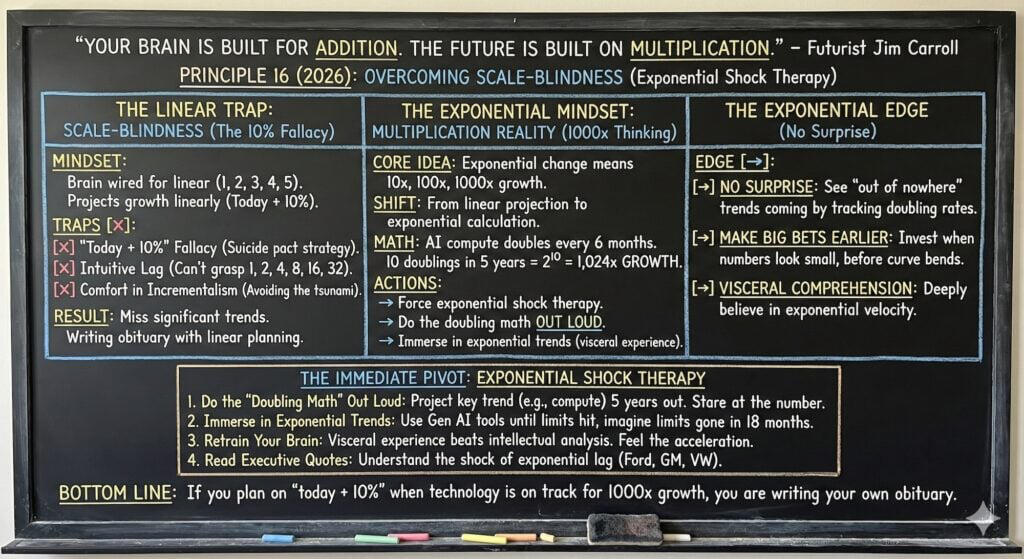
(Even this image should give you pause. Just a few months ago, most AIs couldn’t spell. They can now generate incredibly text-dense images like this – that are mostly error-free – in but seconds!)Consider this: you can read the reports on AI growth, computing power, or synthetic biology until your eyes bleed. You can nod your head and agree that things are moving fast.But deep down, you don’t believe it.Why? Because you are a human being. We are linearly wired creatures living in an exponential world. Our brains evolved to track linear threats—a lion moving across the savannah at a constant speed. We understand “1, 2, 3, 4, 5.” Slow, linear growth.But it seems we are biologically incapable of intuitively grasping “1, 2, 4, 8, 16, 32.” Wildly fast exponential growth.Because of this evolutionary flaw, the vast majority of leaders suffer from “Scale-Blindness.” When we look at an emerging exponential technology, our brains instinctively project its growth linearly. We do a 1-2-3-4-5 – not a 1-2-4-8-16-32. We look at what it can do today—which is usually underwhelming—and assume next year it will be maybe 10% better. And the fact is, it could be 100% better, or 1,000%, or maybe even 10,000%And because of our blindness, we fail to miss out on the significance of the trend.
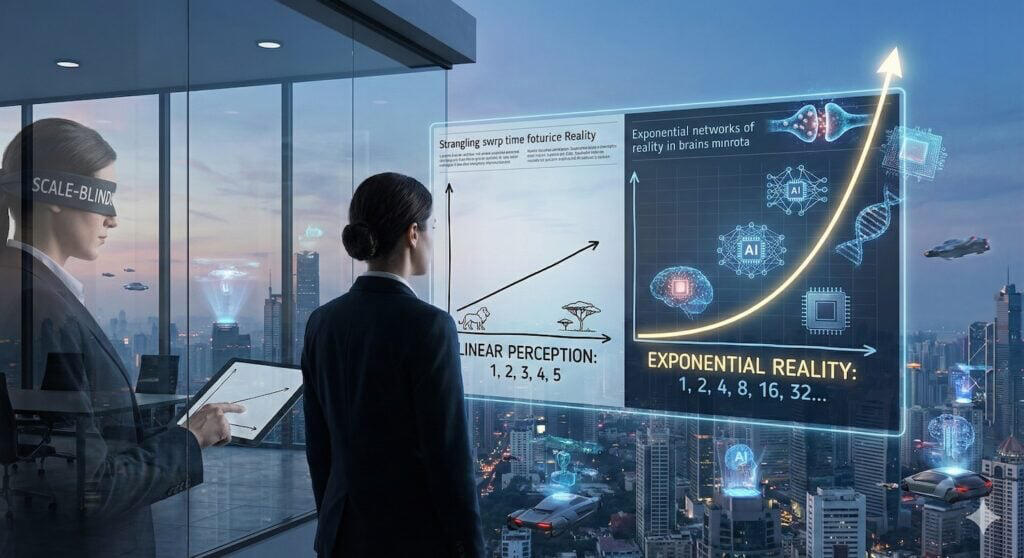
Think about it another way – if we see a 10-foot wave coming and prepare accordingly, completely blind to the fact that the exponential function will turn it into a 100-foot tsunami by the time it reaches shore.
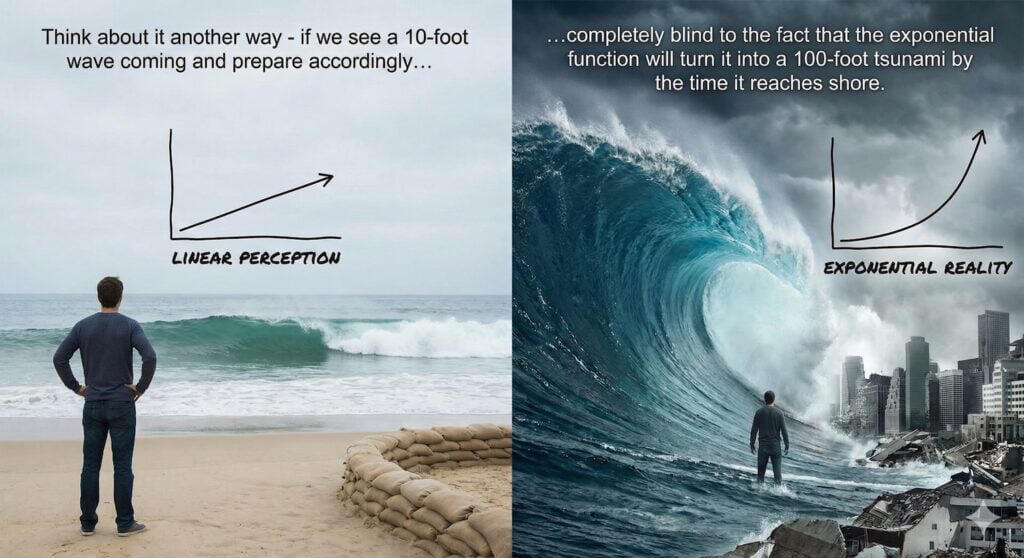
That’s why principle #16 in this series isn’t about learning more facts; it’s about forcing your brain to undergo a sort of exponential shock therapy so you can cure this blindness before it’s too late. That’s because there is comfort in incremental thinking!The Exponential Edge: Economic WhiplashI want you to go back just a few years – not for the typical Blockbuster, Kodak, and Nokia stories – but for more recent events. We have witnessed an unprecedented collection of corporate reckoning moments from 2020 to 2025—executives publicly admitting shock as billions in value were destroyed or created in months rather than decades.Some of this was due to this exponential lag – they were strategizing for a linear world in which exponential change was taking hold. The implications of that blindness are stark!Automotive: The “Humbling” Reality of China’s EV ScaleFor years, legacy auto treated electric vehicles (EVs) as something that would always be just a niche market. And now, even as EV mandates are rolled back in the US, the rest of the world marches on. Norway is almost 100% EVs! China owns the future of the automotive market because of EVs. And that data proves how quickly “niche” becomes “dominant.”
The Velocity: EVs were 2% of global car sales in 2018. By 2023, they were 18%, with weekly registrations roughly equal to the entire year’s total in 2013.
The Shock: Ford CEO Jim Farley admitted that China’s EV lead was “the most humbling thing” he had ever seen.
The Consequence: Ford’s Model E division accumulated approximately $15 billion in losses since 2021. This is not a “sales dip”; it is an entire national auto industry realizing a foreign bloc can undercut their economics and industrial base in less than a decade.
Semiconductors & AI: The Trillion-Dollar JumpWhile other industries worry about 10% growth, the infrastructure of the future is rewriting energy plans and national budgets.
The Scale: Global semiconductor revenue is projected to jump from $650 billion in 2024 to over $1 trillion by 2029.
The Demand: The AI server market alone is forecast to grow 6x—from $140 billion to $850 billion—by 2030.
The Power: Goldman Sachs estimates data center power demand will grow 160% by 2030, consuming 3-4% of global electricity.
Strip away these numbers, and it’s pretty evident the US would be in a pretty significant recession if it weren’t for the AI buildout. Tech companies like Crucial, which provided technology to the consumer sector, have suddenly abandoned those markets to take part in the AI frenzy.Retail & Logistics: Automate or EvaporateThe definition of “fast” within this has been rewritten by software.
Fashion: Traditional design cycles took months. Shein now adds roughly 7,200 new styles per day, using real-time predictive data to test micro-batches. An influencer wears a new design on Instagram? It’s in production in hours on the other side of the world.
Logistics: Maersk pivoted from “shipping” to “integrated logistics,” using AI to flip physical assets into data engines. This mirrors the “Asset Flipping” strategy seen where logistics firms integrate AI to predict package returns before delivery, improving effectiveness by 15%.
Biotech: The Collapse of TimeIn a linear world, drug discovery took a decade. In an exponential world, biology is programmable and now takes months, if not weeks.
The Old Way: Traditional drug development takes 4-6 years to reach trials.
The New Way: Insilico Medicine took a molecule from target identification to Phase 2 clinical trials in just 18 months.
The Vaccine: Moderna compressed a typical 10-15 year vaccine development timeline by 90%, going from sequence to authorization in 11 months.
The Math: A Visceral AI Reality CheckIf you want to understand why your current 5-year plan might be obsolete, grab a calculator. Consider AI training compute:
The Trend: Compute used to train leading AI models has been doubling roughly every six months since 2010.
The Calculation: Ten doublings in five years is 2¹⁰, which equals 1,024.
The Implication: If a frontier model in 2025 uses “1 unit” of compute right now, a continuation of this trend means models in 2030 will train on roughly 1,000 times more compute.
General human knowledge, which once took a century to double, now doubles approximately every 12 hours. Consequently, the half-life of a professional skill has plummeted from 30 years to a mere five years. We are now leveraging this 1,000 times exponential growth on top of that – what’s going to happen with knowledge and careers?Insurance: Data as a Differentiator
The Win (Progressive): Progressive built a 30-year advantage in telematics, accumulating 10 billion miles of driving data. Executives confirmed that telematics was “3x more predictive than any other rating factor”. By 2023, their market share grew to 15.3% while competitors stumbled.
The Miss (GEICO): GEICO’s late adoption of telematics contributed to the largest auto underwriting loss in its 100-year history ($1.9 billion in 2022). The result was a forced 60% workforce cut, dropping from 50,000 employees to 20,000.
Automotive: The Teardown Shock
The Win (Battery Costs): While OEMs struggled, battery economics defied forecasts. Pack prices dropped to $115/kWh in 2024, with some Chinese cells hitting $44/kWh—a 97% decline since 1991.
The Miss (Ford & GM): When Ford tore down a Tesla Model 3, engineers were shocked to find their own Mach-E contained 1.6 kilometers more electrical wiring. Meanwhile, GM’s Cruise unit—once confident they had “the lead“—burned through $10 billion before a safety incident forced a total shutdown and a “reset“.
Energy: Forecasts vs. Reality
The Win (Xcel Energy): In 2017, Xcel received “shocking” bids for solar-plus-storage at $36/MWh and wind at $21/MWh – lower than the operating cost of existing coal plants.
The Miss (The IEA & Big Oil): The International Energy Agency’s 2022 solar forecast for the year 2040 was nearly met in 2024, missing the mark by 16 years. Meanwhile, Shell and BP took combined write-downs exceeding $40 billion in 2020, explicitly acknowledging the risk of stranded assets.
Agriculture: The Robot vs. The Vertical Farm
The Win (John Deere): Deere successfully transformed a 185-year-old heavy iron business into a robotics leader. By acquiring Bear Flag Robotics and iterating fast, they launched fully autonomous tractors by 2025 that process visual data in 100 milliseconds. They were rapidly aligning with the new world of smart farming.
The Miss (Vertical Farming): High-tech farming startups Bowery and AppHarvest burned through over $3 billion in capital before collapsing. They failed because they tried to defy basic economics (selling $16/lb lettuce vs $6/lb store brands) rather than solving a scalable problem. (I still believe there is a real path forward for vertical farming – see my post on it.)
Professional Services: The AI Implementation Gap
The Win (Allen & Overy): The legal giant deployed Harvey (GPT-4) to 3,500 lawyers, processing 40,000 queries in beta and saving a reported 7 hours per contract negotiation.
The Cautionary Tale (Klarna): Klarna initially bragged about AI doing the work of 700 agents and froze hiring. By May 2025, they had to reverse course and rehire humans, admitting that prioritizing cost over quality led to degraded service.
Conclusion: The Imperative of Velocity!If you are planning on “today plus ten percent” in a market where the underlying technology is on track for 1000x growth over your planning horizon, you are not planning. You are writing your own obituary.The greatest risk today isn’t the speed of change; it is your failure to pick up your pace. To survive, you must move from “safe experiments” to “massive deployment” instantaneously – the scale issue covered in Principle #15.The future belongs to those who can do the math—and then have the courage to scale.Remember – scale blindness is hard to cure – because linear thinking feels safe. We fall to the “Today + 10%” Fallacy.” We build ourselves a suicide pact built on linear assumptions, taking last year’s results, adding 5-10% for growth, and call it a strategy. That thinking no longer works!I’ve been covering this challenge for quite some time, calling it the ‘acceleration gap’, often in the context of particular industries and issues.
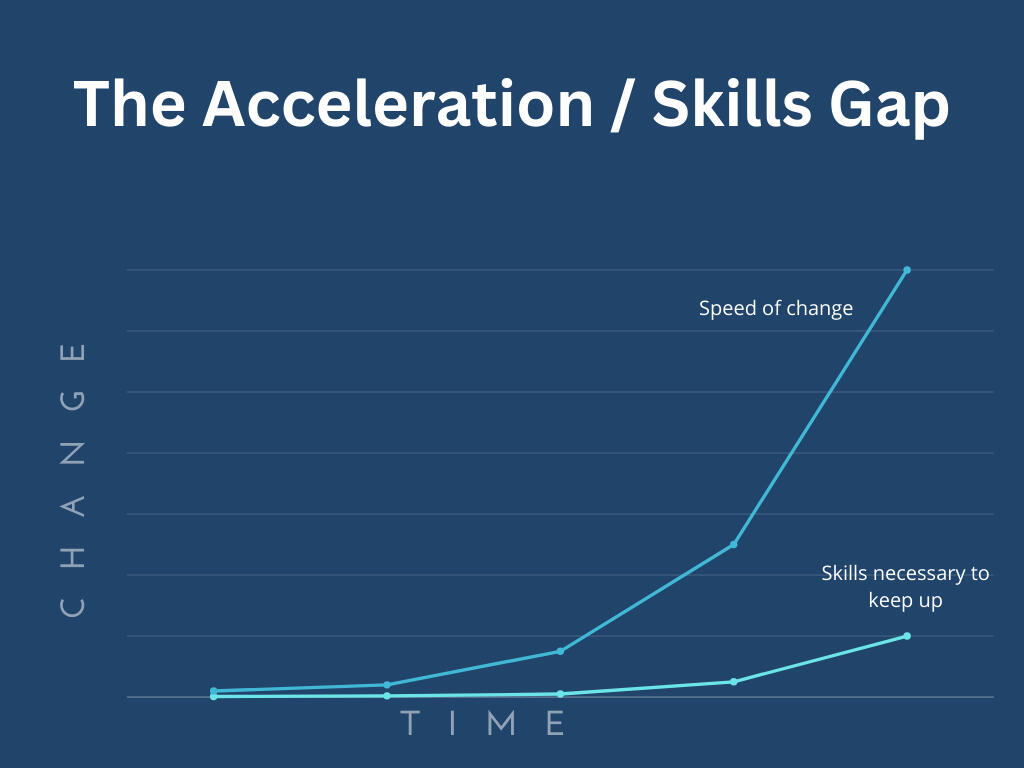
The acceleration gap, driven by exponential change, is real, it’s growing, and your inability to narrow it will increasingly impact your future!In that context, here’s what you need to do.1. The Exponential MindsetThis isn’t about being intellectually smart. It’s about changing the way you think!It is understood that in an exponential environment, the phrase “that will never happen” is usually just code for “my linear brain cannot process that growth rate.”2. The Linear TrapWhy is this blindness so hard to cure?Because linear thinking feels safe!It’s comfortable because it relies on the past to predict the future.But in an exponential world, if your future targets are linear, you are actually planning to shrink relative to the velocity of the market.3. The Exponential EdgeWhen you decide to try to cure your scale-blindness, the world starts to look VERY different:
The element of surprise disappears: You come to understand, accept, and align with some of the exponential change around you. While competitors are shocked when a technology seemingly comes “out of nowhere” to dominate an industry in 24 months, you saw it coming. You were tracking the doubling rate, not the current market share.
You make the ‘big bets’ earlier: You understand that in exponential growth, “early” looks indistinguishable from “wrong” for a long time, right up until the moment the curve bends upward and it becomes “everything.” You have the stomach to invest when the numbers look small.
4. The Immediate PivotThis means forcing yourself to change your thinking., Get rid of your old intuitive ‘thinking’ – and work harder to actively retrain your brain to see the scope of change. Think of it as a form of exponential shock therapy:
Do the “doubling math” out loud: When looking at a critical trend affecting your industry (e.g., computing power, AI capability, battery density), stop looking at today’s numbers. Put them out into the future, and exponentiate them. Don’t. do 1-2-3-4-5 – do 1-2-4-16….. Find its doubling rate. Now, grab a calculator and project that doubling out five years. Write that number down. Stare at it. That is your reality. Plan for that, not today + 10%.
Immerse yourself in exponential trends: Get away from your traditional sources of trends insight and find some new ones. You have to feel the acceleration, understand its pulse, and think about what it’s telling you. Example? Don’t just read about generative AI; force yourself and your team to use it for a critical task until you hit its current limits—and then imagine those limits evaporating in 18 months. Go in and generate a short video clip on Google Gemini – and realize that with exponential change, we’ll see an entire TV series produced totally in AI, probably within a year. Visceral experience beats intellectual analysis every time.
If you want a visceral sense of how far your intuition lags behind the curve, look at AI training compute. Epoch AI and Our World in Data estimate that the computing used to train leading AI models has been doubling roughly every six months since 2010, a growth rate of about 4 to 5 times per year.What does that mean?Ten doublings in five years is 2¹⁰, which is 1,024. So if a frontier model in 2025 used “1 unit” of compute, a continuation of the same trend would mean models in 2030 train on roughly 1,000 times more compute.Try and think about what that means.Let’s close with this: I used Google Gemini to find some great observations of senior executives and the issues of exponential change. Read them – and think!
Ford CEO Jim Farley on tearing apart Chinese EVs: “It’s the most humbling thing I have ever seen. Seventy percent of all EVs in the world are made in China. Their cost, the quality of their vehicles is far superior to what I see in the West.”
GM’s Kyle Vogt after $10 billion Cruise shutdown: “In case it was unclear before, it is clear now: GM is a bunch of dummies.”
Insilico Medicine CEO Alex Zhavoronkov on AI drug discovery skepticism: “When we first presented our results, people just did not believe that generative AI systems could achieve this level of diversity, novelty, and accuracy. Now that we have an entire pipeline of promising drug candidates, people are realizing that this actually works.”
VW CEO Herbert Diess (before being fired over software failures): “The development of our own software expertise is the biggest switch that the automotive industry has to make—much bigger than the transition to e-mobility.”
Wood Mackenzie’s Luke Parker on Shell/BP’s $40 billion write-down: “Just a few years ago, few within the oil and gas industry would even countenance ideas of climate risk, peak demand, stranded assets, liquidation business models, and so on. Today, companies are building strategies around these ideas.”
SAG-AFTRA President Fran Drescher on AI: “Artificial intelligence poses an existential threat to creative professions.”
Klarna CEO Sebastian iemiatkowski is reversing his AI-replaces-humans strategy: “Cost, unfortunately, seems to have been a too predominant evaluation factor… what you end up having is lower quality.”
Former PwC Partner Alan Paton on accounting’s future: “Most structured, data-heavy tasks in audit, tax, and strategic advisory will be automated within the next three to five years, eliminating about 50% of roles.”
Ohio State professor Scott Shearer on John Deere’s autonomous tractor: “Before its introduction at CES, everybody thought [full autonomy] was pie in the sky. But when Deere, with 60% of the tractor market share in North America, comes out with one, that’s when reality sets in.”
GM CEO Mary Barra (2022): “We have the lead right now. Those who are writing that it’s not going to work and that it’s decades off haven’t taken a ride in the vehicle.” (Said two years before shutting down Cruise entirely)
#17 Unapologetic Uniqueness
Always remember that conformity is where tomorrow’s greatness goes to die!
I’ve long suggested that one of the best ways to align with the future is through this thinking: when everybody is running one way, run the other way!Be the contrarian. The hole in the bucket, the square peg with a bunch of round holes, the one who says “why not?‘ when everyone else is saying ‘why?‘We are on Day 17. Yesterday, we looked at the terrifying math of the future—the sheer scale of change that is coming. 1-2-4-16-64 vs. 1-2-3-45.When faced with that kind of overwhelming scale, the natural human instinct is to feel overwhelmed. And I am willing to admit that one reaction I see in common with all of my audiences is that this feeling is universal. I’ve been doing text-message-based polling from the stage for over 15 years, and one overwhelmingly consistent attitude is that people feel universally overwhelmed by the speed of the future.So they try to avoid it. They try to fit in. They take the cautious route.They choose the comfortable over discomfort.The result? When we feel a need for comfort, to fit in, to follow the herd instinct, we try to be like everyone else. We look for safety in numbers. Case in point: we look at our competitors and say, “Well, they are doing AI this way, so we should too.” Korn Ferry made this observation about AI: “Among the most expensive keeping-up-with-the-Joneses games in corporate history”Need more proof? We seek out “best practices,” which is usually just a fancy word for “copying the average.”I rest my case.In a linear world, fitting in was a survival strategy. You survived by being a cog that fit perfectly into the machine.In an exponential world, conformity is a death sentence.Here’s your chalkboard summary – Google’s AI decided today it was just going to change the format -spelling mistakes and all!
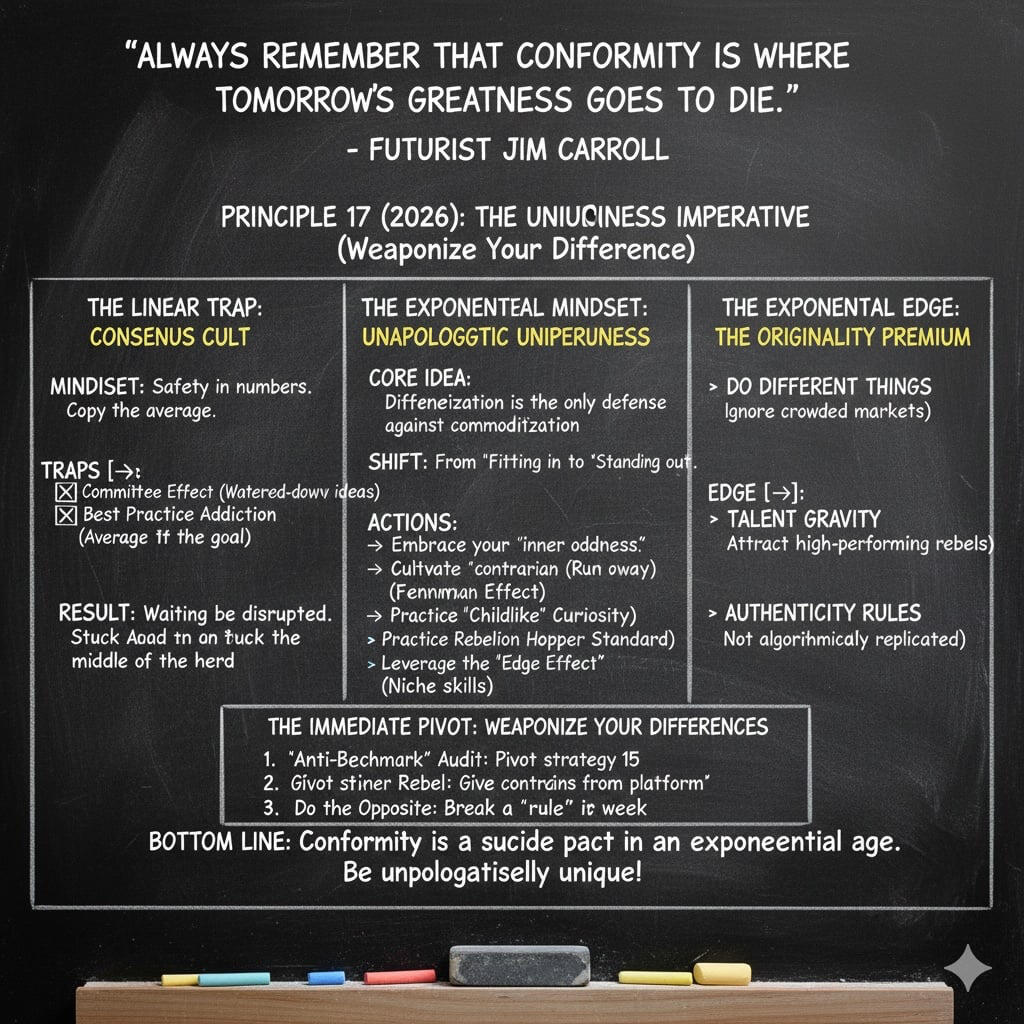
It’s being unique LOL!The truth? If you are doing exactly what everyone else is doing, you are not innovating; you are just waiting to be disrupted by the same force that eventually kills them. As I’ve been writing in my book Being Unique, the safe path to tomorrow is now the riskiest route. In that context, one of the most significant opportunities for moving forward in a faster world is to practice the idea of Unapologetic Uniqueness.Let’s put it this way: the future doesn’t belong to the people who fit the mold. It belongs to the misfits, the rebels, and the “industry expatriates” who see the world differently. It belongs to the people who understand that their “inner oddness” isn’t a flaw—it’s their strategic superpower. It goes to the heart of that famous Steve Jobs quote:
Here’s to the crazy ones. The misfits. The rebels. The troublemakers. The round pegs in the square holes. The ones who see things differently. They’re not fond of rules. And they have no respect for the status quo. You can quote them, disagree with them, glorify or vilify them. About the only thing you can’t do is ignore them. Because they change things. They push the human race forward. And while some may see them as the crazy ones, we see genius. Because the people who are crazy enough to think they can change the world, are the ones who do.” Steve Jobs
The discipline you must master is Unapologetic Uniqueness.The Acceleration of the Odd: Why Uniqueness is Your Only StrategyYou can’t buy uniqueness. You can’t take a course on it and instantly discover its secrets. You can’t wake up one day and decide you are going to be unique.But you can learn what makes it special and perhaps do a little more about it, in the context of what to do about your future.I have spent the better part of the last year pouring my soul into a new book, Being Unique: Turning Curiosity, Creativity, and Courage into Your Competitive Edge. It is about 90% done, and as I write the final chapters, one terrifyingly clear conclusion has emerged that is critical for our discussion on 2026: The safe path to tomorrow is now the riskiest route.
Yesterday, on Day 16, we looked at the idea of “Scale-Blindness” and the math of exponential change. That’s the reality that knowledge, technology, and competition are doubling at rates our linear brains struggle to comprehend.In that kind of environment, “being average” is not a safe harbor. It is a mathematical guarantee of obsolescence.Why? Because in a world of exponential trends, the center of the bell curve moves faster than you do. If you are standing in the middle of the herd, doing what everyone else is doing, seeking “consensus” and “best practices,” you are actually standing still while the world accelerates away from you.The ones who are getting ahead? Those who aren’t thinking like everyone else, but are thinking their own thoughts. People who are busy doing something while everyone else is doing the same ‘other’ thing. Those who look at a trend and say, “let’s go for it!” while everyone has yet to spot the trend.Here’s what you need to know for 2026 and beyond: conformity is a curse.It whispers the lie that safety lies in sameness. But in 2026, conformity is just an anchor dragging you down into the past.Let’s dig into a little bit of what I’ve covered in my book. I’m not aiming to have it out in Q1 2026!The Science of the Shift: Why Outsiders WinTo understand why you must pivot to uniqueness, we have to look at the science of how breakthroughs actually happen. We need to look at the work of physicist and philosopher Thomas Kuhn, the man who coined the term “paradigm shift”. He’s in the book!Kuhn taught us that “normal science” is just a process of puzzle-solving within an accepted framework—it is the definition of conformity. Every scientist tends ot chase the same idea that everyone else is chasing. But eventually, anomalies pile up. The old rules are broken. We enter a crisis, and then, a revolution. And here is the key: these shifts never come from the establishment. They come from the outsiders, the people at the margins, the individuals who aren’t indoctrinated into the “old way”. The ones who don’t follow established science, but follow the unestablished!Right now, we are living through the mother of all paradigm shifts. If you are clinging to the “normal science” of your industry – the way things have always been done – you’ll be stuck. To borrow from my favorite phrase: The future belongs to the “odd one out”.The Three Powers of Uniqueness in an Exponential WorldUniqueness is not just about being “quirky” or “artistic.” In the context of 2026, uniqueness is a hard-edged acceleration strategy. Based on the research for my book, there are three specific powers that unique individuals weaponize to move faster than the speed of change.1. The Power of “Childlike” Curiosity (The Feynman Effect)In an exponential world, knowledge doubles every 12 hours. You cannot survive on what you learned a decade ago. You need a new engine for learning. Here’s a bit of the story I tell in the book.
The Spaghetti Principle: Nobel Prize winner Richard Feynman spent evenings breaking spaghetti noodles in his kitchen and watching plates wobble in a cafeteria. Why? Because he approached the world with a “childlike curiosity” that others dismissed as trivial.
The Exponential Link: This wasn’t wasted time; it was the foundation of his genius – he made great discoveries as a result of these experiments (it’s in the book!) He understood that looking where no one else is looking is the only way to see what no one else sees. In 2026, your “curiosity quotient” is the metric that matters. It’s the engine that drives differentiation.
The lesson? Learn – uniquely!2. The Power of Rebellion (The Grace Hopper Standard)She’s in the book too, a computer expert, and the one who invented the phrase “computer bug.” Her story is one that emphasizes that innovation is inherently an act of rebellion. It requires you to break the “Legacy Load” we talked about on Day 2.
Breaking the Binary: She rebelled against the idea that computers could only speak math. She fought the most dangerous phrase in the language: “We’ve always done it this way“. By refusing to accept the status quo, she essentially invented modern programming.
The Exponential Link: Rebels don’t wait for permission. In a fast-moving world, if you wait for consensus, the opportunity is gone. Rebels spot opportunities that others miss because they refuse to blindly accept “what is”.
The lesson? Learn – by rebelling!3. The Power of The “Edge Effect.”Also in the book? A prophetic New York Times editorial from 1987 predicted a future where organizations would be fluid networks, and competitive advantage would rest solely on unique human resources. That article changed my entire life and career trajectory; I’ve written about it often, because that future is here.
The Niche Advantage: As AI commoditizes general knowledge, the value of “standard knowledge” drops to zero. The real opportunities are emerging in the spaces between traditional disciplines—at the edges. In uniqueness.
The Exponential Link: When you possess a unique combination of skills, you don’t compete on price. You command it. You become a “market of one.“
And the reality is this: uniqueness is REALLY going to matter in the AI, because authenticity will rule. More on that later.The Resilience of the “Pointless” ForestFinally, we must address the cost. Being unique is hard. It is lonely. As I explore in the book, through the story of Lady Gaga, it requires a massive amount of grit to sustain disruption.Not only that, it requires the mindset of Oblio from the classic story The Point!. You might feel like the only round-headed person in a village where everyone has a point. You might feel banished to the “Pointless Forest”. That’s a whole chapter in the book!But it is in that forest—away from the crushing weight of conformity—where you will find the perspective that allows you to return and lead. (There’s a reason why my Tesla and my publishing division are named Oblio.)The Mantra for 2026? When you feel resistance, when people tell you that your ideas are wrong or your approach is too weird, remember the lesson of mRNA pioneer Katalin Karikó: “This is hard because it’s early, not because it’s wrong”.That’s uniqueness.Don’t try to fit in.Fit out.Conformity is a suicide pact in an exponential age.Weaponize your difference!Here’s how.1. The Exponential MindsetThe Originality Premium: In an era where AI can generate “average” content and “standard” strategy in seconds for free, the value of “standard” drops to zero.The only value left is in what cannot be algorithmically replicated: your unique perspective, your weird intersections of experience, and your human ability to connect dots that shouldn’t be connected.Your authenticity.The Exponential Mindset realizes that differentiation is the only defense against commoditization.2. The Linear TrapIn the face of reality, it’s important to question whether you might be stuck in what cold call, for lack of a better phrase, a consensus cult!Why do we drift toward the middle? Because being average feels safe. Think about the structures that we put in place that guarantee that we will be stuck there:
The Committee Effect: We water down bold ideas until they are acceptable to everyone in the room. By the time an idea is “safe” enough to get committee approval, it is too boring to matter. Committees are an infrastructure designed to race you to the bottom of opportunity.
Best Practice Addiction: We obsess over “industry standards.” But if you just follow industry standards, the best you can hope for is to be average. You are fighting for the scraps in the middle of the bell curve – because that is what industry standards are based on.
3. The Exponential EdgeWhen you stop trying to fit in and start leaning into your uniqueness, you move faster:
Doing different things – things that matter: While your competitors are all fighting over the same crowded territory (e.g., “Generative AI for Customer Service), your unique perspective allows you to see the opportunities they ignore—the “weird” ideas that become the next billion-dollar market.
Talent Gravity: The best talent doesn’t want to work for a clone. They want to work for an original. Uniqueness is a magnet for the high-performing rebels you need to build the future. Go back to that Steve Jobs quote. You’ll only surround yourself with the rebels that matter if you become a rebel yourself.
4. The Immediate PivotYou need to weaponize your differences, celebrate your strangeness, and play up your weirdness!Here are a few things I’ve written into my Daily Inspiration series in the past. These things matter!
The “Anti-Benchmark” Audit: Look at your top 3 strategic priorities. For each one, ask: “Are we doing this because it’s what our competitors are doing” If the answer is yes, stop. Pivot that strategy 15 degrees to the left. Find the angle nobody else is taking.
Find Your “Inner Rebel”: Identify the person on your team who always disagrees, the one who asks the uncomfortable questions. Instead of silencing them, give them the floor. Ask them: “What is the one thing this industry believes is true that you think is false?”
Do the Opposite: Look at a standard industry practice (e.g., “We always require a 3-year degree,” or “We always price by the hour“). Experiment with doing the exact opposite for one week. See what happens when you break the “rule*” that isn’t actually a rule.
If you think about it, the whole idea of ‘being unique’ is found in how my two new books work together.
You are mediocre when you keep doing what everyone else does. You’ll escape it through uniqueness! Buy the books at mediocrity.jimcarroll.comLet’s close with this paragraph from the book. where I summarize the power in that Steve Jobs quote:
This quote by Steve Jobs captures the essence of innovation and creative thinking – and why and how to be different. When you take it apart, you realize that it’s a celebration of those who dare to think and act differently, and a reminder that these are often the people who drive the most significant changes in our world. Jobs’ message encourages embracing unconventional thinking and the pursuit of bold ideas, which is fundamental for advancement in any field.
These are the people who drive some of the most significant changes in the world.You need to decide to be one of them.Be unapologetically unique!
#18 Anti-Fragility
Don’t fear the chaos. Feed on it.
Bouncing back is a losing strategy!We are on Day 18. We have established that the future is scaling beyond comprehension (Day 16) and that your only defense is Unapologetic Uniqueness (Day 17).Now, we must address the environment in which you will operate through 2026 and beyond. It is going to be even more volatile. It is going to be chaotic. It will be characterized by sudden shocks, black swans, and “impossible” events happening at almost every single moment.Just like 2025.Except far more volatile.If you think about it, the standard corporate response to this has been the idea of developing “resilience.” Everyone is talking about it, listening to experts on it, finding out how to manage, heck. Heck, even I use the phrase too much – I have a website all about it, resilience.jimcarroll.com.I’ve come to realize that going forward, in an exponential world, resilience is not enough.Resilience is a linear concept. It means surviving a shock and returning to your original shape—like a rubber band. It implies that “bouncing back” to the status quo is the goal. It assumes that going back to where you were – rather than where you should be going – is good enough.But in 2026, the status quo is death. If you just “bounce back” to where you were in 2024, you are already behind, because 2026 is wildly different from what ‘was' two years before. Exponential change does that.That’s why you need to stop trying to be resilient and start becoming Antifragile.Here’s your chalkboard summary!
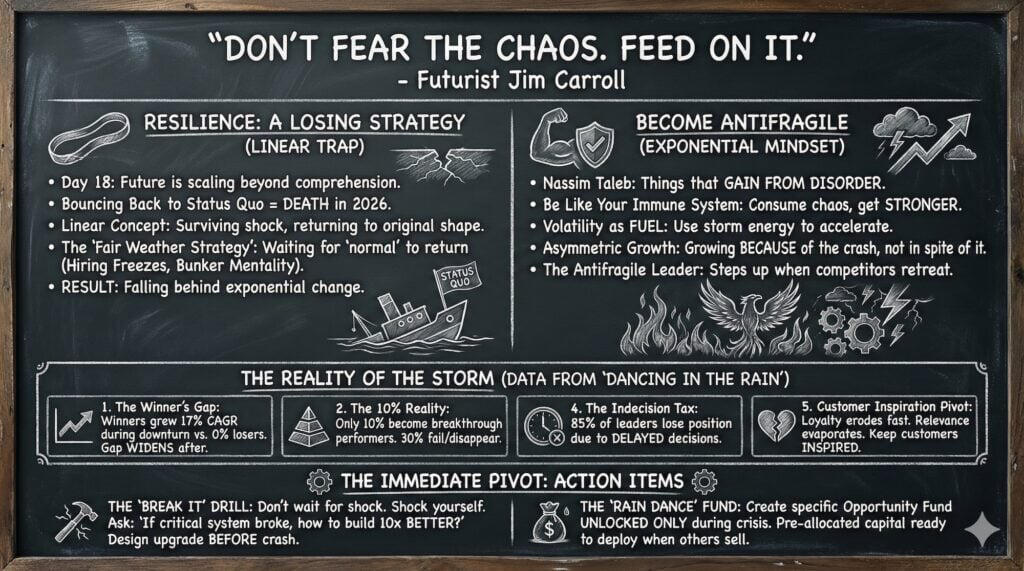
As I wrote in my book Dancing in the Rain: How Bold Leaders Grow Stronger in Stormy Times, the goal isn’t to endure the storm. The goal is to use the energy of the storm to accelerate.
To understand why this shift to a mindset beyond ‘resilience’ is so critical, we can look at the data I compiled in the book. The research is detailed: the safety of the “middle ground” does not exist during periods of volatility. You are either accelerating away from the pack or falling behind it.Here is the reality of the storm, with direct quotes from the book. Maybe you should buy one.Be this guy!
I spent a ridiculous amount of time on a crazy number of stages in front of tens of thousands of people who were shellshocked and whipsawed from 2000 to 2003 by economic volatility. I did it again after the 2008 global economic meltdown. And after that, too – every once in a while, I whip out these observations and share them from the stage, such as within this keynote in London, England, recently.
Consider the title of that video – “It’s what you do right now that matters.”That being the case, here’s what you need to do right now!1. The Winner’s GapHistory shows us that people who decide to move forward, not back, are the ones who win.
Observation: History shows that during the 2008 recession, “Winners grew at a 17% CAGR (compound annual growth rate) during a downturn, compared to 0% for the losers.”
The Impact: The gap widened after the volatility ended. “After the downturn was over, those same winners achieved 13% CAGR, while losers stagnated at 1%.”
What you need to do: You must explicitly “refuse to participate in the fear.” You must “choose strategic investment over reckless retreat” and “reignite your innovation engine” while your competitors are stalling.
2. The 10% RealityHistory also shows us that only a small percentage of people and organizations decide to do this!
Observation: “Only 10% of organizations become breakthrough performers during a recession.“
The Impact: The vast majority fail to adapt. “60% are simply marginal performers… The remaining 30%… do not make it—they go bankrupt, are bought out, or disappear altogether.”
What you need to do: You must decide to “double down on innovation and opportunity despite lingering and pervasive uncertainty.” You need to “keep [your] idea factories running” and ensure “innovation is on full throttle” even when budgets are being cut elsewhere.
3. The “Grief” Speed-RunOh, and guess what! History tells us that most people and organizations don’t get through the shock of volatility fast enough!
Observation: Organizations move through “Seven Stages of Economic Grief,” starting with “Shock” and “Denial.”
The Impact: “It is not the recession that breaks companies, it is how long they stay stuck in it.” “You cannot build the future if you are in the shock, denial, anger, or bargaining phase.”
What you need to do: You must “move with speed through doubt and into direction.” Your job is to lead your team “through the fog of the grieving process” and race to the “Acceptance” phase immediately.
4. The Indecision TaxSo what happens? They stop thinking, stop acting, stop doing. They adopt freezing as a strategy, which is just about the dumbest thing you can do.
Observation: “85% of pre-recession growth leaders lose their position during downturns.”
The Impact: They lost their lead “primarily due to delayed decision-making rather than poor choices.” “Waiting too long weakens the company.”
What you need to do: You must focus on “accelerating the decision processes.” You need to “simplify approval chains, establish clear decision thresholds, and enable action at all levels.“
The worst thing to do is to freeze, particularly when it comes to customer relationships, because during volatility, those relationships undergo a significant change.
Observation: “Customer behaviour is changing faster than your business model.” “Loyalty erodes faster as one in three highly loyal customers now typically switch in less than one year.”
The Impact: “You… render a brand new product instantly obsolete if it does not match their expectations.” Organizations that fail to innovate become invisible because “relevance evaporates.”
What you need to do: You must change what you do. “Do not focus on keeping your business alive; focus on keeping your customers inspired.” You must “tune in, not tune out” and “adapt faster.“
6. The “Bunker” FallacyThey retreat to bunkers, seeking shelter from the storm, rather than existing within it.
Observation: When volatility hits, mindsets change. When “most companies believe a recession is coming,” they prioritize controlling expenses, rather than investing for the other side.
The Impact: Those who failed to thrive “performed heavy cost-cutting” and “scaled back R&D.” “Decisions made for short-term survival rarely reward the bold.”
What you need to do: You must balance the ledger. Companies that “win the downturn” combine discipline with “a matching vision to align ongoing investment with strategy and opportunity.”
The discipline you must master to do all these things is what I call Antifragility.Did I mention you should buy the book? You can do that via the Website – dancing.jimcarroll.com!1. The Exponential MindsetNassim Taleb, who came up with the theory of the ‘black swan,‘ coined the term “antifragile” to describe things that gain from disorder. A package is fragile; if you drop it, it breaks. A rubber band is resilient; if you stretch it, it returns. Your immune system is antifragile; if you expose it to germs, it gets stronger.You need to be like your immune system!Consume the chaos! Thrive on it! Turn it into a lever to move forward faster!The exponential mindset treats volatility as fuel. As the data above shows, heavy weather scares away the “tourists.” When the market gets scary, your competitors retreat. They cut innovation. They hunker down. That is the moment the Antifragile leader steps onto the floor. The storm clears the field for you to capture market share cheaply.2. The Linear TrapDo you retreat into a “bunker mentality” when times get tough?When the clouds gather, linear leaders instinctively seek shelter. They initiate “hiring freezes” and “travel bans.” They pause their boldest projects to “wait and see.” They put barriers in place instead of opening doors. They instill fear to keep control.Is that what you’d do?If you think about it, this is a strategy you might pursue when the sun is shining.It assumes that the storm is a temporary aberration and that “normal” will return. But in an exponential world, volatility is the new normal.Under that phrase. Imprint it in your mind. Make it a sticker on your desk – and know this: if you pause every time there is uncertainty, you will be paused forever. While you are hiding in the bunker waiting for clarity, the antifragile player is out in the rain, rewriting the rules of the industry.3. The Exponential EdgeWhen you stop fearing the storm and start dancing in it, you gain leverage.That’s why I gave the book the title “Dancing in the Rain.” It gets you into a mindset that while conditions might not be perfect, you might as well make the most of it and flip the traditional thinking on its head. But here’s what you also need to know about what you can learn once you accept exponential change as your new reality.Here are some key facts:
There is a hidden opportunity in the stress! So do a stress test! A storm reveals the cracks in your organization that fair weather hides. It shows you exactly where your supply chain is weak or your team is slow. The antifragile leader uses the crisis to fix the structural flaws, emerging with a harder, faster machine than before.
There is growth hidden in the volatility: During the 2008 crisis and the 2020 pandemic, while most companies were trying to survive, the winners were making their biggest acquisitions and launching their boldest products. They bought assets for pennies on the dollar. They grew because of the crash, not in spite of it.
4. The Immediate PivotWhat are you doing right now to turn the wild world that is 2025 – which is likely only going to be more challenging through 2026 – into opportunity?The first thing you need to do is move from “resistance” to “antifragility” (or adaptation). Here are your immediate actions:
The “Break It” Drill: Don’t wait for the market or scary economic headlines to shock you. Shock yourself. Make them your new normal. Look at a critical system (e.g., your cloud infrastructure or your supply chain). Ask: “If this broke tomorrow, how would we not just fix it, but build something 10x better in its place?” Design the upgrade before the crash.
Put in place a “rain dance” fund: Most budgets are designed for the good times. What’s your budget for the bad? Create a specific “Opportunity Fund” that is only unlocked during a crisis. When the market tanks or a competitor stumbles, you shouldn’t need a committee meeting to act. You should have pre-allocated capital ready to deploy when everyone else is selling!
I wrote Dancing in the Rain because I saw too many talented leaders freeze up the moment things got scary.Everyone seemed to think the best strategy was to hide and wait for “normal” to return, but I knew that waiting was the most dangerous thing they could do. I wanted to prove that you don’t have to be a victim of the chaos. I wrote this book to show you that the storm isn’t something to fear—it’s an opportunity to grow stronger, move faster, and build your future while everyone else is running for shelter.Did I mention you should buy it?Like, now.You can do that at, well, dancing.jimcarroll.com
#19 Optionality Architecture.
Throw out the roadmap. Build a portfolio of instant pivots instead.
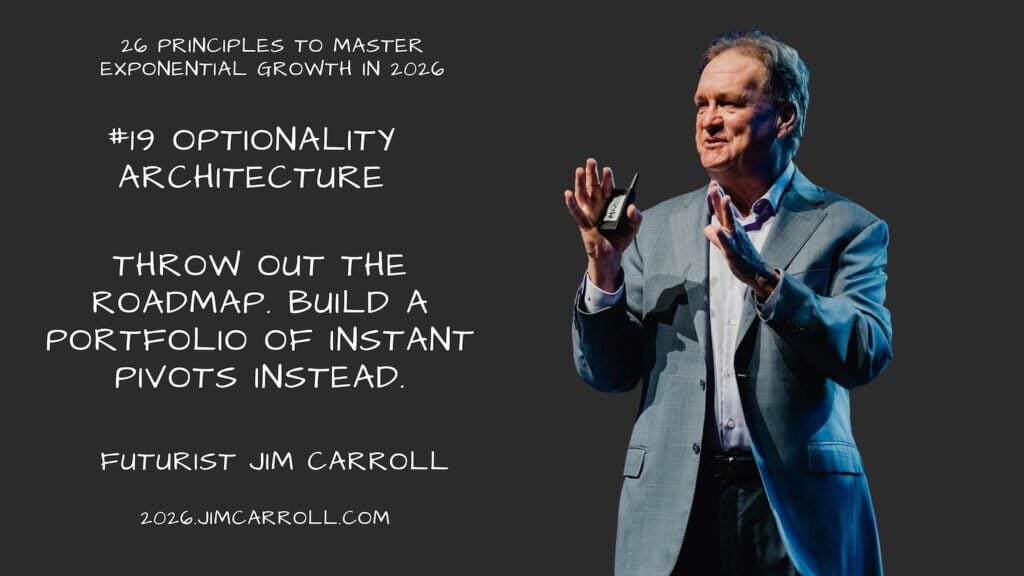
Build options, not plans!We are on Day 19 of this series and have covered a lot of ground. We’ve established the necessary foundation: the future is terrifyingly fast (Day 16), your only defense is being (Day 17), and you must adopt an “antifragile” mindset to feed on the chaos (Day 18).The question today is this: How do you plan when you can’t predict? Or when what you predict doesn’t happen because something else does. Or a trend is too complex?Welcome to the idea of Optionality Architecture.Instead of building a plan, build a series of pivots, so that you are ready for whatever the hell happens!Here’s your chalkboard summary!
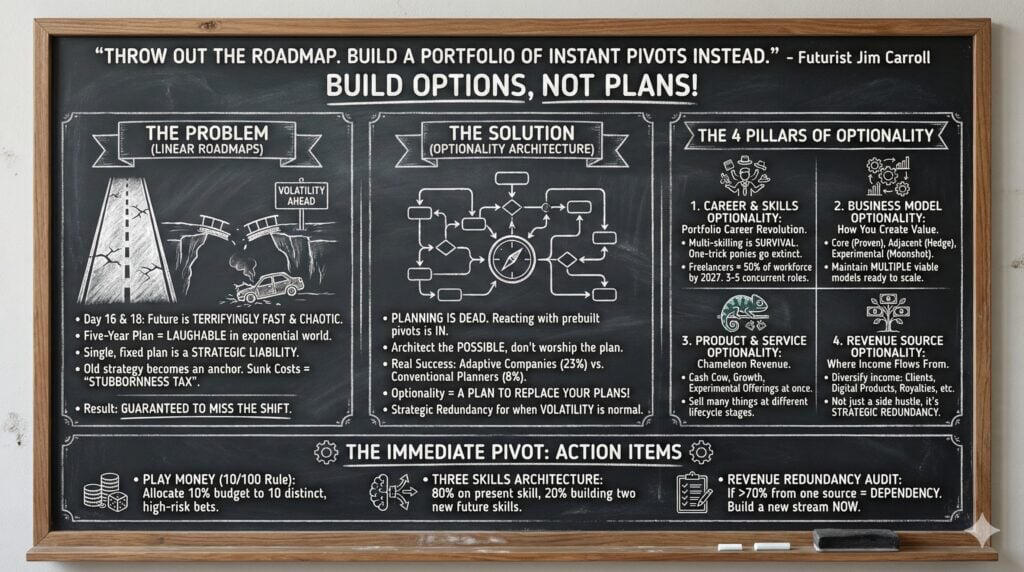
Think about this idea.Planning is dead.Reacting with prebuilt plans is in.Here’s why.In a linear world, the five-year plan was the gold standard. It was a single, rigid path based on the comforting (but false) assumption that the future would look mostly like the past. Strategy was about prediction and sticking to pre-determined plans.A five-year plan today? *Laughable! *In an exponential world, a single, fixed plan is a strategic liability. The moment you commit to one path, a technology curve goes vertical, or a Black Swan event lands. The old strategy instantly becomes an anchor that guarantees you miss the shift.The winning move is to stop worshipping the plan and start architecting the possible.That’s why the new principle you must master for 2026 and beyond is Optionality Architecture.Beyond being a cool phrase that rolls off your tongue, it’s a critical survival and success strategy you need to go forward. To get it, you must understand what it is.It’s knowing that your old way of planning for tomorrow is dead. Instead, it’s knowing that your future can no longer be defined by a plan, but instead, by many plans.Options.This.
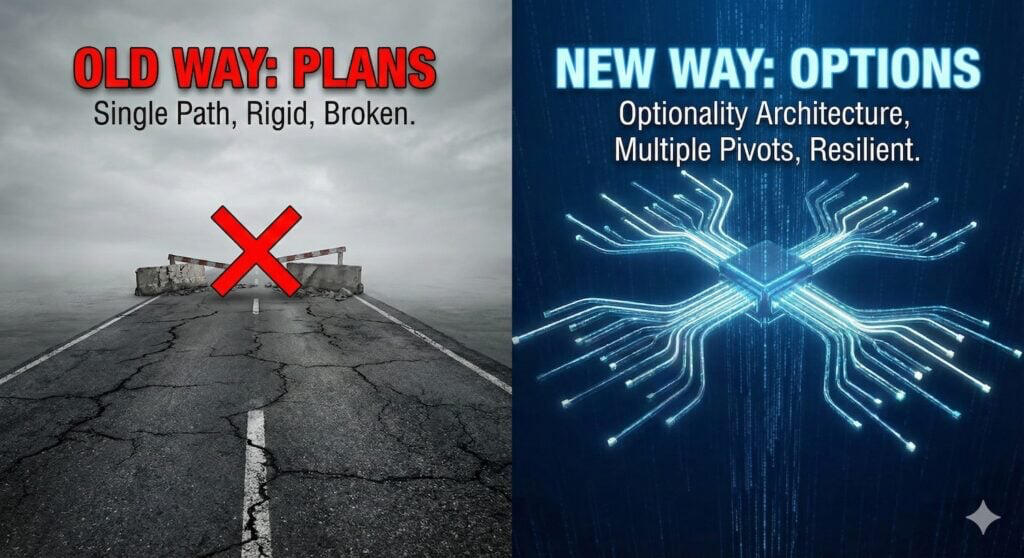
Digging into Optionality ArchitectureHere’s the brutal math from one study: Only 8% of companies using conventional planning models achieved real success during a period of volatility. Compare that to 23% for truly adaptive companies. The lesson? Plans don’t work. Adaptability does.And if our reality is that volatility is the new normal, it becomes pretty clear what we need to do.It also means that the five-year plan isn’t just an outdated idea from the olden days – it’s an actual competitive disadvantage as well.And here’s what it implies – the idea of optionality isn’t just a mindset. It’s an architecture, a methodology, a plan to replace your plans! It’s a deliberate structure you put in place so that you are ready for anything. Such as … volatility being the new normal.The most successful individuals and organizations in an exponential world don’t just have options. They systematically construct portfolios of options across four critical areas of their future
Career & Skills Optionality — Your personal capabilities portfolio
Business Model Optionality — How you create and capture value
Product & Service Optionality — What you offer to the market
Revenue Source Optionality — Where your income flows from
Let’s examine each.Career & Skills Optionality: The Portfolio Career RevolutionWe all know that the traditional career path – climbing the ladder at one company for decades – has become the exception rather than the rule. The data is unambiguous:The shift is already here.
By 2030, half of all professionals will have portfolio careers (OECD forecast)
In 2025, more than 40% of professionals globally report having more than one income stream
In Singapore, 57% of professionals plan to change jobs this year, with 58% of workers observing a rise in individuals holding multiple jobs
U.S. freelancers are projected to reach 86.5 million by 2027—that’s 50.9% of the entire workforce
This Isn’t Junior Talent Testing the Waters:
72.8% of fractional professionals have 15+ years of experience
These are seasoned executives who’ve proven themselves in traditional roles and are now choosing flexibility
Average monthly compensation for fractional sales leaders hit $9,651 in 2024, with hourly rates reaching $213
The Returns Are Real:
Portfolio careerists earn 30% more than equivalent full-time employees on average
Portfolio careerists report 43% higher job satisfaction than traditional employees
For many executives, a portfolio of three fractional roles generates more income than a single full-time position while offering greater autonomy
People who don’t have a job are the new people with a job. Heck, in my case, I haven’t had a job for 35 years and have had tremendous success. I have worked really hard throughout my career to NOT have a job!That has influenced my thinking. Years ago, I suggested on stage that not only would most people NOT have a job, but that they would have multiple jobs all at once. Today’s data bears that out. Research indicates that many of these freelancers have 3-5 concurrent jobs and income sources at any given moment.The World Economic Forum’s Future of Jobs Report 2025 projects that 39% of key skills required in the job market will change by 2030. Multi-skilling isn’t a nice-to-have—it’s a survival strategy. One-trick ponies are going extinct.Business Model Optionality: How You Create ValueYour career isn’t the only thing that needs a portfolio approach. If you run a business, your business model itself needs optionality architecture.The goal is to maintain multiple ways of creating and capturing value and generating revenue, each with different risk profiles:
Your core business model: Your proven, profitable engine. Optimize it, but don’t worship it. Know that it might go extinct as soon as a disruptor comes along.
Adjacent model: In addition to your main business model, you have another one that serves a different segment, uses a different channel, or monetizes things differently. This is your hedge against volatility – you can kick it into high gear at any moment.
Experimental model: A fundamentally different approach that could become your next core. This is your moonshot. It’s your disruptive idea.
The companies that thrive in exponential times aren’t those with the single “best” business model. They’re the ones with multiple viable business models ready to scale depending on which future arrives!Product & Service Optionality: What You OfferThe same architecture applies to your product and service offerings. In a world where customer behavior changes faster than your product lifecycle, betting everything on a single product or service is suicide. I’ve long suggested that you focus on the idea of chameleon revenue – developing the ability to earn income from products that do not yet exist, to replace the income from products that soon won’t exist!This means having multiple product or service streams happening all at once:
Cash cow offerings: These are your mature, profitable products, requiring maintenance but not reinvention. These provide investment funds for your experiments.
Growth offerings: New products that are new to market. They are gaining traction, requiring investment, but proving out new value propositions.
Experimental offerings: These are your newest risky bets. They are early-stage, high uncertainty products but positioned to capture emerging demand.
You no longer sell one thing – you sell many things at different stages of the product lifecycle.Revenue Source Optionality: Where Income Flows FromThe final dimension of Optionality Architecture is diversifying where your money comes from. This applies whether you’re an individual or an organization.For individuals, not only do you need multiple careers, but you need multiple sources of income to stay resilient and adaptable. When one stream dries up, others continue flowing. This isn’t about the idea of the”side hustle” as something fun to do – it provides strategic redundancy.That’s why you see some of the most successful people on LinkedIn talk about their multiple revenue sources, which might include:
Primary employment or client work
Consulting or advisory retainers
Digital products (courses, templates, content)
Investment income or equity stakes
Royalties, licensing, or intellectual property
Speaking, teaching, or training
For organizations? It’s all about diversification of revenue:
Different customer segments (enterprise vs. SMB vs. consumer)
Different geographies (domestic vs. international markets)
Different payment models (recurring vs. transactional vs. outcome-based)
Different value chain positions (direct vs. platform vs. infrastructure)
Take all of the above, and you get an idea that the future is all about options – and about having an architecture or structure that lets you put those options in place.1. The Exponential MindsetThe mindset you need to get into is learning how to develop low-cost, high-upside bets across all four areas above.Your individual capabilities—your skills, knowledge, and career path—should be treated as a financial portfolio: de-risked by diversification, and constantly positioned for a major payoff.2. The Linear TrapAre you trapped in a linear world, trapped by one thing, instead of having options with many things? Here’s a key question you need to ask yourself: If your primary product or service became obsolete in 18 months, what would you sell instead?If you don’t have an answer, you don’t have optionality—you have a single point of failure. Right now, you should do an immediate ‘what-if’ test:
What if your largest customer left tomorrow?
What if your primary revenue stream declined 50% in a year?
What if your industry’s pricing model fundamentally shifted?
If any of these scenarios were catastrophic, your revenue architecture lacks sufficient optionality!But once you have options, you have a future!3. The Exponential EdgeWhen you construct an architecture of options, you gain critical survival skills
A pivot plan: You stop waiting for certainty and start creating it! With multiple low-cost experiments running (in skills, business models, products, and revenue sources), you gain real-time insight into what might work for you tomorrow (remember my idea of ‘experiential capital‘)
The ability to quickly pivot: When one idea suddenly takes off, you can kill or pull back your other experiments and redirect resources instantly, gaining weeks or months of advantage over competitors. They’re still trapped in the decision-making loop – while you are moving forward, fast.
Have many options, many plans! The faster you cycle through options, the faster you learn which futures are actually arriving.4. The Immediate PivotSo how do you get there? You must move from a fixed roadmap to ‘portfolio thinking.’. Here are your immediate actions:
Play money: the 10/100 rule: Reallocate 10% of your available budget (time, money, or talent) away from incremental projects (the 10% gain) and dedicate it entirely to 10 distinct, small, high-risk bets (the 100x potential). If all ten fail, you only lost 10% of the budget. If one succeeds, you win the future. From a personal perspective, spend more time playing with new things. (Hello, AI!)
The “three skills” architecture: For your own personal development, identify your current, highest-value skill (i.e., your present income stream). Then, identify two new, non-overlapping skills that might be complementary to it (the future option). Dedicate 80% of your learning velocity to the present, and 20% to building this new future skill.
The revenue redundancy audit: Map every source of income you currently have. If more than 70% comes from a single source, you don’t have optionality—you have dependency. Begin building at least one additional stream this quarter.
Bottom line?Understand the scope of this critical change – it turns upside down a century or more of traditional thinking!Linear leaders are prisoners of the past. They cling to the single, massive investment—the obsolete technology, the fixed office tower, the narrow skill set—because of the time, money, or ego already invested. They focus on minimizing losses on old decisions (sunk costs) rather than maximizing gains on new opportunities (optionality).And if you think about that, it’s like a “stubbornness tax.” It’s the compounding cost of refusing to adapt.In an exponential world, every year you cling to a single path while the market shifts is a year of compound disadvantage.The winners of volatility move forward, not back.They do so by having options.
Many options.An architecture of options.
#20 Network Velocity
If you are the fastest person in the room, you are in the wrong room.
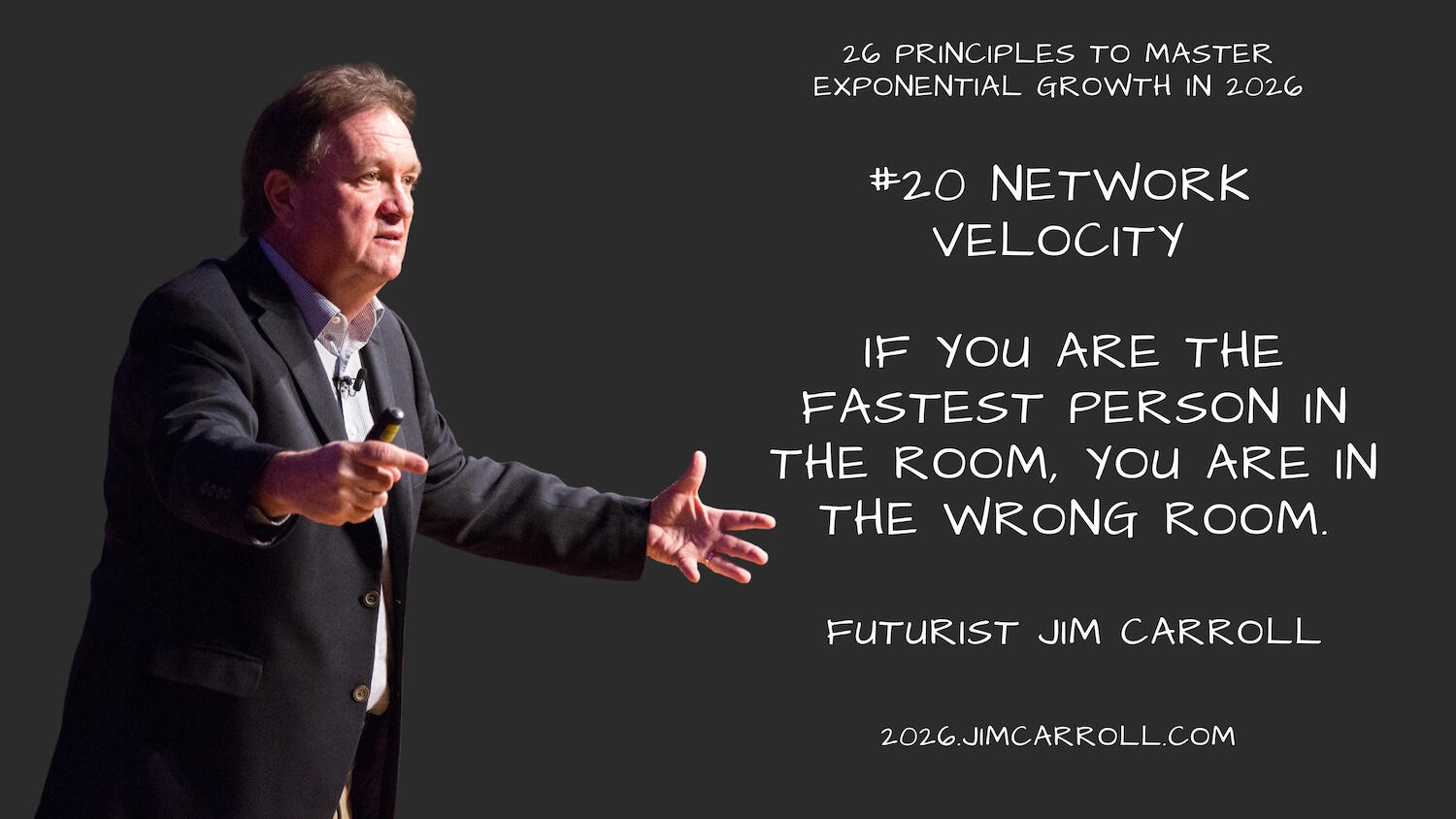
The 1987 editorial “Tomorrow’s Company Won’t Have Walls” stands as one of the most accurate corporate prophecies of the modern era.And it had a profound impact on my life.It’s probably fair to say that if I hadn’t read it, I wouldn’t have stepped out on my own to start my own company, chase my own career, do my own thing – and become a global freelancer, a nomadic worker, a lone wolf, long before the trend became real and the idea fashionable. Like I’ve said – I haven’t had a job for 35 years, and I work really hard to not have to get a job!It’s worth reading, because it predicted with precision the modern organization of today.“Tomorrow’s Company Won’t Have Walls”, New York Times, October 1987The hub of the network organization will be small, centralized, and local. At the same time, it will be connected to an extended network that is big, decentralized, and global. People from the network and from outside the company will join the group at the hub for periods of time and then leave it.But the network organization will also present its own set of paradoxes. For instance, how will these new organizations be able to manage the often conflicting interests of the centralized hub and the decentralized network? And how can a system that is both centralized and decentralized be unified and coordinated, and quick to respond to changes in the marketplace?For the global organization of the future, the ability to acquire new products, services, technologies, and capital will not be the problem. The marketplace is crowded with each of these as never before.But for exactly this reason, the challenge for each company will be to nurture its own unique culture and develop the quality of its human resources. That is because competitive advantage will rest increasingly in the way each network organization gathers and assesses information, makes its decisions, and then carries out those decisions.The 21st century will be full of organizational surprises. The challenge of arranging cooperative efforts between companies to achieve strategic gains is beginning to emerge. Changes in the marketplace have given companies from around the world the opportunity to develop these new linkages. Advances in telecommunications technology also enable companies to bring people together for a competitive advantage. The time has now come to form new global collections of companies, and to fully utilize human relationships.Think about where we are now: many organizations don’t define themselves by the depth of their staff – they do so by the reach of their skills network.But in 2026 and beyond, the sophisticated reach of a networked organization is not enough.It’s no longer about the reach of your skills network, but also the speed with which they operate.If they aren’t as fast as you, it will slow you down even further, stunt your progress, and ruin your ability to align with exponential trends.Here’s your chalkboard summary!
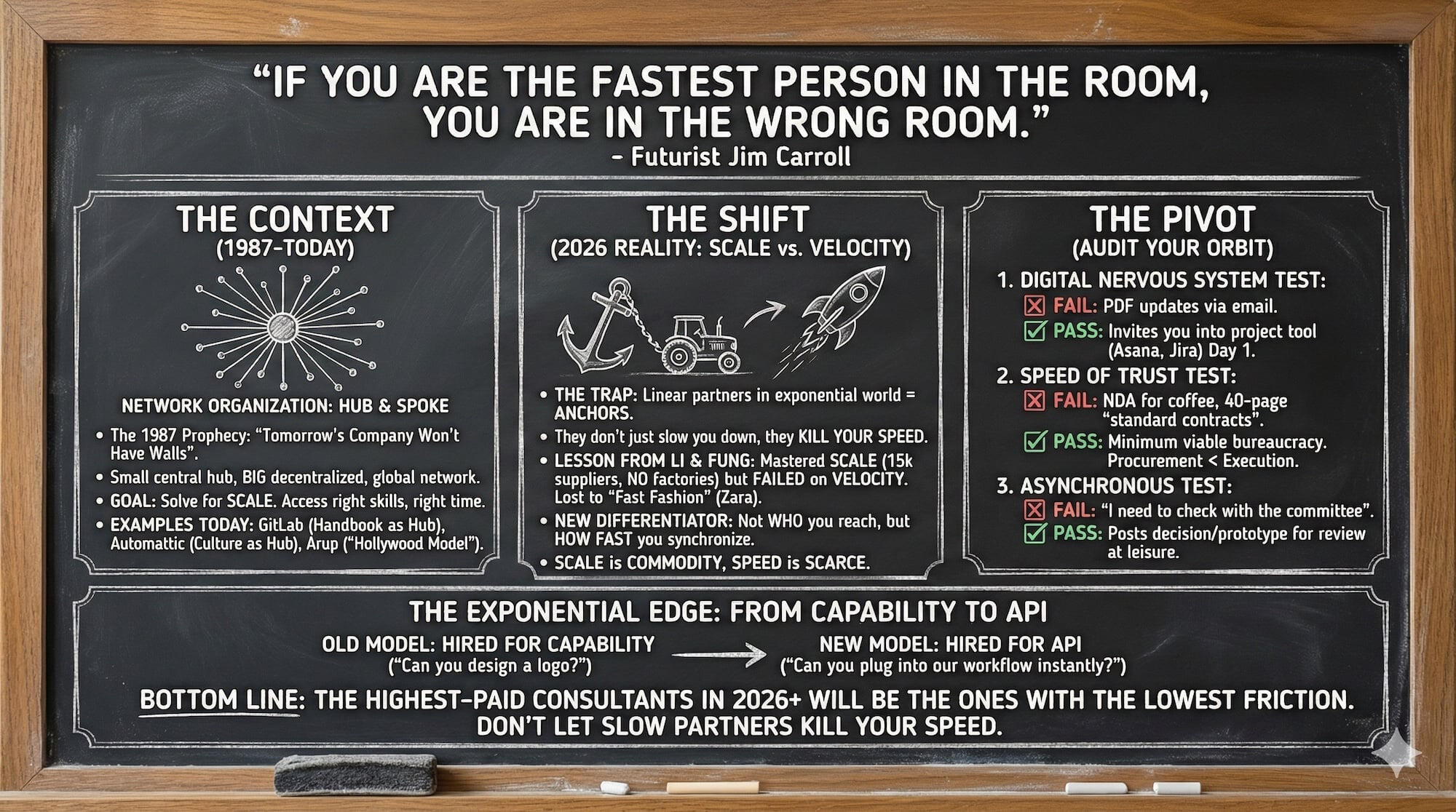
That’s why, in 2026 and beyond, you have to stop letting slow partners kill your speed.The Issue of Network VelocityWe are on Day 20. We have built your internal engine: You have the Unapologetic Uniqueness (Day 17), an Antifragile Mindset (Day 18), and Optionality Architecture (Day 19).Do those things, and you are getting ready for our exponential world.But as they say, “but wait, there’s more!” Now, we must look outside.You can have a Ferrari engine (your mindset), but if you are driving in a convoy of tractors (your partners), you are going to move at the speed of a tractor!
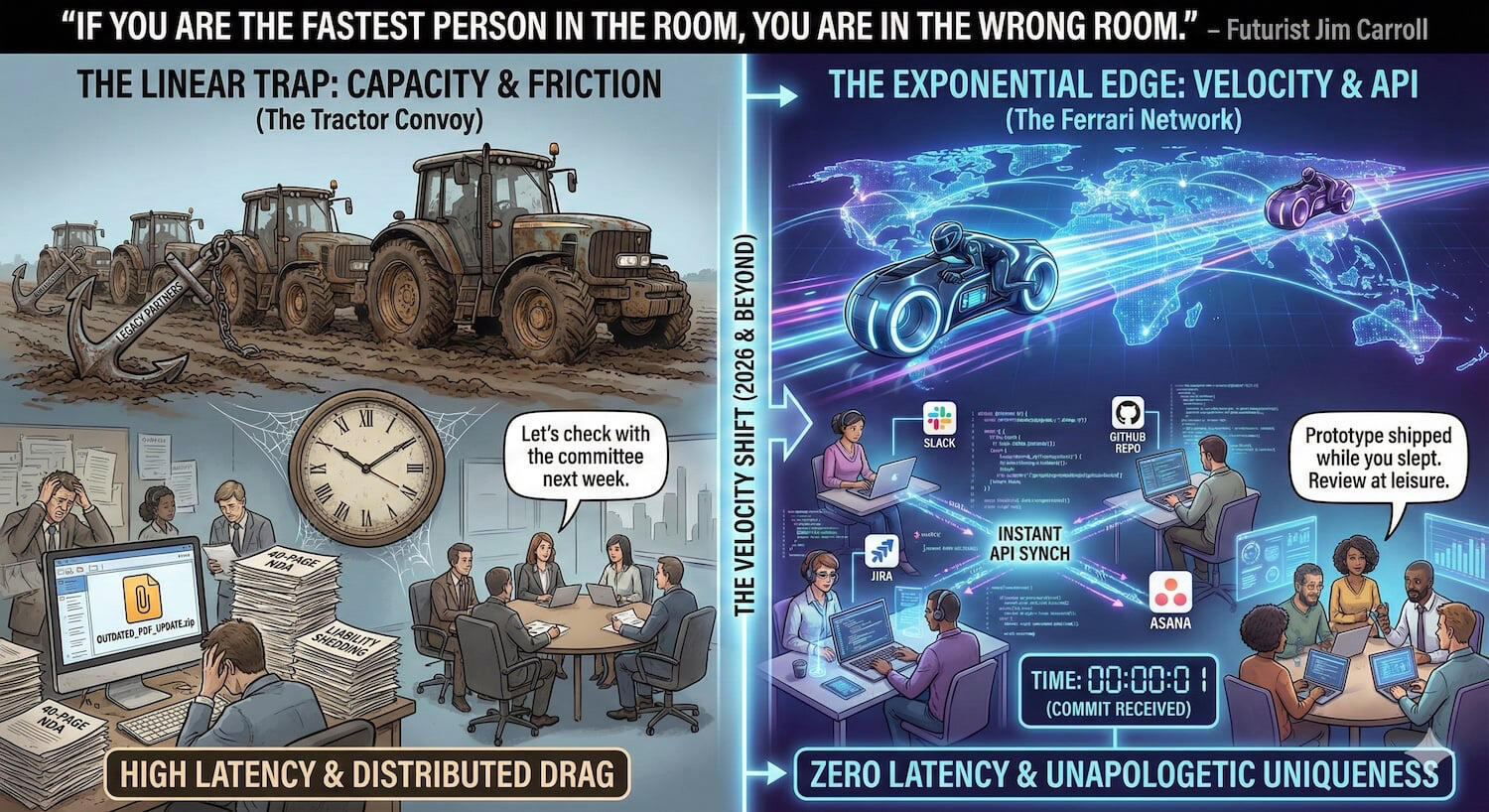
And here’s the thing about what this means to the networked organization, and perhaps your role in it as a freelancer: in a linear world, we picked partners based on stability, history, and comfort. We stuck with the vendor we’d used for 20 years because “they know us.”In an exponential world, loyalty to the past is a guarantee for failure. If your supply chain, your technology vendors, or your peer group are evolving linearly while the market accelerates exponentially, they aren’t just slowing you down.They are anchors.This means that another discipline you must master going forward is Network Velocity.The Networked Organization is No Longer a TheoryIt’s worth revisiting the idea of the networked organization to think about how it is now impacted by exponential speed. The New York Times article predicted a “wall-less company” where a small central hub would coordinate a massive, decentralized web of resources.That future has already happened. The most successful organizations today are structured exactly this way. And for many people, their career path as a global freelancer fits perfectly into this business model:
GitLab (The Handbook as Hub) This software giant operates as a fully remote company with team members in 60+ countries and no corporate office. Their “hub” isn’t a headquarters; it is a 2,000+ page public Handbook. This document acts as the single source of truth, replacing middle management with documentation. By forcing everything into text and code, they decouple their ability to scale from the need for physical oversight. Go take a look at the site – handbook.gitlub.com. That’s the heart and soul of the company right there.
Automattic (The Cognitive Orchestrator): The company behind WordPress employs over 2,000 people across 96 countries. Their “hub” is a shared digital reality and culture that coordinates global talent without physical boundaries, proving that “culture” is the only wall that matters in a digital firm.
Arup (The “Hollywood Model”): This global engineering firm operates like a movie studio. For massive projects like the Beijing Olympics, they assemble a temporary “hub” of specialists—structural engineers from London, acoustic experts from New York—who form a cohesive unit for the project and then disband.
This model works because it solves for scale. It allows a small core to leverage massive resources, scaling up and down as requirements change and as new skills and capabilities are required.It goes to the heart of one of the key trends that I often talk about: the future of every organization comes from the ability to access the right skills at the right time for the right purpose. Your role as a freelancer? Providing those skills – but now – just in time!The Master of Scale: A Lesson from Li & FungTo understand the power—and the danger—of this model, we have to look at the original master of the network: the Hong Kong trading giant Li & Fung. It’s a good lesson as to why the speed of the network now matters more than ever before.For decades, Li & Fung was the ultimate “network orchestrator.” They didn’t own factories; they owned the process. They would break a single garment down into steps: spinning the yarn in Pakistan (for cost), weaving it in China (for capacity), and stitching it in Vietnam (for labor rates). They managed 15,000 suppliers without owning a single needle.How did they keep this massive, decentralized beast from collapsing? They invented the concept of “Little John Waynes.“They broke their central trading hub into small, autonomous cells. The leader of each cell—the “Little John Wayne“—acted like an independent entrepreneur running their own small business within the giant group. They had total autonomy to serve their specific customers, giving the massive conglomerate the “local feel” of a small shop.It was brilliant. It solved the problem of size. They mastered scale. They could get the right skills and the right partner at the right time…..But it failed to solve the problem of time. A faster world!As the world moved from “seasons” to “fast fashion,” Li & Fung’s analog network of phone calls and relationships became too slow. They had the biggest network in the world, but slow speed began to kill them. They began to lose out to fast-fashion movers like Zara. They couldn’t compete against the weird new networked world, which involved an influencer posting a picture of some new outfit on Instagram, and a series of small Chinese factories beginning to produce knockoffs within hours for shipping the next day.This is the world of exponential change, and where we will find ourselves in 2026 and beyond!The Freelancer ImpactLet’s spin into this, a key component of this global network – you. Your skills. The freelancer. The person who makes their skills available to a global economy.If you are this person – a freelancer, a nomadic worker offering your skills to this globally outside world – you now need to work at a new and different speed. You need to be fast. Stunningly fast!Why? Because in the 1987 model, you were “outsourced help.” In the 2026 model, you need to be part of a faster machine.The client isn’t hiring you to “add capacity” (they can get that from a junior employee). They are hiring you to inject velocity. They are paying a premium because they believe you can do in 4 hours what their internal team takes 4 weeks to approve.If you are slow to respond, slow to onboard, or slow to deliver, you aren’t just annoying; you are breaking their value proposition.The data proves this shift is already here. High-value freelancing is no longer about junior talent “gigging” between jobs. Today, 72.8% of fractional professionals have 15+ years of experience. These are seasoned executives who operate as autonomous, high-speed units. They win not because they are cheaper, but because they have zero “latency.’ They know how to operate at speed.If you treat your freelance business like a traditional 9-to-5—with “I’ll get back to you next week” energy—you are acting like a linear component in an exponential machine. The system will reject you.If you can’t provide the right skills at the right time, you’re toast! Your freelance opportunities will be over.The Velocity Trap: Why Scale Is No Longer a MoatAnd so, with all that in mind, here’s where we are in the context of that 1987 article: many organizations discovered the power of scale through partnership. They won the war on “walls.” But they are now losing the war on time.In the era of 2026, scale has become a commodity, but velocity has become scarce.Here is the brutal reality: Access to a “massive global network” is no longer a competitive advantage. Everyone has access to Upwork, AWS, Alibaba, and ChatGPT. The differentiator is no longer who you can reach, but how fast you can synchronize with them. If you have a network of 1,000 partners, but it takes three weeks to get a decision, you don’t have a network; you have a bureaucracy that spans multiple time zones.You have replaced “corporate bloat” with “distributed drag.”The simple fact is this – in an exponential world, organizations now need faster partners. To be a partner, you need to be faster than everyone else!In 2026, network scale has become a commodity. The new scarcity is Velocity.1. The Exponential MindsetWe spent the last thirty years dismantling vertical silos and replacing them with horizontal networks. But what has been lost is speed. We’ve replaced old bureaucracies with new ones – because we let our partners show us down.The brutal reality is that access to a “massive global network” is no longer a competitive advantage. Everyone has access to Upwork, AWS, and ChatGPT. Everyone can access new skills on a dime. The global freelance economy is bigger than ever before – read the previous post. We are closer than ever to the goal I often share – “our success comes from our ability to access the right skills at the right time for the right purpose.” Aka just-in-time knowledge.But going forward, the differentiator is no longer who you can reach, but how fast you can synchronize with them.Think of it this way: if your partners can not operate as fast as you, you are running a race with a slow team2. The Linear TrapTo understand the danger of the old model, look at what happened to Li & Fund, the original master of the skilled network.As the world moved to “fast fashion,” their analog network of phone calls and relationships became too slow. They had the biggest network in the world, but slow speed killed them.The simple fact is this: you cannot have an exponential strategy with a linear network. If you are running an AI-driven business model but your legal counsel takes two weeks to review a prompt, your “scale” is irrelevant.You are stalled.And doomed.3. The Exponential EdgeWhen you prepare for Network Velocity, you unlock the secrets to the new style of “companies without walls.”In the past, you were hired for your Capability (“Can you design a logo?”). In 2026, you will be hired for your API (“Can you plug into our workflow instantly?”).For the independent worker or the agile firm, this means the difference between a Linear Partner (who sends an email, asks for a meeting, deliberates) and an Exponential Partner (who grants access to the GitHub repo, tags you in the tool, links you into Slack, and expects the commit by 5:00 PM).Bottom line? The highest-paid consultants in 2026 and beyond won’t be the ones with the most experience; they will be the ones with the lowest friction.4. The Immediate PivotYou need to audit your orbit! Take a look at your network! Figure out if your skills and partnership network are fast enough, or falling behind. If you freelance, you need to check your speed.Speed is easily faked. Every potential partner will claim to be “agile.”In the sales pitch, everyone looks like a Ferrari. It is only when you get on the highway that you realize you hitched your wagon to a tractor.You need to do an audit.So let’s jump there!The Velocity Audit: How to Spot a “Ferrari” PartnerHere is your 3-point inspection checklist to judge if a partner can keep up with your 2026 trajectory.The “Digital Nervous System” Test (Metric: Information Latency)
The Question: Does this partner communicate via APIs and shared platforms, or via email and meetings? Are they a Slack organization, or are they still using Microsoft Office?
Fail: A partner who sends you a PDF attachment of a project update that is already 24 hours out of date.
Pass: A partner who invites you into their project management tool (Asana, Monday, Jira) on Day 1. In a digital ecosystem, email is the new snail mail.
The “Speed of Trust” Test (Metric: Transaction Costs)
The Question: How much legal and bureaucratic “tax” do I pay to start working?
Fail: A partner who requires an NDA to have a coffee, or whose “standard contract” is 40 pages of liability shedding.
Pass: A partner who operates on standard, clean agreements and focuses on the idea of “minimum viable bureaucracy.” If the “Procurement” phase is longer than the “Execution” phase, walk away.
The “Asynchronous” Test (Metric: Decision Autonomy)
The Question: Can they make progress while you are sleeping?
Fail: The partner who says, “I need to check with the committee.”
Pass: The partner who posts a decision or a prototype for you to review at your leisure. You want partners who care more about the outcome than the ownership.
Here’s what I know – I experience slow organizations regularly. My wife and I know when an organization is stuck in a slow lane – they take our 3-page simple speaking contract, and layer on top of it 40 pages of legal addendum. They view a simple one-hour speaking gig as a 40,000-hour consulting contract, with IP ownership and other clauses as part of the deal. They end up paying our deposit via credit card because they can’t figure out how to get us into their ERP system. (American Express actually did this once, via Amex, and we still have a good laugh about that!)And the running joke with all of this is that they’ve booked me to do a leadership keynote on speed and agility – and don’t realize how massive a hill they have to climb!For 2026 and beyond? Their world is going to be ‘interesting.‘Because in an exponential world, you can’t be a slow partner in a fast world!
#21 Signal Intelligence
Your new challenge isn’t finding the insight – it’s filtering out the noise
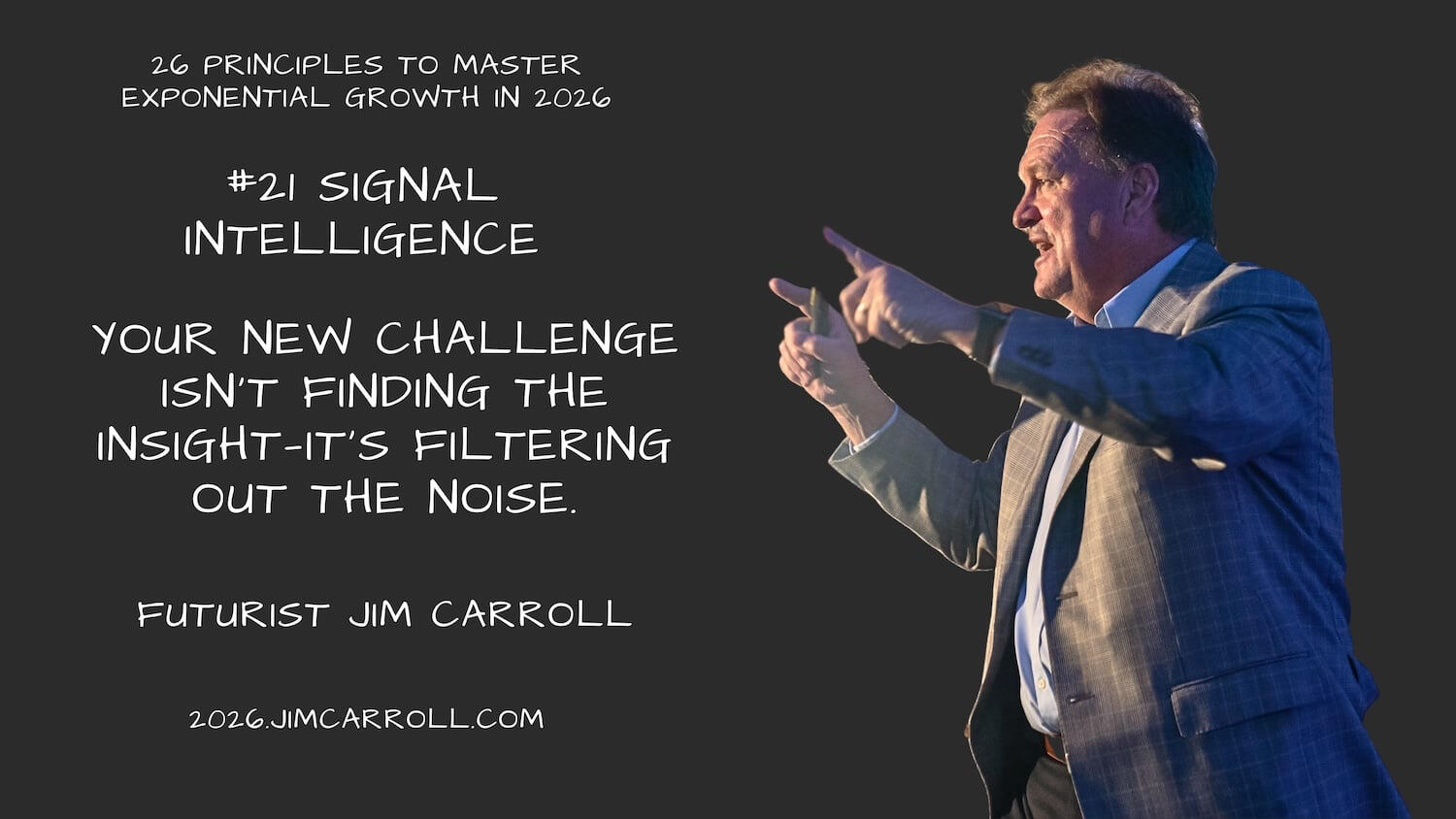
It used to be that the problem with the information age was that there was too much information.That’s changed.The new problem is now that not only is there too much information, but much of it is crap. And pretty soon, most of it is going to be crap.That means one of the most important skills you need to develop in the information age is how to sift through the noise, to find what really matters. Finding the gold amidst the crap matters.Simply put, enhancing your ability to weed out reality from unreality, facts from the unfactual, the gems amidst the wreckage – this is what will move you forward into the future. I’m not talking only about the misinformation and disinformation machine that has roiled our world, but the new megainformation machine that is AI that is emerging.All of us are on a unique voyage into this strange new world, and as I often like to say: “We don’t know where we are going, but we are making great time!'” In a world of infinite noise, the ultimate competitive advantage is not what you pay attention to. It is what you choose to ignore.Here’s your chalkboard summary!
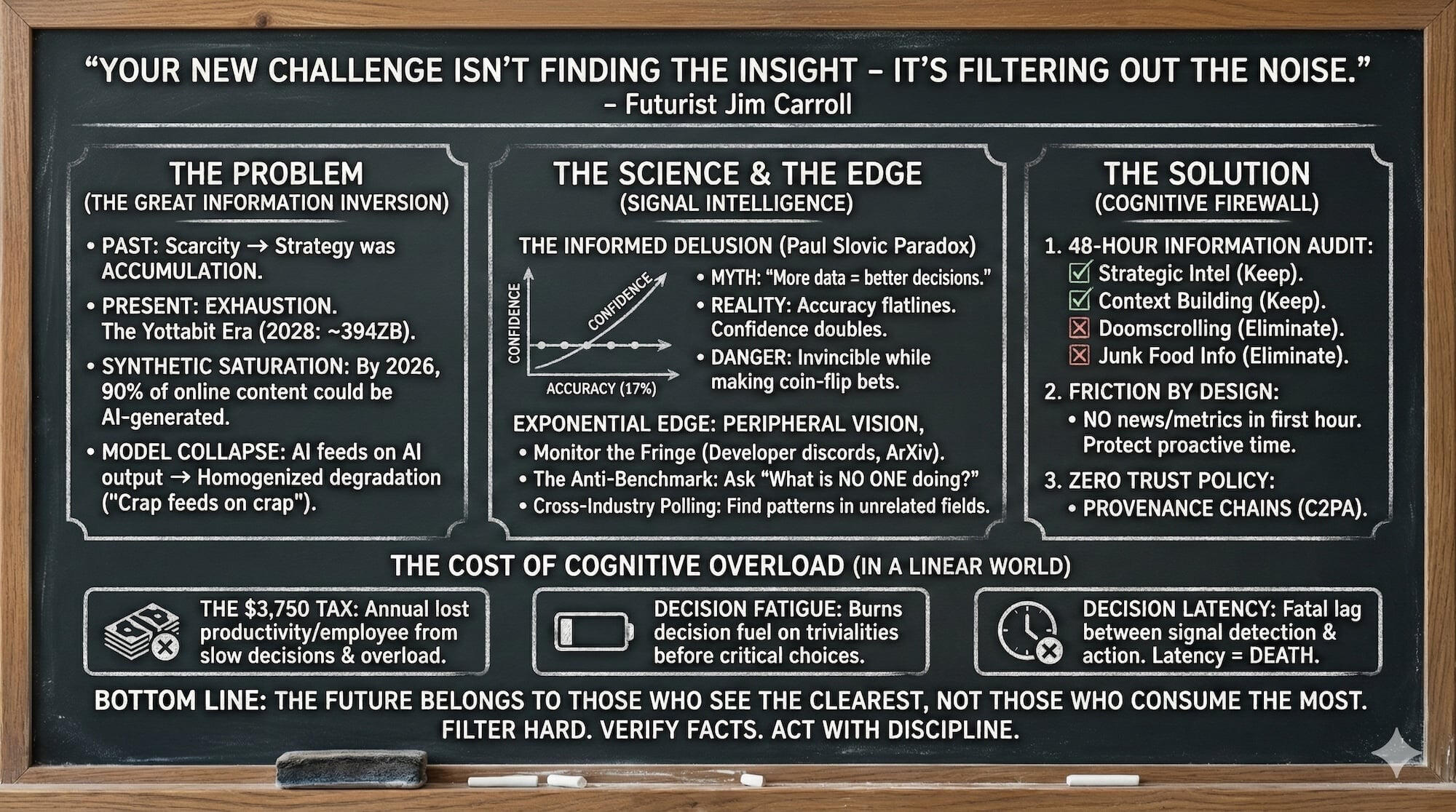
It’s not lost me on that I’m using AI to tell you about the problems of AI! The very idea of the chalkboard summary, you find the challenge of our future – any complex idea, and long treatise, any deep exploration of a topic – can now simply be reduced in moments to small, digestible chunks, information-hits that we soak directly into the veins of our brains in a rush of insight chasing.It’s weird, isn’t it?And how do we know it’s right?We are on Day 21. You have stripped away the mediocrity (Day 17), embraced the chaos (Day 18), built your options (Day 19), and upgraded your network (Day 20). Now, we must upgrade your eyes.Now we need to think about Signal Intelligence: aka the art of ignoring in order to see. Success no longer depends on acquiring more information. It depends on ruthlessly filtering noise.The Great Information Inversion: From Scarcity to ExhaustionLet’s put this challenge into perspective.For decades, the world of learning and knowledge was simple: Information was scarce, so the strategy was accumulation. In a business context, the leader with the most reports won; the researcher with the deepest research team had the advantage; and the individual who mastered speed-reading had a leg up on everyone.Then the Internet emerged, and we all began to learn about the strange new world of vast sums of electronic information. We taught ourselves to search. Then, as the volume of information grew, we began to graze. Finally, we began to rapid-scan.The “new reality” with AI now takes us into a world that is crazier than we think. We are facing the yottabit era. (I own the domains Yottabit.Net, Yottabit.com, and Yottabits.com, LOL!) The global datasphere is experiencing a form of exponential growth that defies human intuition. It isn’t just “more data,” it is a fundamental change in the density of our digital atmosphere, because not only will there be more of it, but much of it will be of dubious value.In that context, the math is unforgiving: If human cognitive capacity remains static while information doubles every few years, the signal-to-noise ratio collapses. Our brains can only take in so much. We feel overwhelmed. We don’t know where to start, and don’t know what to look up. Not only that, we have no idea what’s real and what’s not.This means that the challenge isn’t finding insight anymore. It’s filtering the overwhelming flood of synthetic noise to avoid exhaustion.The AI Information ExplosionAnd boy, are we ever going to become exhausted!In 2018, the world was managing approximately 33 zettabytes of data, a volume driven largely by the initial maturation of mobile computing, social media usage, and the migration to the cloud.However, that baseline has been rapidly surpassed. By the time we look toward 2028, global volumes will increase to nearly 400 zettabytes.
2018: ~33 Zettabytes (Driven by mobile computing, social media, and cloud migration)
2022: ~97 Zettabytes (Accelerated by pandemic digitization, video streaming, and IoT sensors)
2025: ~181 Zettabytes (Fuelled by Generative AI, 5G deployment, and real-time analytics)
2026: ~230–240 Zettabytes (Rising due to synthetic media, autonomous systems, and edge computing)
2028: ~394 Zettabytes (Projected reach via humanoid robotics, 6G networks, and quantum data)
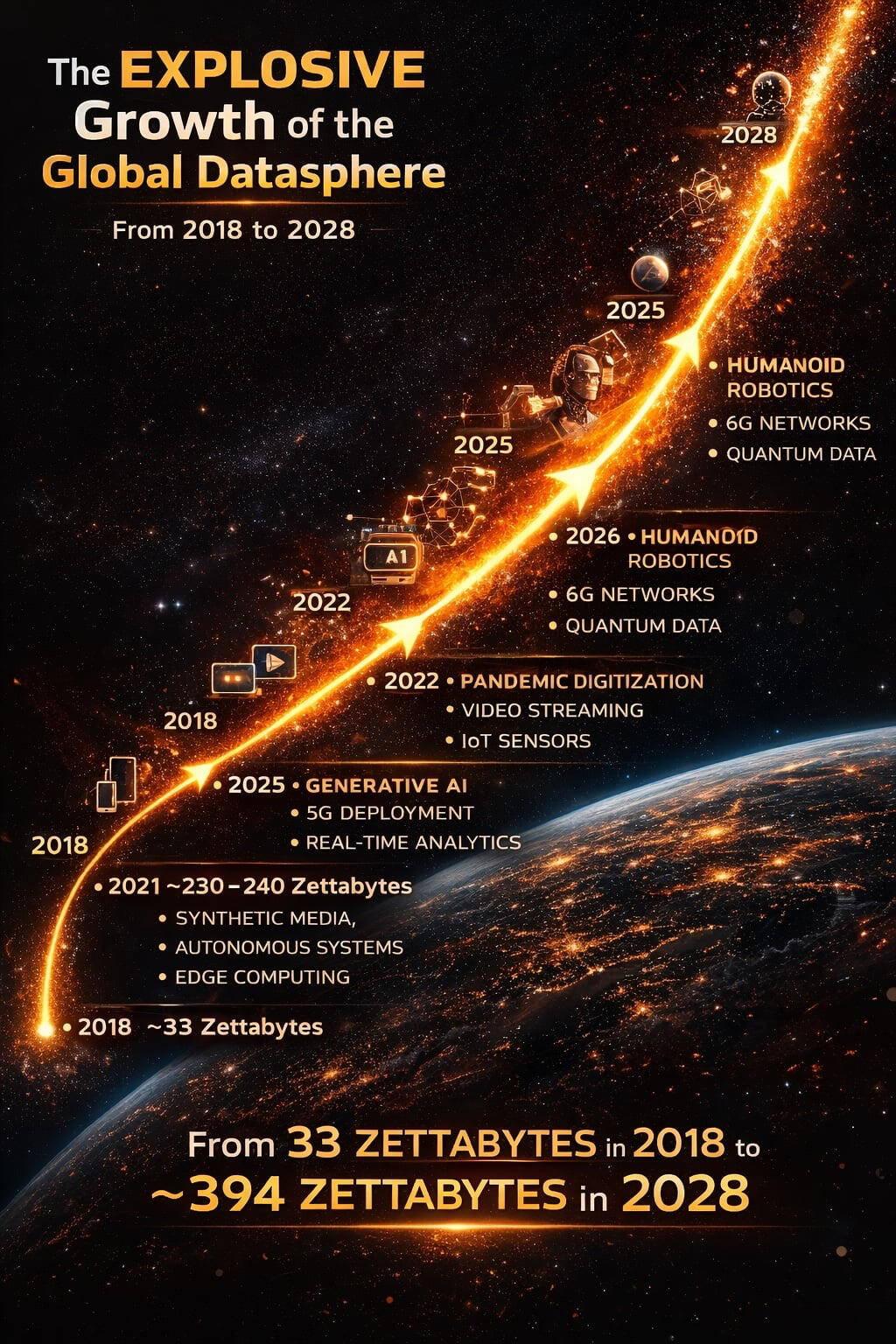
Not only is there too much information, but much of it will not be real. It’s called Synthetic Saturation.
The 90% Threshold & The Dead Internet. By 2026, as much as 90% of online content could be synthetically generated – thrown at us by all that massive emerging AI infrastructure.
“The Dead Internet Reality.” What this means is that everything will not be real. Already, nearly 50% of internet traffic comes from automated bots. Executives relying on “social sentiment” are risking their strategy on bot hallucinations rather than human behaviour.
Model Collapse. It’s not just about fake news; it’s about degradation. As AI models ingest content generated by other AIs, outputs become homogenized and detached from reality through recursive degradation. Crap feeds on crap, festering in putrid piles of information crap.
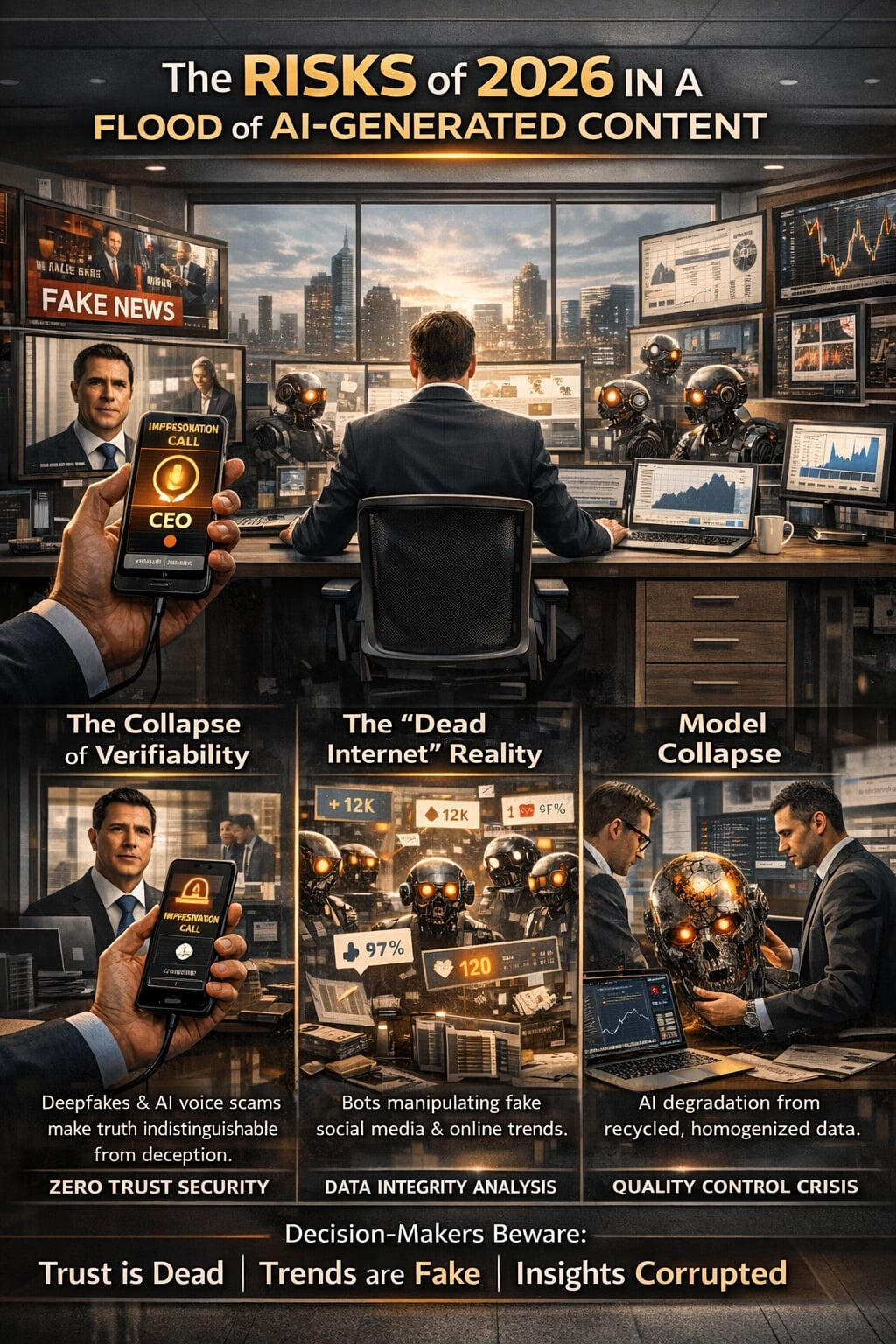
Did I mention that the fact that I am using AI to generate an image to tell you about the risks of AI is not lost on me?But here’s the thing: as organizations adopt identical AI tools to filter this information, a dangerous phenomenon emerges: algorithmic monoculture. Think about what is already happening in HR – people are using AI to try to make their resumes look better. At the other end, HR departments are using AI to try to sift out the flood of applications. Machines talking to machines, as it were. The same AI systems are being used to generate content and to screen through that content. What does it mean? To find Alpha (value above average), you must look where the algorithm isn’t looking!The cartoonist Tom Fishburne has a brilliant take on where this is taking us – and what is probably already happening!
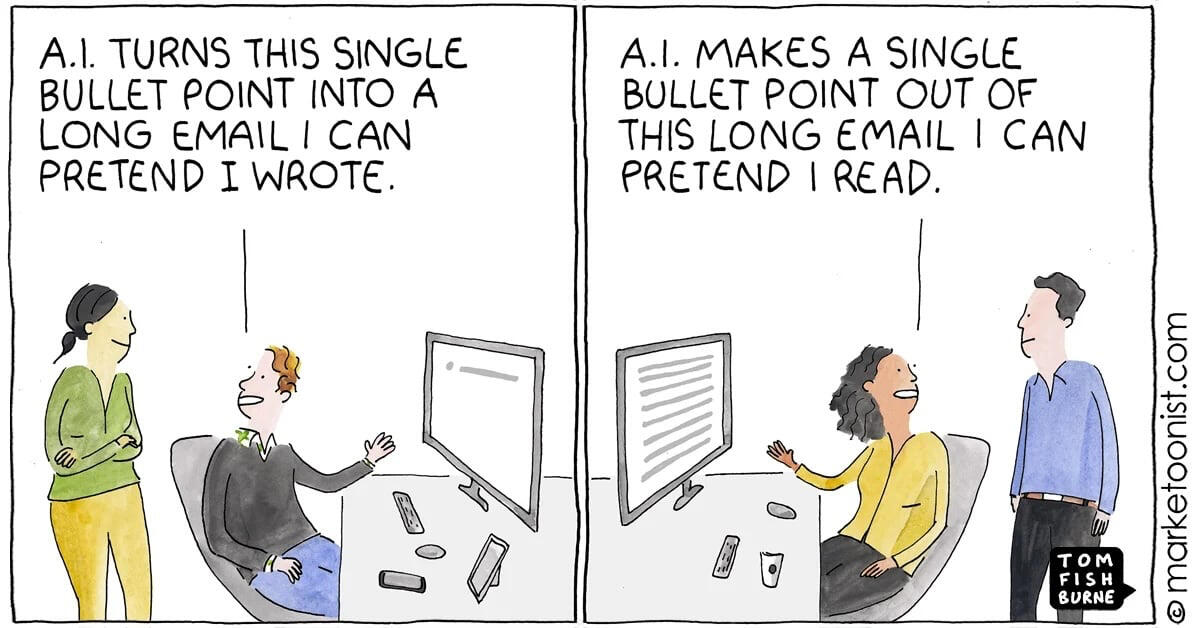
The Informed DelusionAs all of this unfolds at a stunning speed, you need to know something important.More data doesn’t make you smart; it makes you more stupid!That’s not intuitive. Many people try to solve this problem of living in the information age by consuming too much information. They believe the dangerous myth that “more data equals better decisions." Researchers call this The Informed Delusion, and they have scientific proof!Psychologist Paul Slovic’s classic study on horse race handicappers reveals exactly what happens. Slovic gave professional handicappers increasing amounts of information across four rounds: 5, 10, 20, and 40 data points per horse. The results exposed what is known as the Paul Slovic Paradox:
Accuracy flatlined: With 5 data points, accuracy was 17%. With 40 data points, accuracy remained… 17%. The extra data didn’t improve predictions at all!
Confidence doubled: While accuracy stayed flat, the handicappers’ confidence in their bets nearly doubled as they consumed more data. The more information they had, the better they thought they were doing – but there was really no improvement at all! And in fact, things became worse with increasing amounts of information.
The implication for you is brutal: Pursuing “more data” beyond a critical threshold doesn’t improve your foresight—it only increases your belief in the validity of what you see. You feel invincible while making bets no more certain than coin flips. And in the context of what is coming at us with the AI tsunami, the results will be fatal unless we can take on the paradox.That’s why developing the discipline of Signal Intelligence is so important. All of us need to develop the disciplined capability to detect, verify, and act upon weak signals of change amidst synthetic noise.It is the prerequisite for maintaining network velocity and optionality in 2026.1. The Exponential Mindset: The Cognitive FirewallHere’s what you need to know: you now exist in an attention economy where the dominant business model is harvesting and reselling your focus. Social media is designed to feed you outrage.The algorithm isn’t giving you what’s useful -it’s sending you stuff that makes you mad.It’s really an adversarial system that is designed to trigger your outage and to exploit your psychological vulnerabilities. In this emerging new world, not only will it make you madder, but there is going to be even more of it to make you madder. That’s why you must think about the idea of building a cognitive firewall. It’s your defense against neuro-phishing and attention hijacking. It is a set of rules designed to engage your analytical “System 2” thinking and bypass your reactive “System 1” thinking. The Exponential Leader treats “outrage,” “hype,” and “breaking news” as malware, protecting their attention as a sovereign resource.Not only that, but you have to teach yourself to search differently. AI search tools are obviously powerful, useful machines. But have you experienced hallucinations, AI systems apologizing to you after you’ve called them out for feeding you false information? Have you come to rely too much on what you see and not enough on determining what might be real?Our ability to sift through the noise to find the nuggets will be an absolutely critical part of our exponential mindset.2. The Linear Trap: Chasing Strong SignalsThe problem? Most of us have been living in a linear world. While the Internet has become a part of our lives, we’ve become used to the slow and steady growth of the information available to us. We’ve become proud of our ability to search, to learn through what we find online. But we really have no idea what’s coming in terms of the volume of information coming at us. Go back and read the information about zettabytes. Why do you think I bought Yottabit back in 1999? Because I knew what was coming.Not only that, but it's the speed with which all this new synthetic information is coming at us.And the reality is, there’s a cost to cognitive overload. People using 2020 methodologies in a 2026 world to manage this flood will be effectively blind. The costs are not just psychological; they are financial.
The $3,750 Tax: The estimated annual cost per employee in lost productivity from making slow decisions and information overload.
Decision Fatigue: Filtering low-value information tired us out. By the time we face critical choices, their decision fuel is burned on trivialities. I wrote about this in a post some time back. The issue is real.
Decision Latency: The desire to process incoming floods creates a fatal lag between signal detection and action. In exponential trends, latency means death.
History already shows us we do a lousy job at filtering out information. Consider the Metaverse Hype Cycle of 2021-2022 – a powerful warning against confusing noise with signal. The hype was deafening—a strong signal generated by PR and FOMO. Companies bought virtual land for millions.But Signal Intelligence would have looked for the user signal: retention rates and daily utility. These were absent. The noise was high; the signal was zero. Companies that exercised Hype Immunity saved billions.Now imagine a world in which a global hype machine is selling you a big idea, a massive megatrend, a fascinating future – and it’s coming at you so fast, you simply can’t make the right decision – because your mind is wired into a 2020 world in a 2026 reality.Ugh!3. The Exponential EdgeWhat I’m trying to lead you into here is that you need to develop the ability to see real trends among the signals. To do that, you need to perfect your skill of Peripheral Vision. That’s learning how to see what matters, and discarding the rest. Here are a few ideas:
Monitor the Fringe: Innovation begins in fringe communities. Study developer discords, academic pre-prints on ArXiv, and “weird” internet subcultures.
The Anti-Benchmark: Instead of asking “What is everyone doing?“, ask “What is no one doing?“. This protects you against Algorithmic Monoculture.
Cross-Industry Polling: A logistics CEO studying the biology of mycelium networks might discover new routing efficiency models. Yes, that’s a thing – I’ve written about that as a trend option. Look for patterns in industries with no obvious connection to yours.
4. The Immediate Pivot: Protocols for Day 21So what do you do? You must move from “Information Accumulation” to “Signal Detection.” Here are a few ideas.An information audit. You cannot manage what you do not measure. For 48 hours, log every piece of information you consume (emails, news, feeds). Categorize them using a matrix:
Strategic Intel (High Signal/High Action): Keep and prioritize. This is where decisions happen.
Context Building (High Signal/Low Action): Useful for understanding, but doesn’t require immediate response.
Doomscrolling (Low Signal/High Emotion): Political outrage, manufactured controversy. Eliminate immediately.
Junk Food Info (Low Signal/Low Action): Algorithmic feeds, viral content. Eliminate to reclaim attention.
Build yourself an information firewall. Implement these specific rules to stop the hijacking of your attention.
Friction by Design: Deliberately introduce friction. Never check metrics or news in the first hour of the day to protect proactive cognitive time.
The Prebunking Layer: Train yourself to recognize manipulation patterns (emotional triggers, urgency traps) before engaging with content.
The Diogenes Stance: View attention as a finite resource to be fiercely protected, not spent.
Learn more about verification in the age of deepfakes. Have you noticed how quickly sophisticated video from AI is now completely indistinguishable from reality? Deepfakes are no longer theoretical; they are mainstream.
By 2026, 66% of cybersecurity professionals report dealing with deepfakes regularly. You must adopt a Zero Trust policy for unverified digital content.
Provenance Chains: If a critical file lacks a provenance chain (like C2PA), treat it as synthetic until proven otherwise.
Triangulation: Never act on a single digital source. Require corroboration from distinct, non-correlated channels.
Our world will be flooded with AI content, so information verified by real humans will become rare and more valuable. A heavy reliance on AI will weaken our critical thinking, so we need to work harder to think clearly on our own. Our choice is simple: get pulled into noise and constant reaction, or focus on the signal by filtering hard, verifying facts, and acting with discipline!The future?It doesn’t belong to those who consume the most.It belongs to those who see the clearest.
#22 Boundary Divergence
Don’t stay in your lane. The future is happening in the blur between the lines.
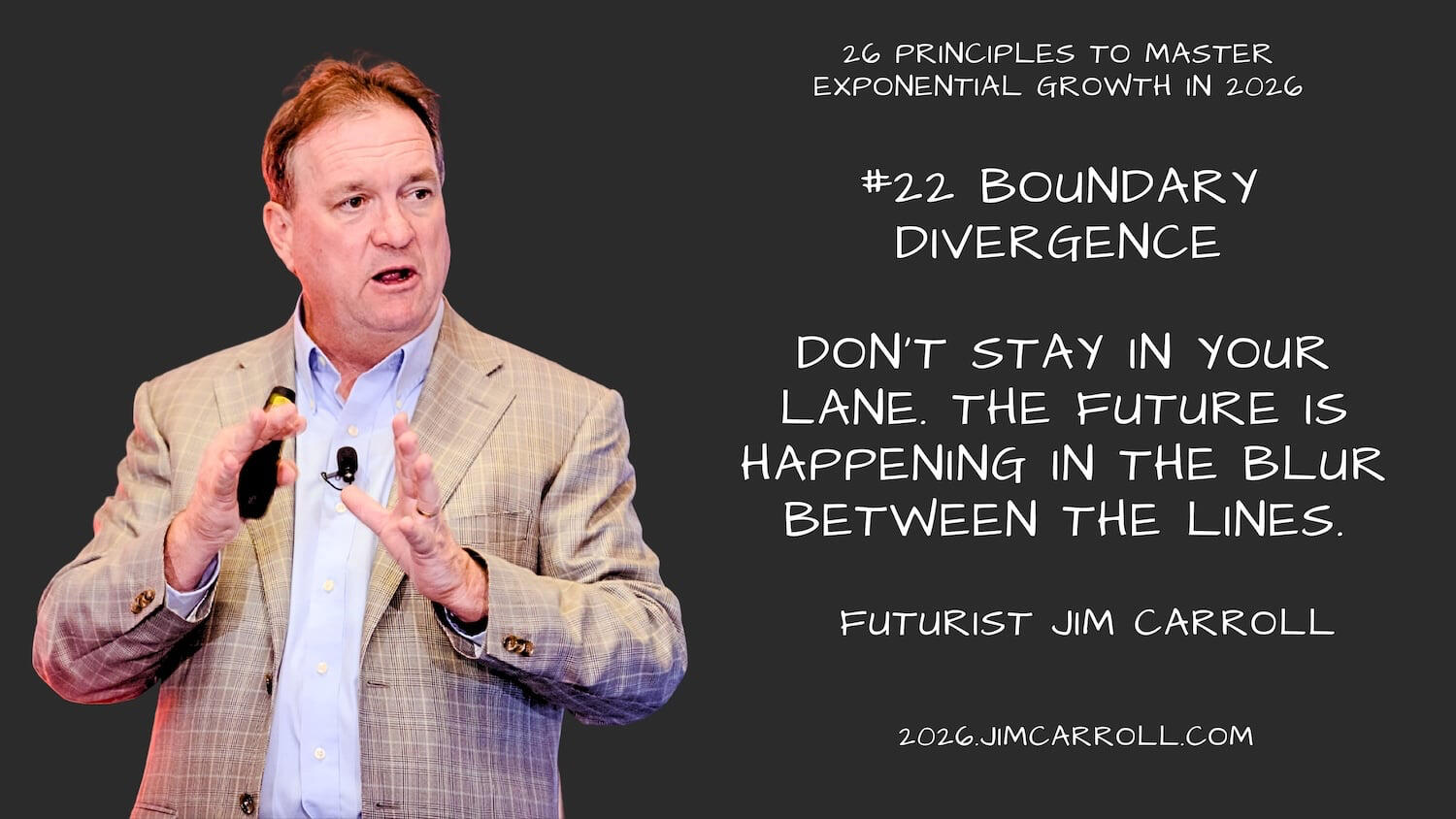
We are on Day 22. You have built the engine (Day 17), fuelled it with an anti-fragile mindset (Day 18), mapped your portfolio of options (Day 19), and opened your eyes to the road ahead (Day 21).But here is the problem: You are still driving as if the old road signs exist!This trend is easy to understand but difficult to comprehend.Here’s what’s going on. In a linear world, we had “industries.” Banks were banks. Car companies built cars. Hospitals treated patients.Competitors were the people who sold exactly what you sold.In an exponential world, these definitions are disappearing – because the boundaries that define an industry are disappearing. Why is that? Because the things that defined an industry were some very strict barriers, and a lot of ‘friction‘ was involved to try to do anything. Today, with faster trends, technology, and AI, those barriers are disappearing because ‘friction‘ is being eliminated.Technology is not just speeding things up; it is melting the walls between sectors. If you define yourself by your “industry,” you are already obsolete, because your biggest threat – and your biggest opportunity – is coming from outside of what you define it to be. From a personal career perspective, this has pretty profound implications – because if you are an ‘expert’ in a certain industry, what happens to you when the industry begins to blur?The discipline you must master in 2026 and beyond is Boundary Dissolution.Here’s your chalkboard summary!
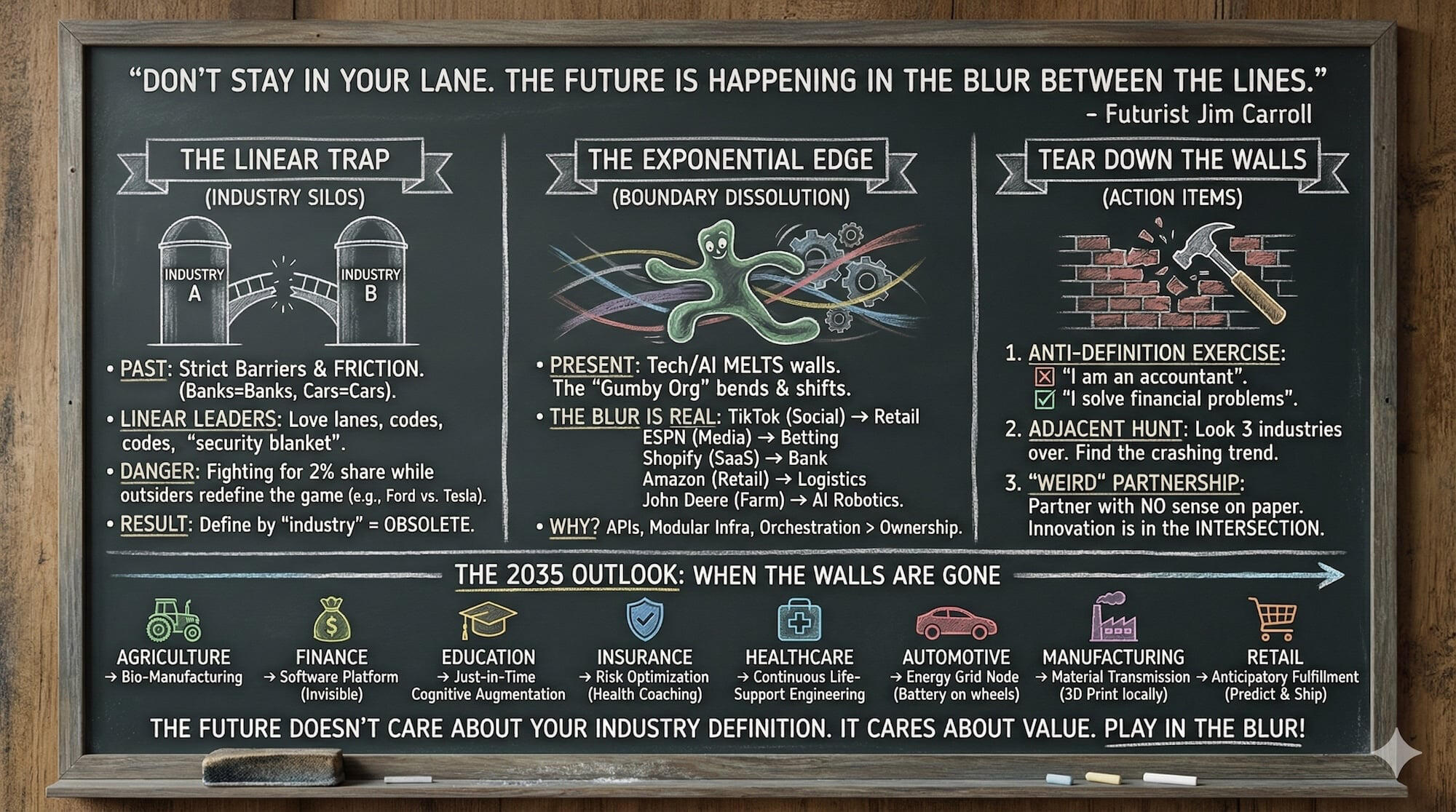
Why are the walls between industries crashing down?It goes back to the “Tomorrow’s Company Won’t Have Walls” idea – the new corporate structure allows companies to bend and shape, mold and modify, shift and change. We are moving from firms as closed, industry-defined “things” to firms as cross-sector systems that route data, payments, identity, logistics, and care across different partners at high speed.To do a lot of these, they are hiring the people who are experts at the career pivot – people who bring a broad range of skills across a vast number of different knowledge areas who have worked and can work in multiple different industries.The new leader of the future is Gumby!
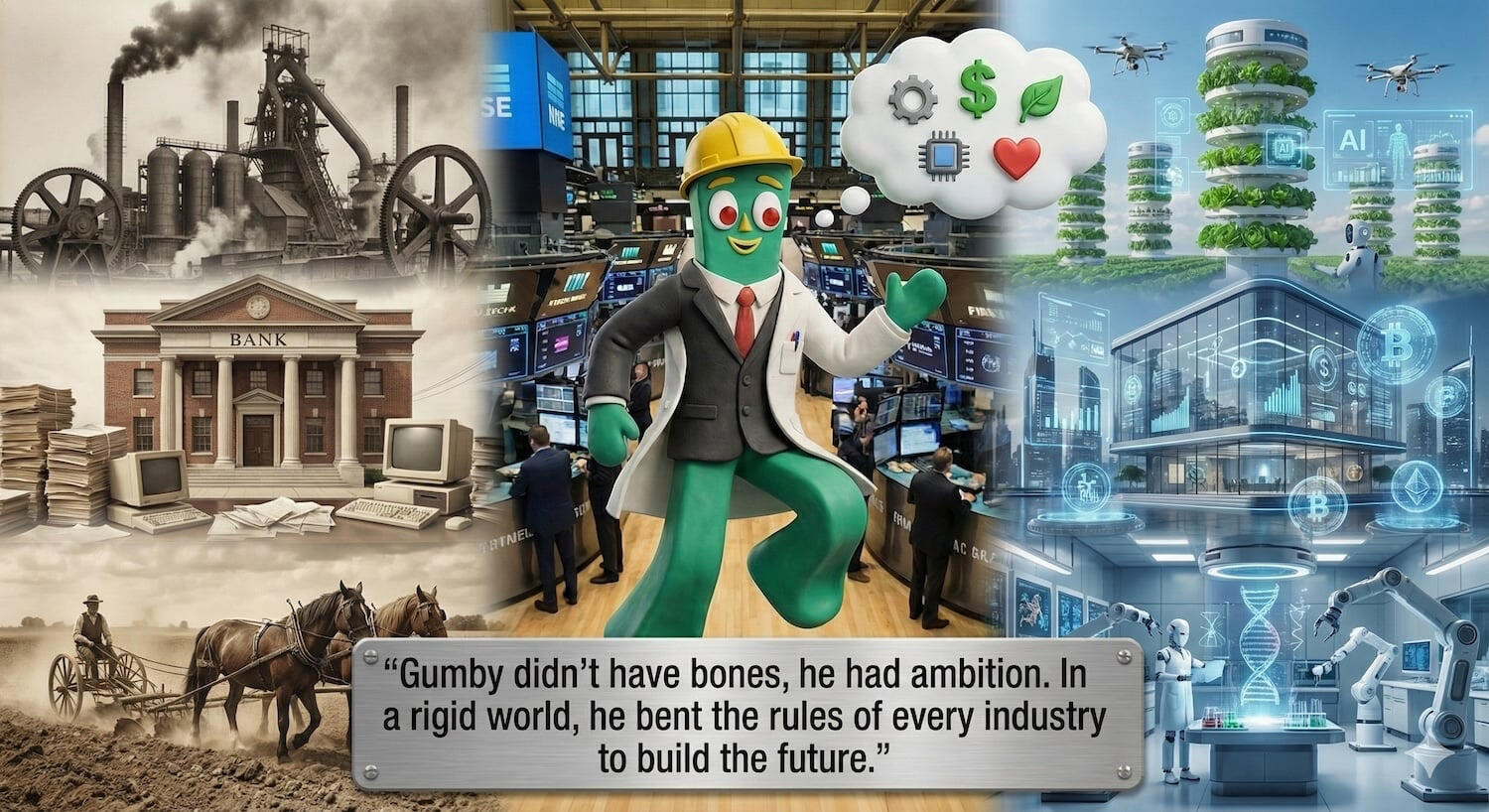
He or she doesn’t have bones, but they have ambition. And in a rigid world, they bend the rules of every industry to build the future.The Evidence: The Blur is Real!Don’t take my word for it. Look at what is happening right now among the world’s biggest players.
A social platform has become a retailer. With TikTok Shop, TikTok isn’t just a media feed anymore; it’s a marketplace with in-app checkout and logistics. They dissolved the boundary between a social media network or a “marketing channel” and a “storefront.”
A sports network became a wagering infrastructure: ESPN is moving betting from a separate app toward direct integration. That’s “broadcast” merging into “transactional entertainment.”
A software company became a bank: Shopify Balance is a financial account embedded inside the merchant OS. That’s “SaaS” merging into “business banking.”
An online retailer became a logistics hub: Amazon is the ultimate Gumby. ‘Buy with Prime’ lets merchants outside Amazon use Prime-style fulfillment. Retail distribution has become a service layer for the broader internet.
An industrial automation firm became an AI ‘stack’: Siemens is expanding a partnership with Nvidia to create “industrial AI,l” providing sophisticated new industrial, smart equipment for the manufacturing sector that isn’t just hardware, but a full industrial operation system.”
A farm equipment manufacturer became an AI robotics company: John Deere bought a technology company called Blue River. A business model that involved pretty basic “see and spray” technology is now quickly pivoting into a real-time machine vision tech company.
Why is this happening now?Technology, AI, and bold thinking
APIs provided an opening. “Application programming interfaces” allow the tech of one company to ‘talk’ to the tech of another company. This allows for companies to plug into each other, which smooths the way for straying out of one’s lane. Want to be a life insurance company that offers real-time healthcare underwriting? Use an API to plug into the real-time health data of an online, real-time health care platform that someone uses to monitor their vitals. You don’t need a five-year merger strategy; you need an API key.
Modular infrastructure makes “buying” cheaper than “building.” Embedded finance, “Prime-like” fulfillment, and industrial AI partnerships all exist because the underlying methodologies and API’s are now buyable, composable services. Want a sophisticated real-time delivery and logistics system? Fill out a form online, and implement some code. Boom!
Online defines interaction. TikTok turns interaction and attention into a checkout process. ESPN turns fandom – people watching live sports – into instant bets. The interface is the marketplace.
The winning design is orchestration, not ownership. Orchestration is a pretty fancy word for coordination. The future belongs to those who know how to plug into all this new, fast-emerging infrastructure and make the most of it!
What happens when the walls are gone?Crazy stuff!The “industries” we know today don’t just evolve. They evaporate! They disappear! They turn into entirely new things! You’ll find your business opportunity and your new career in the opportunities that come about as the lines dissolve.Here is where the blur takes us:
Agriculture: It’s no longer “farming”; it’s biological manufacturing. By 2035, the boundary between the field and the factory is gone. With vertical farming, precision gene editing, and autonomous robotics, food production becomes a predictable software process – a “factory without walls.” It becomes an industry managed by data scientists, not just farmers.
Banking & Finance: It’s no longer a “place“; it’s a software platform. Money ceases to be a distinct product and becomes an invisible part of everything else. Your car pays for its own charging; your fridge negotiates grocery prices, your home thermostat finds the best energy grid arbitrage. Banking dissolves into the operating system of the economy.
Education: It’s no longer “school“; it’s “Just-in-Time Cognitive Augmentation.” Yes, I made up that phrase! The idea of a four-year degree followed by work dies. AI agents deliver the exact knowledge you need, the second you need it, dissolving the line between learning” and “doing.”
Insurance: It’s no longer “risk protection“; it’s risk optimization. Insurers stop paying for bad things that happen and start managing your life to ensure they don’t. The policy becomes a real-time health and safety coaching platform, merging entirely with the wellness and IoT that surround your body.
Healthcare: It’s no longer “medicine“; it’s continuous life-support engineering. (Yes, I made that one up too!) The boundary between the “hospital” and the “home” vanishes. With wearables and ambient sensing, care is continuous, proactive, and delivered by consumer tech companies (like Amazon or Apple) rather than traditional medical clinics.
Automotive & Transport: It’s no longer just “mobility”; it’s become an energy grid – at least in much of the rest of the world outside of the US. The vehicle loses its identity as just a car and becomes a big battery with wheels – and with that, a mobile node in an energy grid. Transportation and energy utilities fuse into a single infrastructure.
Manufacturing: It’s no longer just “making things“; it becomes material transmission. With advanced 3D printing and AI, we stop shipping finished goods and start shipping digital files to be printed locally. The boundary between “digital information” and “physical product” disappears.
Retail: It’s no longer “buying”; it’s anticipatory fulfillment. The boundary between “wanting” and “having” collapses. AI predicts your needs so accurately that products are shipped before you order them. Retail becomes a logistics utility that runs in the background of your life.
Crazy ideas?Maybe.But remember one of my core innovation themes – when people say ‘that’s the dumbest thing I ever heard,’ it usually eventually becomes real!1. The Exponential MindsetCompanies used to own their position in an industry through what they made. They will now own a future depending on how well they can orchestrate divergence into different industries – how well they can morph and merge into new ideas.Why are industries merging? Because physical industries (selling groceries, cars) often have low margins (2-10%), while digital industries (ads, software) have high margins (60-80%). A grocery store must become an ad agency because selling milk has almost no profit, but selling ads on the milk shelf is highly profitable.With that, the Exponential Leader stops asking, “How do I win in my industry?” and starts asking, “What value can I create if I ignore the rules of my sector?"2. The Linear TrapLinear leaders love lanes. They love NAICS industry codes, trade associations and conferences all about their industry because they provide a false sense of order. It provides comfort – it’s a "silo” security blanket. The result is they focus 100% of their strategic energy on competing against their traditional rivals for a 2% market share gain.In the meantime, exponential leaders ignore them and do something different altogether. Need an example? While Ford and GM were busy fighting each other in the marketplace, a software company (Tesla) and a data company (Uber) redefined the idea of mobility. While hotels were fighting over room rates, a software company (Airbnb) redefined hospitality.If you define yourself by your “industry,” you are already obsolete.3. The Exponential EdgeWhen you embrace Boundary Dissolution, you unlock the velocity of Gumby!:
Speed is inherent. You don’t need to build a bank to offer banking; you plug in an API. A coffee shop can become a bank (Starbucks) because the banking infrastructure is just a software plug-in. Did you know Starbucks has over a $1 billion in deposits with its gift cards? They’re a bank!
The Trojan Horse Strategy: Because you don’t look like a traditional competitor, the incumbents ignore you until it is too late. You enter a new market not as a rival, but as an “enabler,” and then slowly create a new industry, leaving the other one behind.
GenAI provides a new universal “glue” going forward: Previously, merging two industries (e.g., biology and software) required humans to learn two different “languages.” Generative AI acts as a universal translator, allowing a biology firm to “speak” code without building massive new departments.
4. The Immediate PivotTear down the mental walls that define your business!
The “Anti-Definition” Exercise: Write down your current “industry” definition (e.g., “I am an accountant”). Now, cross it out. Re-define your value based on the problem you solve, not the method you use (e.g., “I provide financial certainty and algorithmic compliance”).
The Adjacent Hunt: Look at the three industries next to yours. If you are in insurance, look at health tech. Identify one exponential trend in their world that will inevitably crash into your world.
The “Weird” Partnership: Reach out to a potential partner this week who makes no sense on paper. If you sell coffee, talk to a blockchain developer. The innovation is in the intersection.
The future doesn’t care about your org chart or your industry definition.It only cares about value.And in 2026, value flows to those who can cross the lines, who play in the blur, and find the future in the fog!
#23 Algorithmic Partnership
Don’t ‘learn’ AI. Redesign your personal productivity around it.
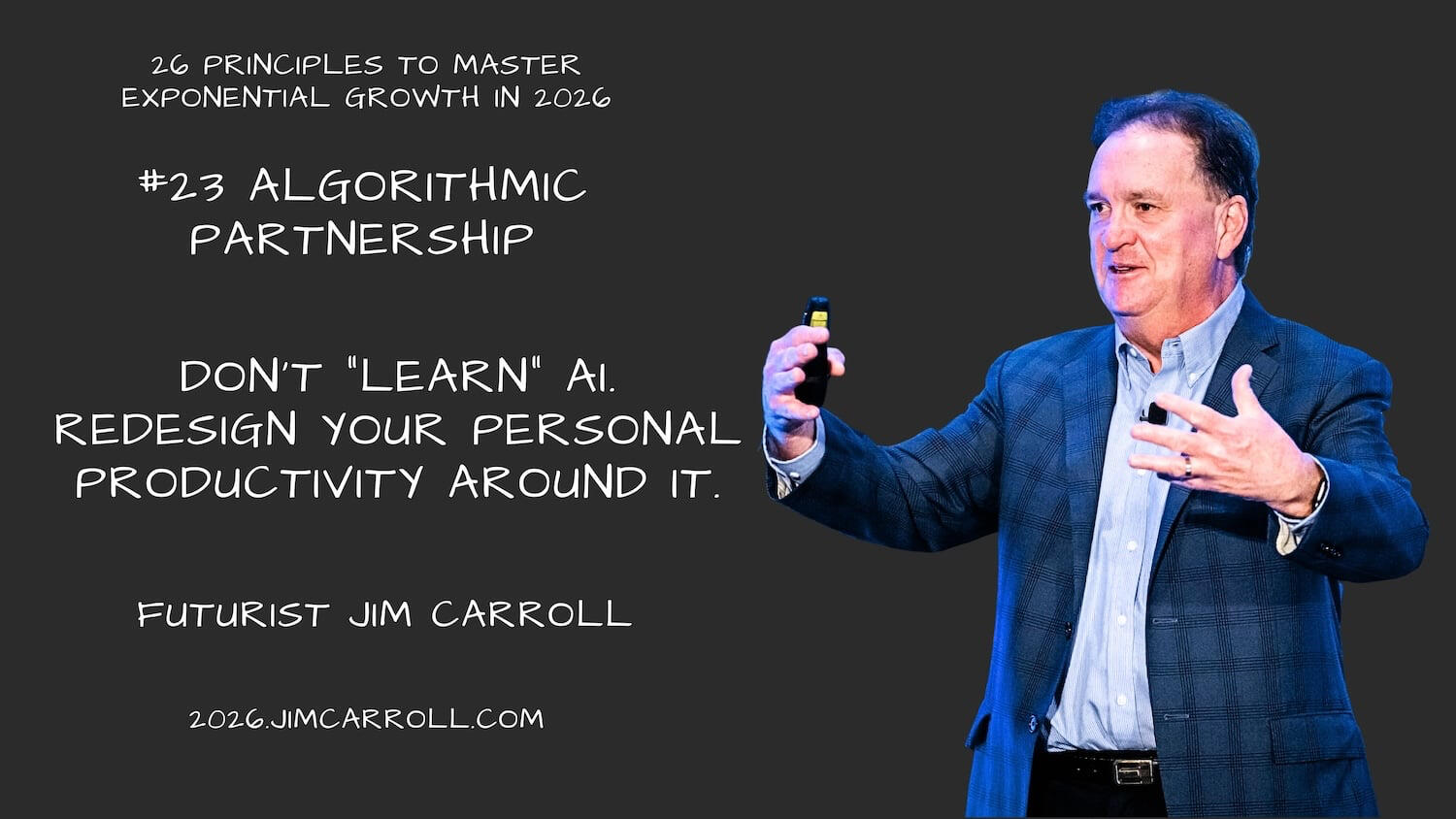
Like it or not, you will have to learn to live with “The Machine.”We are on Day 24. You have the radar (Day 21), the open road (Day 22), and many principles I’ve shared before that. Now, we must address the elephant in the room: The Machine.For the last three years, the narrative has been “Man vs. Machine.” People are going to lose their jobs! We will all be working 2 hours a day, 3 days a week, because AI will do all the work. Stuff like that.In 2026, that line of thinking is obsolete. You need to get beyond the hype and hysteria. The competition isn’t between you and the AI. The competition is between “You + AI” and “You Alone.”The Linear Leader tries to outwork the algorithm. The Exponential Leader learns to partner with it.Don’t fear having to compete with AI. Learn to conduct it. The discipline you must master is Algorithmic Partnership.Here’s your chalkboard summary – generated, of course, by AI!
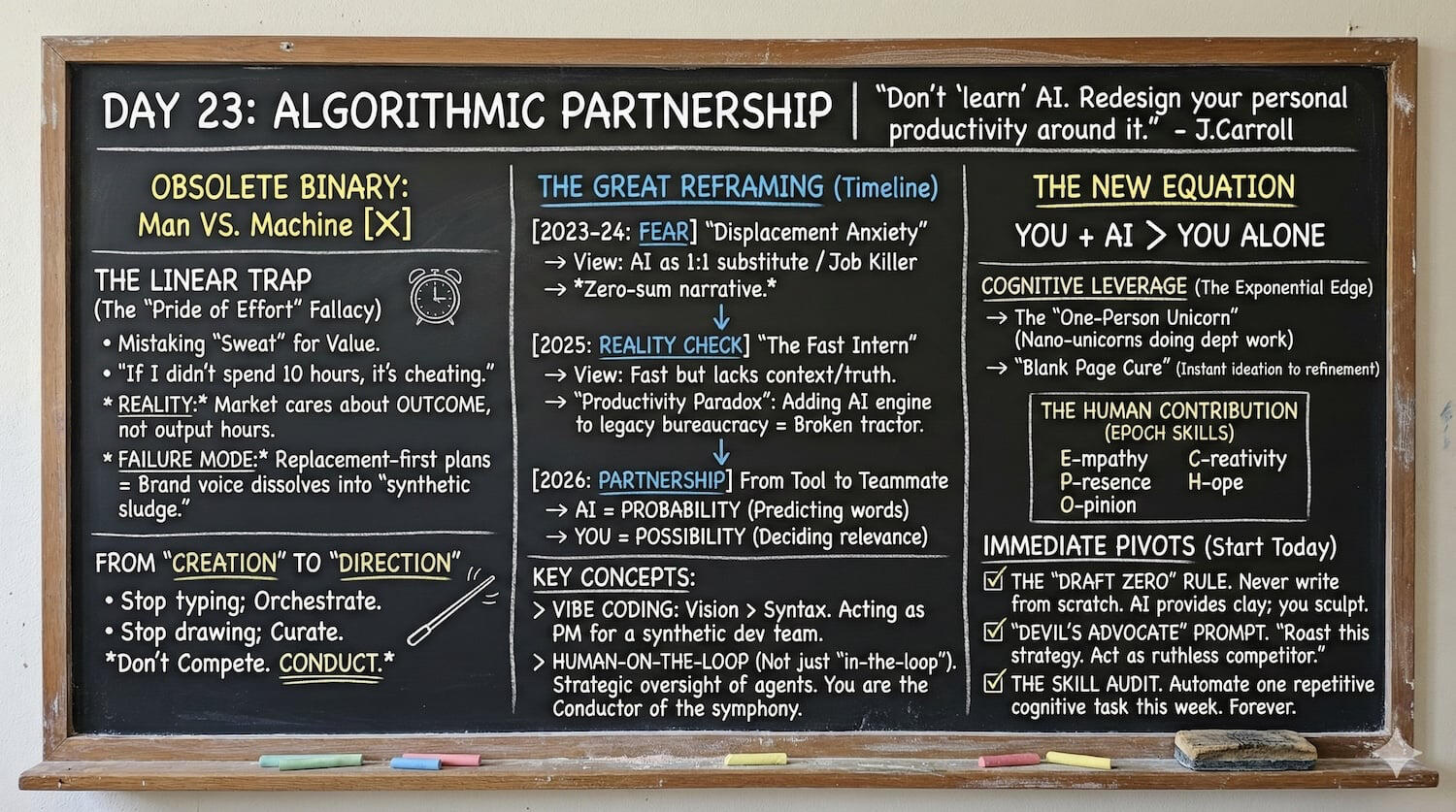
The Great Reframing: From Displacement to OrchestrationTo master this partnership, you first have to understand the emotional and economic rollercoaster we have just ridden. The narrative of “AI as a job killer” didn’t just appear; it evolved, crashed, and reformed into something far more interesting.And the voyage has caused a lot of grief!The Era of Fear (2023–2024)When ChatGPT and its peers first arrived, the world suffered from what we might call “Displacement Anxiety.” The logic was linear and terrifying: If an AI can write a report in 10 seconds that takes me 10 hours, I am obsolete.That fear wasn’t abstract. Major forecasts poured gasoline on it. The World Economic Forum’s 2020 estimates talked about 85 million jobs potentially displaced by 2025, alongside 97 million new roles emerging. That headline shaped how people felt, even though it was always a projection, not a verdict.Then there were grand pronouncements by all kinds of tech CEOs and other leaders about the magic productivity benefits of AI, with one suggesting that they wouldn’t have to hire any new people in the future since AI would do all the work! Folks nodded their heads in some sort of weird agreement, buying into the narrative. People were getting drunk on Kool-Aid!
*It’s going to end wars. *Right. Got it. I rest my case.I’ve been here before. In the 1940s, Popular Mechanics magazine was predicting that the machine era would see us with unlimited leisure time!
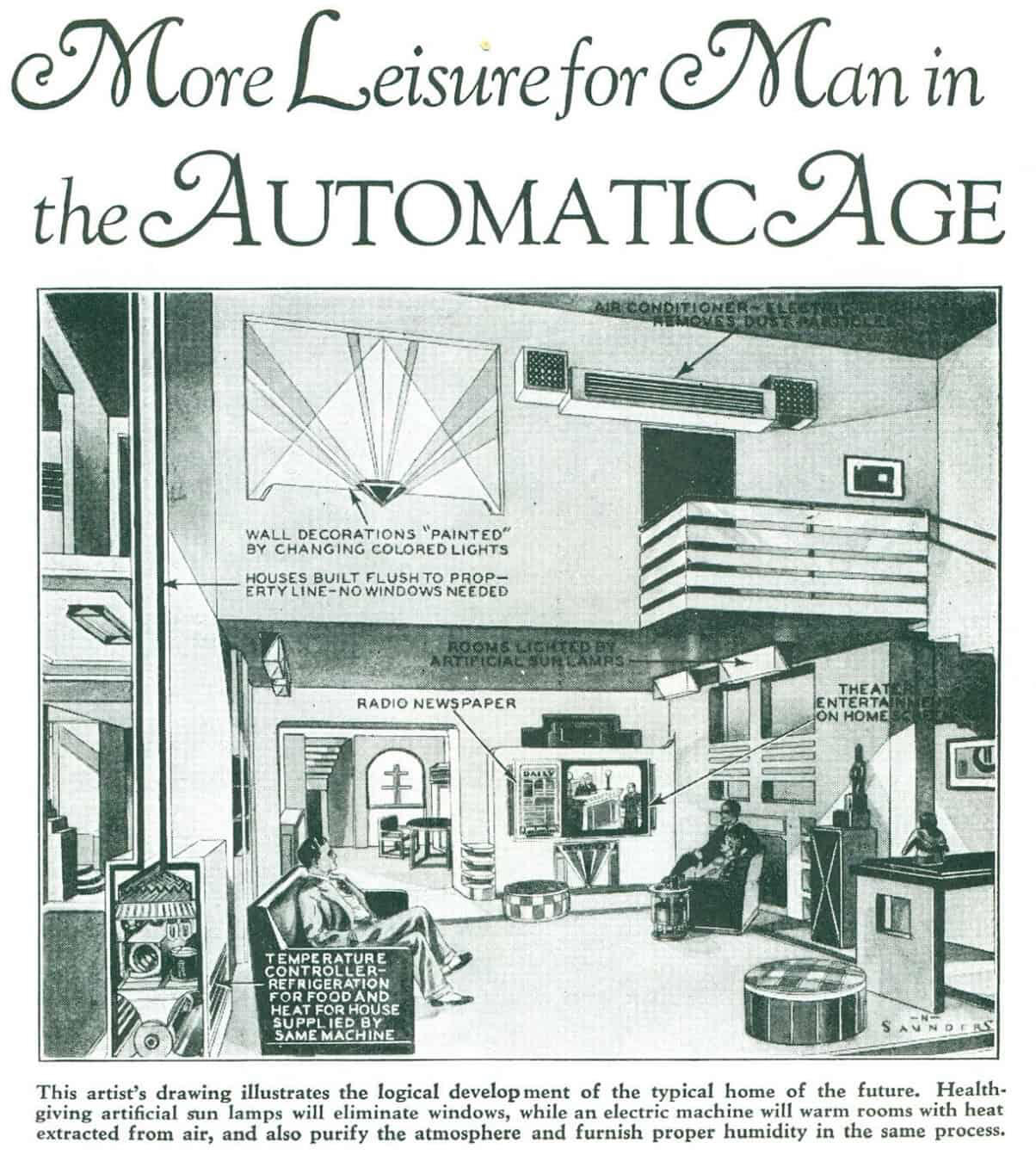
Today. Oh, well, apparently we are going to have 3-day work weeks!

Sigh.One impact of this hype, though, as CEOs themselves not only drank the Kool-Aid but also injected it straight into their veins. They got high on the hype and made ‘bold decisions.’ We saw a wave of tech layoffs often attributed to “AI efficiency,” fuelling this zero-sum narrative.The reality? More likely that companies were using AI as an excuse to do the cost-cutting that they had planned in the face of spending uncertainty.But with all of this, the fear became implanted in our minds – AI was a 1:1 substitute for human intellect, and because of that, we were all going to lose our jobs. We were doomed!The “Fast Intern” Reality Check (2025)Then came the reality.By 2026, we will hit what Gartner calls the “Trough of Disillusionment” on the Gartner Hype Cycle.
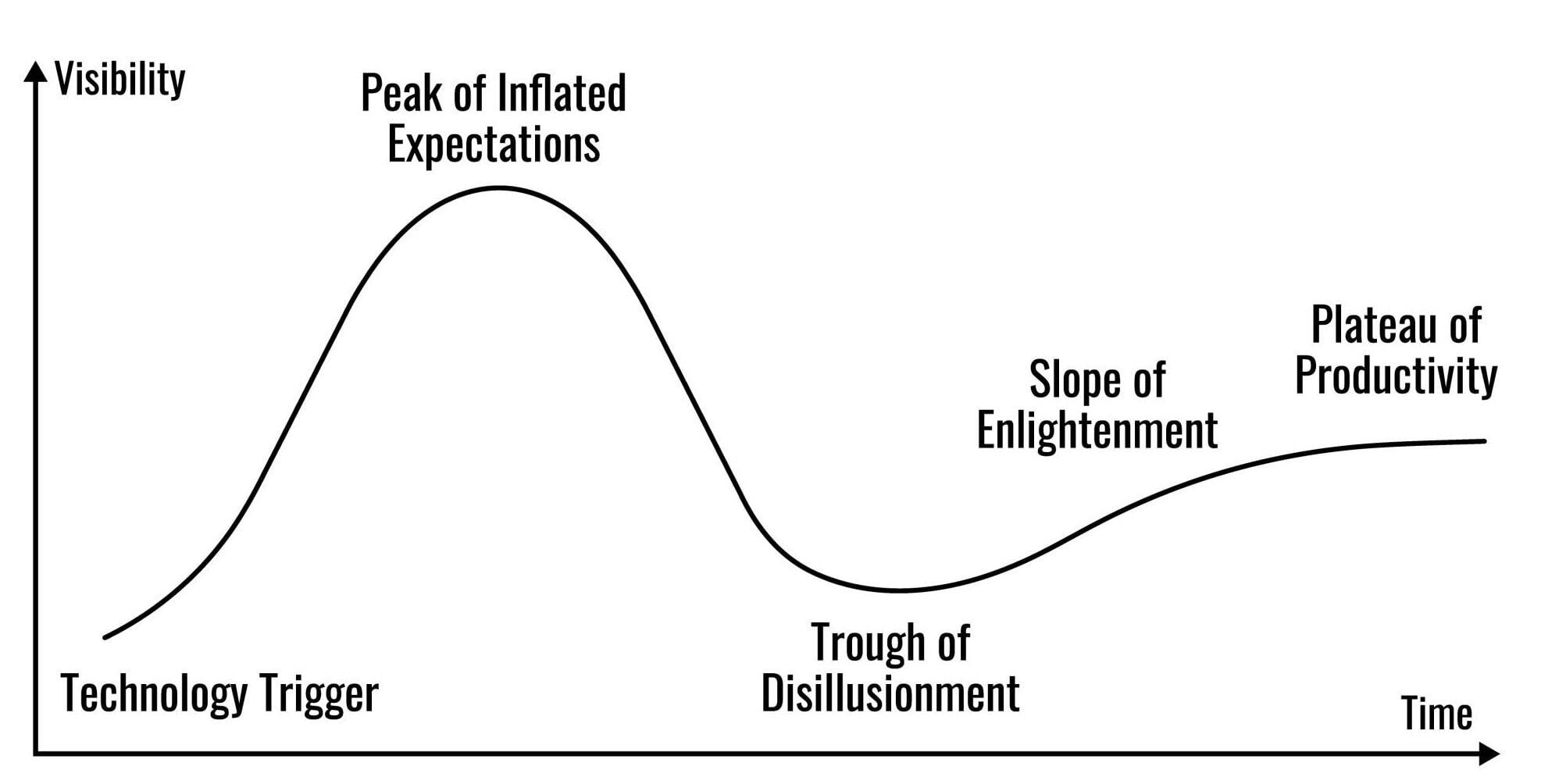
No wonder I had to share the idea, learning to deal with excessive hype as Principle #14 of this series was one of the most important things we could do.Through 2025, many came to realize that while AI could generate content at infinite speed, it often lacked context, nuance, and truth. It made stuff up. It was often full of eras. We started to explain that it was ‘hallucinating.‘ All while it continued to improve at a staggering speed, our understanding of its limitations, weaknesses, and faults also began to grow.And with that, the narrative began to change. It wasn’t to be our master; it was more an immature and fast “intern” that required constant supervision.Rather than replacing us, we had to monitor it, watch it, and carefully assess its work.
The Failure of Replacement: A landmark MIT study revealed that 95% of corporate AI projects failed to deliver ROI when they simply tried to swap humans for bots without changing the workflow. The pattern is consistent: replacement-first programs underperform because they don’t redesign the work.
The Productivity Paradox: We learned that adding a Ferrari engine (AI) to a tractor (legacy bureaucracy) didn’t make the tractor fast; it just shook it to pieces. (I’m coming to love tractor analogies!)
With this came two of the most brilliant observations of our short affair with AI so far, as the floodgate of spending opened up in the face of massive strategic uncertainty:
“AI: It’s among the most expensive keeping-up-with-the-Joneses games in corporate history” – Korn Ferry Report, 2025
“Step one: we’re going to use LLMs. Step two: What should we use them for?” – IBM Report, 2025
Productivity? If you think about it, we ended up doing more work because of it, not less!But at the same time, for those of us who learned to tame it, our productivity soared, all while it continued to get better and better. (Or, as some would say, more productive with more sophisticated errors!) So as we close out 2025, there’s also a second reality check hiding in plain sight: most of what seems to be happening is that we are interrupting specific tasks, but not deleting jobs.Goldman Sachs, for example, has said that even if current AI use cases scaled broadly, only a small slice of total employment would be at risk of full displacement, while a much bigger slice of daily tasks would be reshaped.This is a pretty significant change in the narrative! We moved to this – an image I’ve often shared.
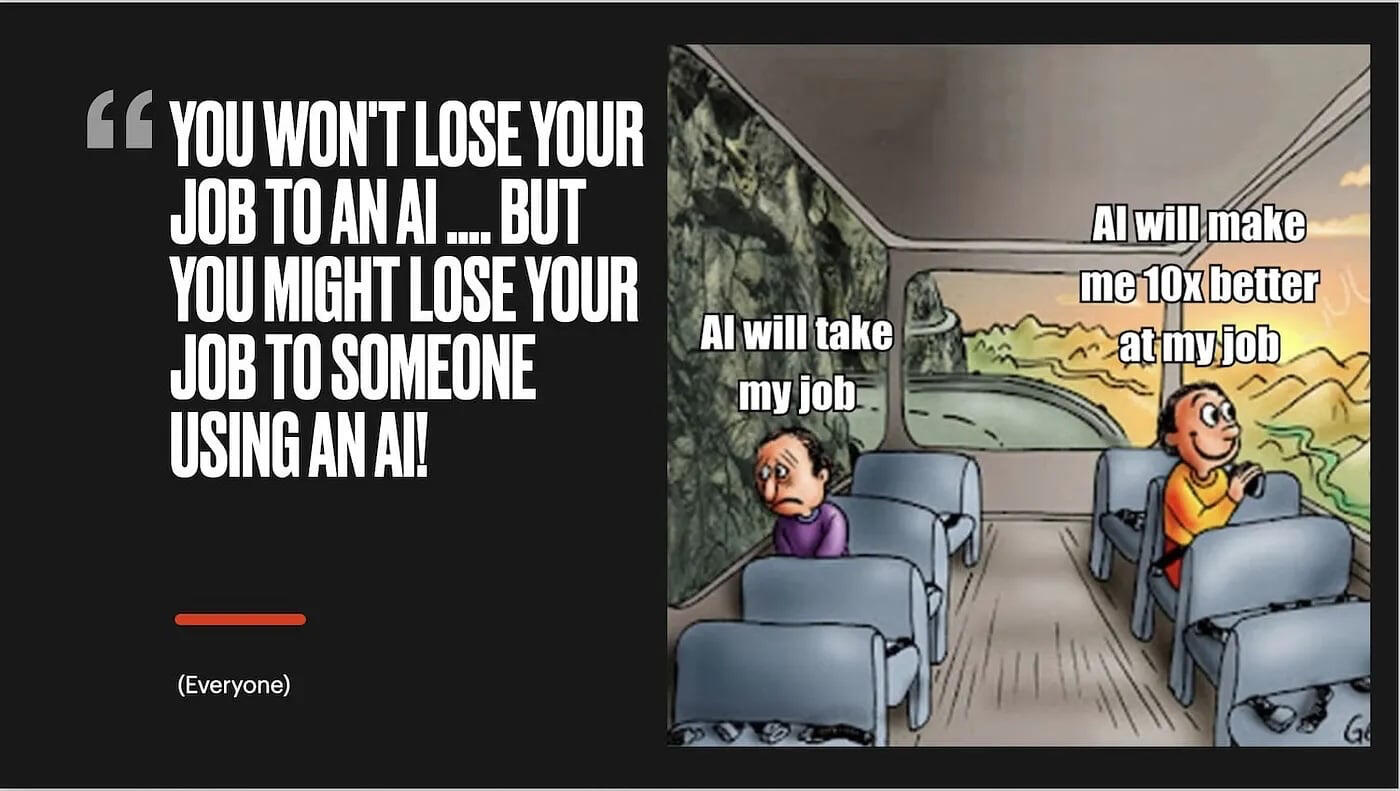
The Pivot to Partnership (2026)Think about what this means.The World Economic Forum now predicts that while 92 million jobs might be displaced by the shift between humans and machines, 170 million new roles are emerging, roles that didn’t exist three years ago.Many of these new roles seem to be exactly what the image implies – they are actually old jobs and careers, enhanced by the impact of AI. With that, it seems pretty clear that the winners of 2026 and beyond aren’t those who automated their workforce into oblivion. We aren’t about to all lose our jobs.Instead, we will continue to see wild chaos as jobs and careers undergo dramatic change, and as corporations try to figure out what all this ‘AI stuff’ actually means, and where the opportunities, productivity, and efficiencies really lie.It’s “jobs chaos,” rather than a “jobs apocalypse.”1. The Exponential MindsetWhat seems to be happening is that AI is moving from a “tool” to a “teammate.”If that’s the case, you’ve got to stop thinking about AI as a search engine like Google, a generator of text, or a creator of images and video.Start thinking of it like your partner. It’s going to be here, and will be a big part of your working life, whether you like it or not. That’s why you need to place the phrase Algorithmic Partnership.What is it? It’s realizing that AI is a force multiplier for your intellect, an enhancement of your knowledge, an enabler of new skills. In this partnership, you don’t type; you orchestrate. You don’t just draw; you ‘imaginate’ (my word, I made it up!) You don’t just code; you architect. Your value shifts from “creation” to “direction.” That’s a big mindset shift.In my case, it’s certainly happening. I am doing a lot of what people have come to call “Vibe Coding.” I’m doing a lot of highly technical work, building very complex apps or solving deep technology support issues, simply by describing the vibe and functionality to an AI. In that way, I’ve developed entirely new skills – managing and orchestrating my own highly specialized tech development and support team.The barrier to entry to get fully into this world? It’s not the words we choose to describe what we are doing – it’s adjusting our vision of what we can accomplish.2. The Linear TrapIn the face of this opportunity, many people are struggling with the uniqueness of “AI guilt.”Think about it: one of the more interesting aspects of this AI voyage is that many people came to believe that if they used AI, they were cheating. Why is that? Linear leaders take pride in the sweat. We’ve come to believe that if we didn’t spend 10 hours writing the report manually, it wouldn’t be valuable. We resist AI because it feels like we are ‘bending the rules.In 2026, the market does not care how hard you worked. It cares about the output; it cares about what you produce; it cares about what you can do. That being the case, clinging to manual effort in an automated world isn’t integrity; it’s inefficiency. And the simple fact seems to be this: we are shifting from “output” (hours worked, lines of code written) to “outcome” (business impact, customer value).So while you are proud of your 10-hour draft, your competitor’s Algorithmic Partnership has produced 10 variations in 10 minutes and is already executing the best one. You can’t compete against that – and if you remain stuck in the old mindset, you’ll fall way, way behind.3. The Exponential EdgeWhen you master Algorithmic Partnership, you unlock the very unique leverage this strange new world provides us:
The “One-Person Unicorn”: We are entering the era where a single individual, powered by a stack of AI agents, can do the work of a traditional department. We are already seeing “nano-unicorns,” startups reaching massive valuations with fewer than 10 employees. You can be the writer, the coder, the designer, and the strategist simultaneously because your partner handles the execution.
The Blank Page Cure: You never start from zero. Your algorithmic partner provides the clay, the raw draft, the basic code, and the initial list. You provide the sculpting, the judgment, the empathy, the strategy. You move instantly from ideation to refinement.
And the productivity evidence is getting harder to ignore. In controlled and field experiments, human-AI teams and AI-assisted workers often move materially faster, sometimes dramatically, while quality becomes a management choice instead of a guarantee. According to Microsoft, GitHub Copilot experiments, for example, found large speed gains on defined coding tasks. xArciv reports that in a large marketing experiment pairing humans with AI agents, researchers observed major productivity lifts per worker, alongside a reminder that the partnership still needs tuning, especially when moving beyond text into multimodal work.Different frameworks label this change bucket differently, but the core observation is the same: while AI can do a lot of work, the power and role of human judgment and orchestration are the missing link. With that, entirely new roles are appearing that are basically “partnership operators,” people paid to make the human-AI system reliable, useful, and aligned to outcomes.Algorithmic orchestrators, as it were.4. The Immediate PivotSo here’s what it all means – you need to stop using AI as a tool and start treating it as a partner! How do you do that? Try a few ideas:
The “Draft Zero” Rule: Commit to never writing a first draft from scratch again. Use your partner to generate the skeleton, the Draft Zero, and then use your human expertise to add the muscle and soul. Save your energy for the elevation of the idea, not the generation of it.
The “Devil’s Advocate” Prompt: Before making any strategic decision, feed your plan into your AI partner and ask: “Roast this strategy. Act as a ruthless competitor and tell me three reasons why this will fail.” Use the machine to challenge any built-in bias that you might have and that you might not be aware of!
The Skill Audit: Identify the one low-value, repetitive cognitive task that consumes your week (for example, summarizing meetings, sorting emails). Spend one hour this week building a simple AI workflow to kill it forever. Vibe the code!
The principle for 2026? Like it or not, you’re going to live with the machine, so stop treating AI like a new subject to study and start treating it like the operating system for how you get work done.The old “man vs. machine” panic is fading because the real contest is “you plus AI” versus “you alone.” We’ve learned that replacement thinking fails when you bolt AI onto old workflows, but partnership thinking wins when you redesign the work itself.In that model, your value shifts from grinding out first drafts and doing ‘busywork’ to orchestrating.That’ directing, judging, and refining the things you do, using AI to generate momentum while you provide context, truth, and strategy.It’s not Man vs. Machine.It’s You.With The Machine.
#24 Trust Capital
In an era of synthetic perfection, your flaws are now the ultimate watermark of your authenticity.
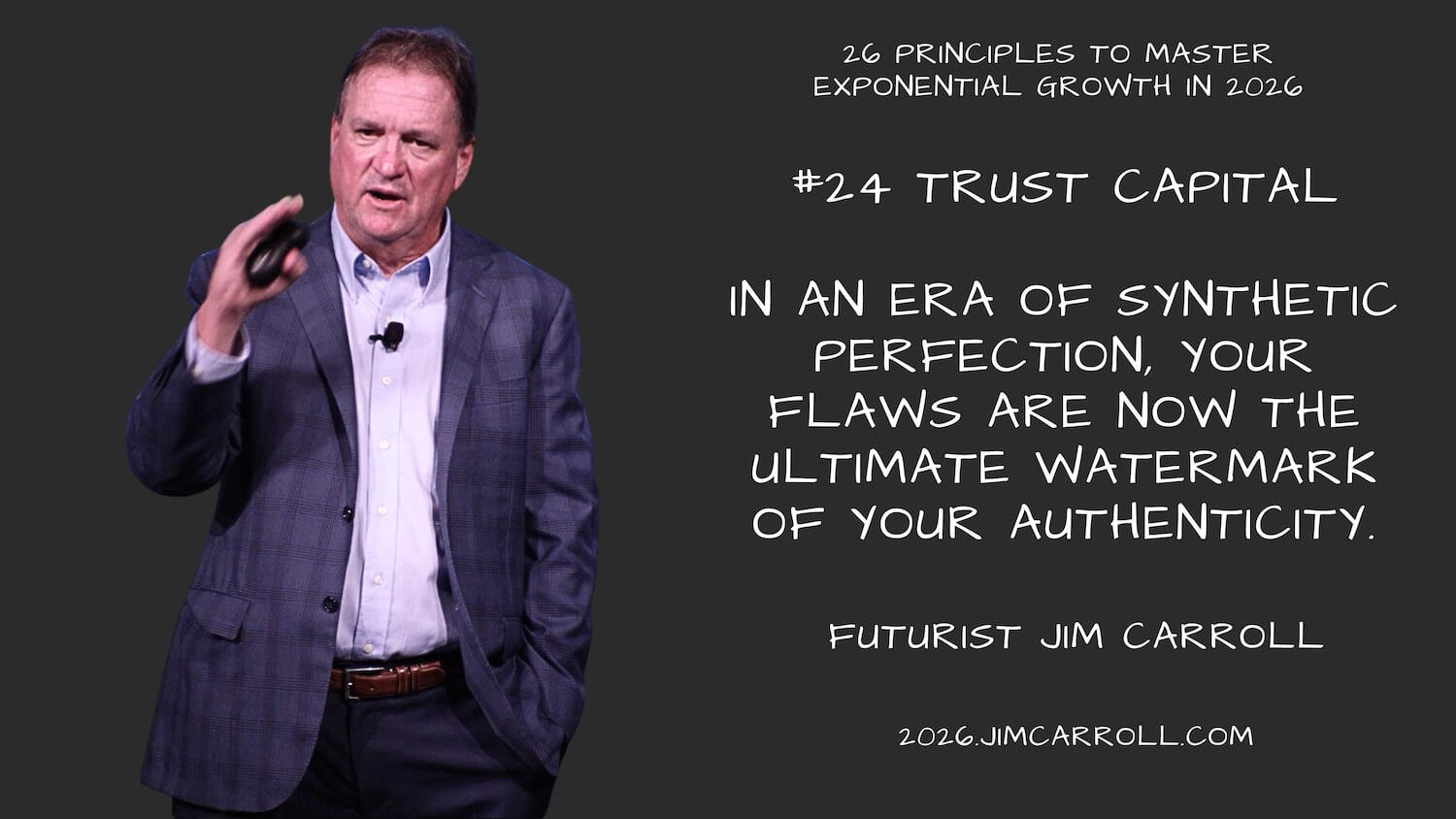
in 2026 and beyond, you need to take the time to secure your most valuable asset: Your humanity.How do you do that?Share your flaws. Highlight your failures. Document your mistakes.Admit you are human!There’s no doubt that with AI moving as fast as it is, we stand on the precipice of a strange new era – we could call it the “Age of Infinite Perfection.” Synthetic media, algorithmic amplification, and automated engagement surround us. Slop, we’ve called it. And it is quickly leading to what some have called the “dead Internet,” a world where a staggering percentage of online traffic and content generation is generated by non-human sources. Generated by AI, indexed by algorithms, and served to you based on what a machine thinks you need to see.And the problem with a lot of this is that the machines are getting so good that they are getting close to absolute perfection. Have you seen the latest with AI video? Have you looked at an image and had to check yourself to remember that its;’ from an AI? Have you been duped by an artist with stunningly powerful music only to discover it’s an AI?I have!Check out Let Babylon Burn. Listen to this song. I had it on repeat for a month before I realized it wasn’t real!
If you are a brand, a product, a company or an individual, how will you ever manage to stand out among the slop?(Oh, and if you are skimming, here’s your chalkboard summary. Yes, it was AI-generated, so I am working a bit at cross purposes here, but at least I’m admitting it!)
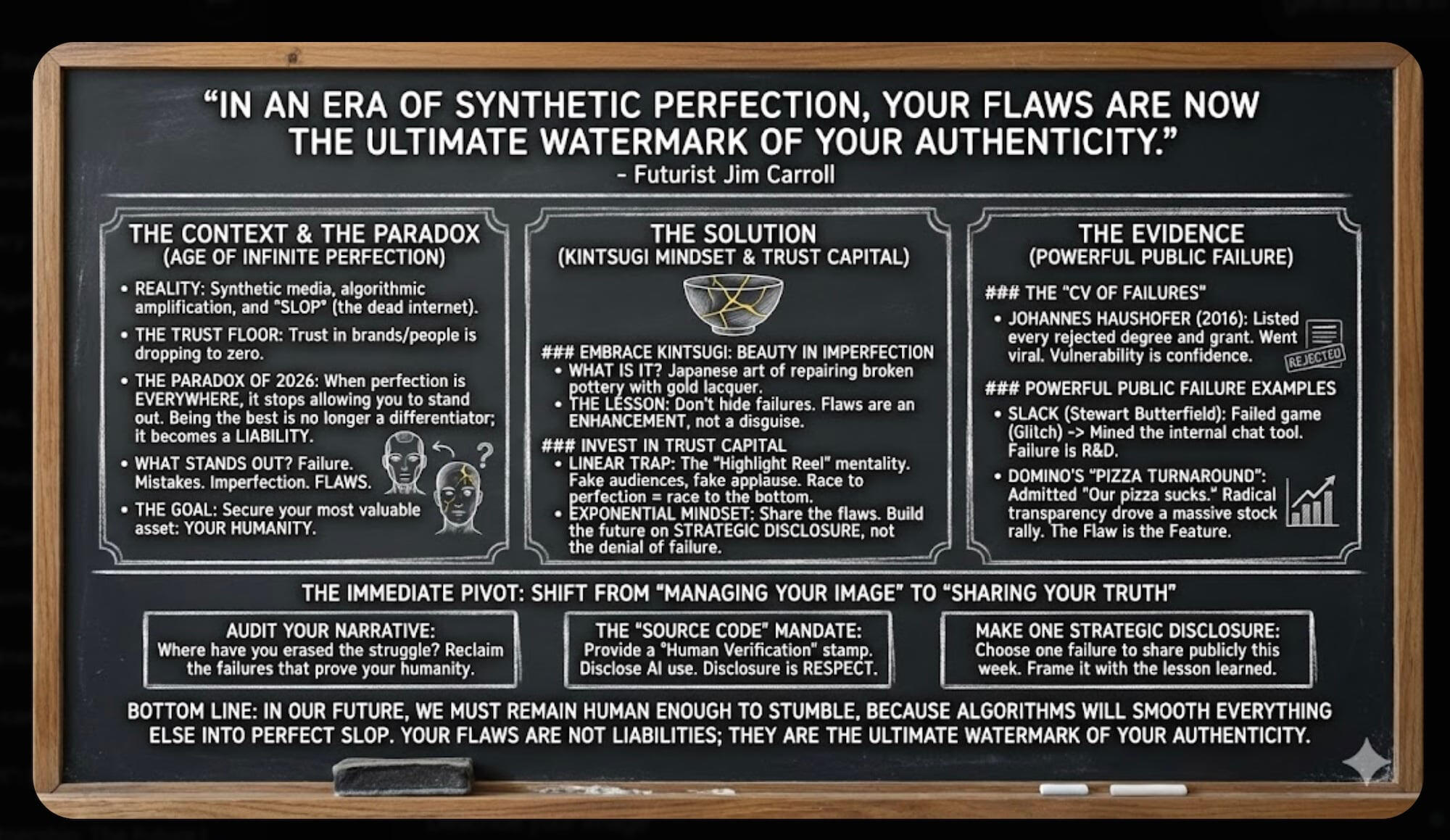
In this environment, the trust that people have in people, companies, brands, and transactions is dropping to zero. Some call it the ‘trust floor.’ Not only that, but we are all getting access to the same tools that allow us to generate perfection on demand.When everyone is perfect, what stands out? That’s the paradox of 2026 and our future: When perfection is everywhere, it stops allowing you to stand out. Being the best is no longer a differentiator – instead, it becomes a liability.Think about where we are headed – when a machine can instantly generate a convincing quarterly report, a flawless biographical summary, or a photorealistic image of a product that does not exist, perfection dominates. In that context, a resume without a gap, a product launch without a stumble, or a leader without a scar becomes common – the common thread of a world of perfection.What stands out? Failure! Mistakes! Imperfection!Flaws.What’s the solution? Embracing the idea of KintsugiThe Beauty of KintsugiThe Japanese are wonderful with the way they conceive of ideas that others can’t.That’s where the idea of Kintsugi comes in.What is it? It’s the art of repairing broken pottery with lacquer mixed with powdered gold, silver, or platinum, making the cracks part of the object’s history and beauty, not something to hide. It embraces the idea that we can find beauty in imperfection and the concept that we can treat something that breaks as something that is actually an enhancement. It treats the repair of broken pottery as part of the history of the object rather than something to disguise.

That’s what WE should be doing in a world of imperfection.We shouldn’t hide our failures, bury our flaws, or disguise our mistakes. It’s a part of who we are, and in the era of perfection, it will do more to help us to stand out than to try to play the algorithmic game that dominates our future. In that context, the specific, painful details of a rejected grant application, a failed product launch, or a public stumble serve as a verification signature that proves human identity.The Resume of FailureWith that, I bring you the idea of a resume of failure!In 2016, Princeton professor Johannes Haushofer published a “CV of Failures” listing every degree he was rejected from and every grant he was denied, noting that these “invisible” failures vastly outnumbered his visible successes.
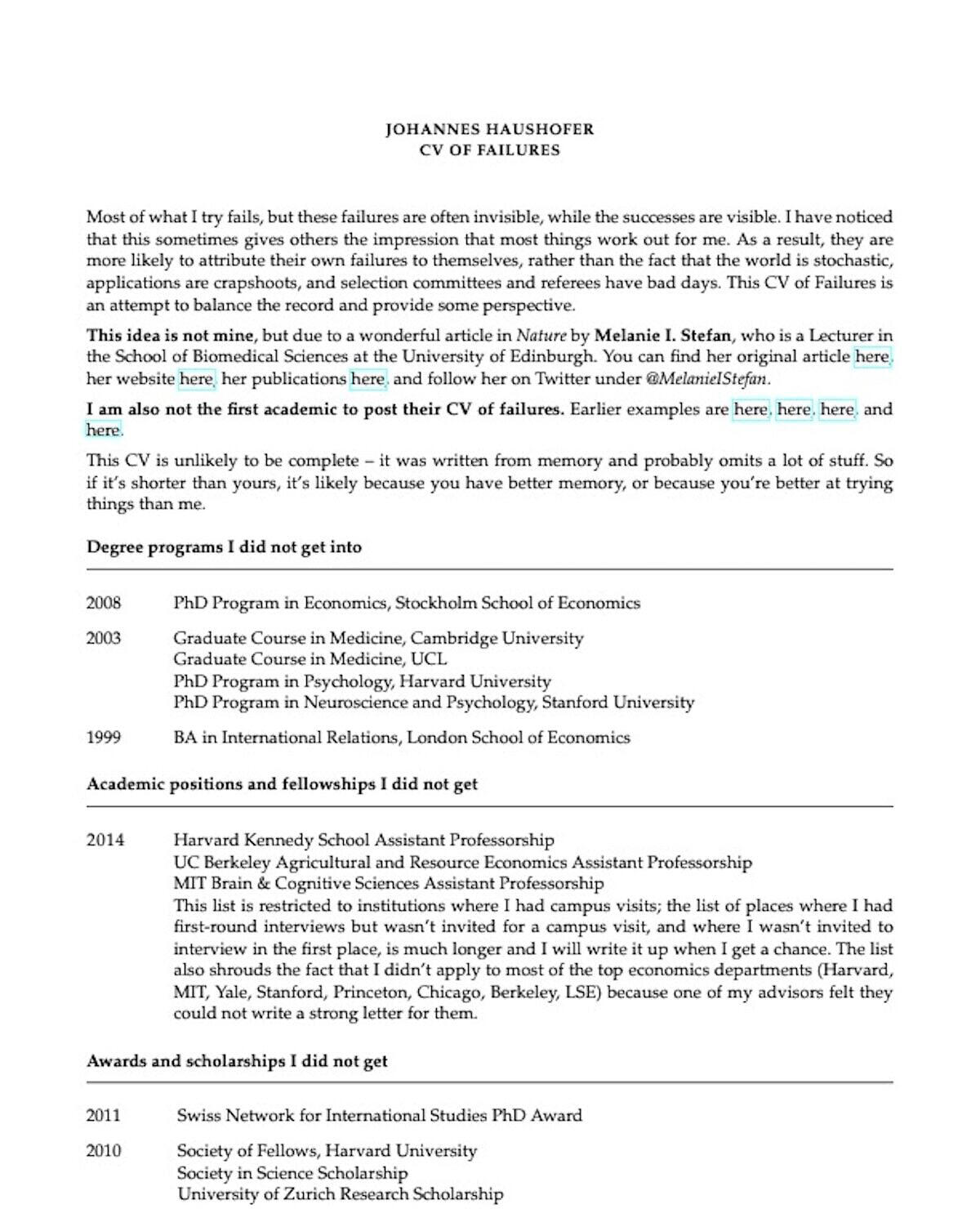
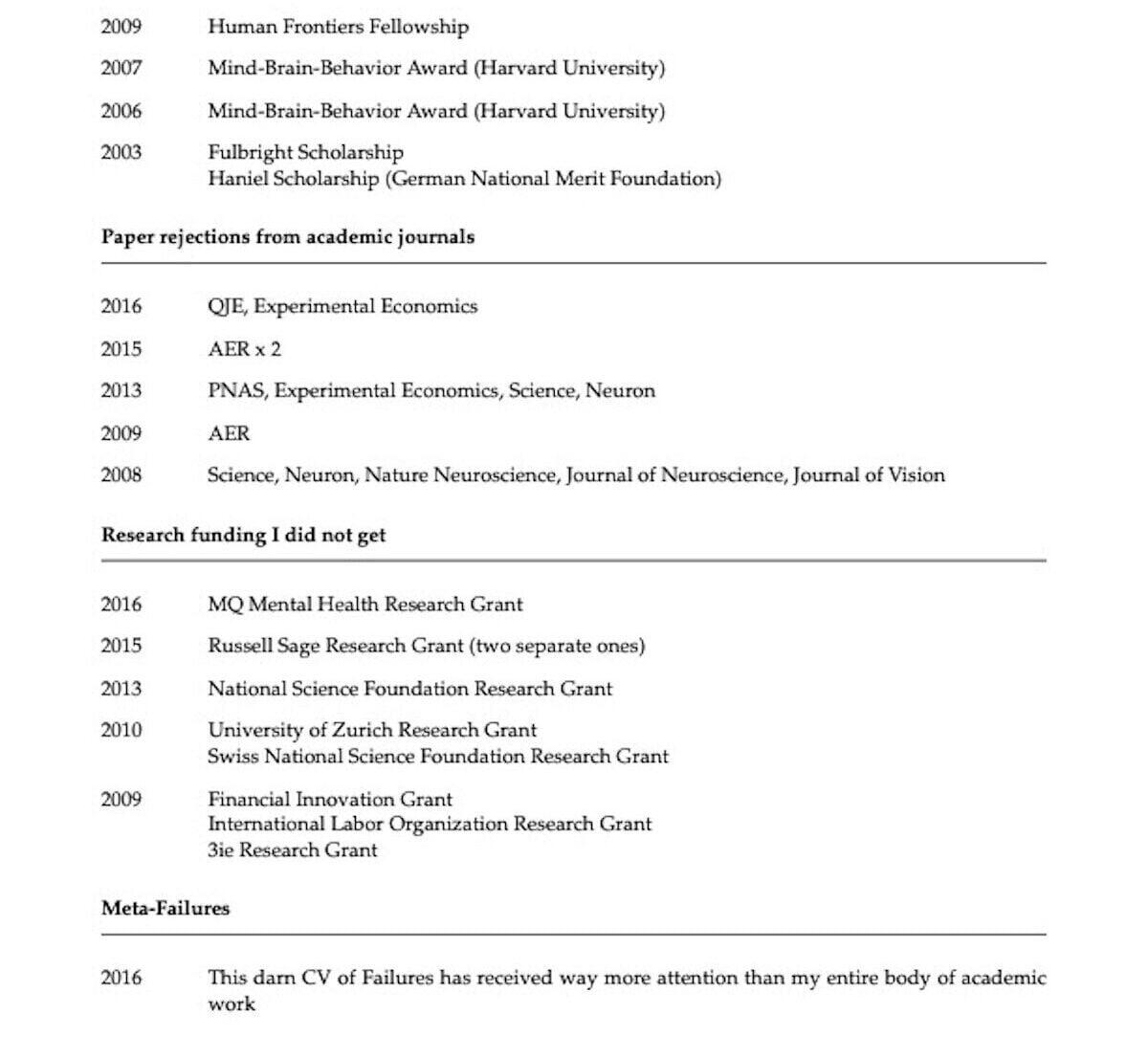
It instantly went viral. No wonder. Not only that, but read the last line! Failure stands out.Since then, others have copied his model.
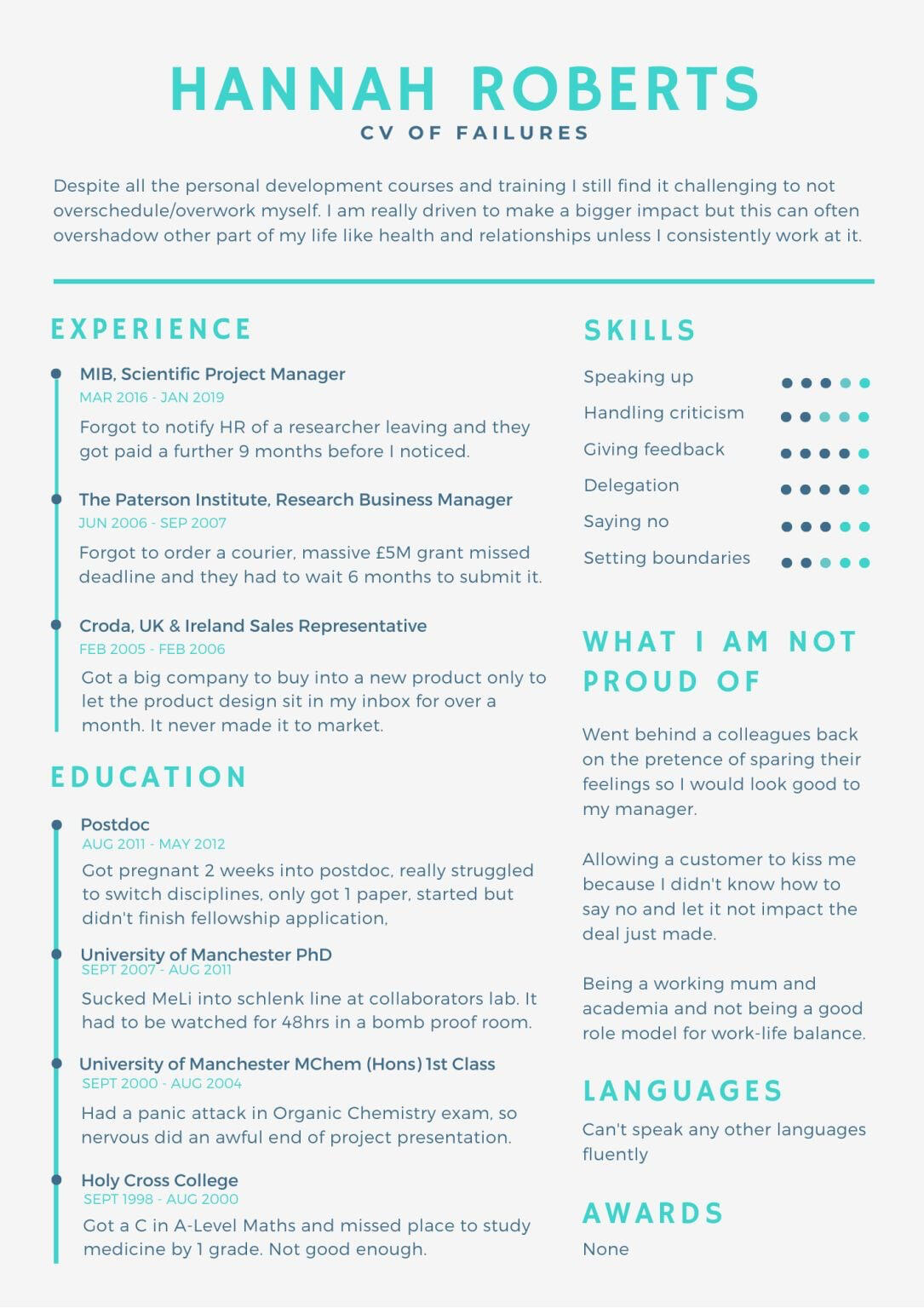
Why does this type of thing appeal to us? Why will we see more of it? Why is this a powerful strategy in the era of AI?Because our failures are proof of our effort, a signal of our learning, a statement of our resolve.An overview of our honesty.Demonstrating that we’ve put in the work to get to success.For Haushofer, an academic, he works in a sector obsessed with prestige. And despite his unique resume of failures, he proved that his success was developed through effort, not gifted to him through luck. By quantifying his rejections, he provided a “source code” verification of his resilience that a polished bio could never convey.The lesson? Vulnerability is a presumption!. IN a world saturated with “toxic positivity,” the admission and sharing of failure signals a level of confidence so high that the individual can afford to expose their flaws.History proves the pointPowerful public failureI dug into this idea and found lots of examples of how failure is actually success. Read on!The “Slash and Burn” Pivot: Stewart Butterfield (Glitch to Slack)Failure can become success – even if it is not planned. That’s the story of the collaborative software platform Slack. The video game failed – but the software the team used to develop it became one of the most powerful collaborative platforms in the world today!
The Context: Before Slack was a $27 billion company, it was a failed video game called Glitch. Instead of burning cash to delay the inevitable, Butterfield admitted the failure to investors immediately and shut the game down. But he realized that the internal chat tool they had built was something unique – and so he turned that into the product!
The Authenticity Signal: Butterfield didn’t hide the corpse of the failed project; he mined it. He told his investors what went wrong – but what he saw going right! In doing this, he preserved the transparency with his investors – he had the “trust capital” he needed to make a pivot. If he had hidden the reality, Slack would never have been funded.
The Lesson: Failure is R&D. Linear leaders try to fix the failure to save face; exponential leaders extract the asset from the wreckage and move on.
Radical Transparency: The Domino’s “Pizza Turnaround”
The Context: In 2009, faced with a stock price of $11 and customer complaints that their product tasted like “cardboard,” Domino’s ran national ads admitting, “Our pizza sucks.” They used real focus group footage bashing the product.
The Authenticity Signal: This was the ultimate “Anti-PR” move. By validating the public’s perception, they reset the bar of trust. People saw the company and the brand as honest, someone standing out in a world of sameness. The admission of the flaw became the primary feature of their marketing campaign, driving a stock rally that eventually outperformed Google and Amazon over the ensuing decade! (Wow!)
The Lesson: The Flaw is the Feature. When you admit the negative, the market believes the positive. In an “Age of Infinite Noise,” consumers are adept at spotting corporate speak; they crave the raw signal of honesty. They got it with pizza!
The Anti-Portfolio: Bessemer Venture Partners
The Context: One of the world’s most successful VC firms maintains a public “Anti-Portfolio“—a list of the massive companies they refused to invest in, including Apple, Google, and FedEx. In doing so, they indicate they aren’t scared of some of the biggest investment failures of all time.
The Authenticity Signal: This is a corporate “CV of Failures.” It demonstrates “intellectual honesty,” signalling to entrepreneurs that the firm is grounded, realistic, and confident enough to admit to multi-billion dollar mistakes.
The Lesson: Confidence acts as a filter. Perfection equals suspicion; admitting to the “one that got away” proves that your wins are based on judgment, not just luck.
The Serendipity of Error: Viagra and Post-it Notes
The Context: Viagra was a failed heart medication; Post-it notes were a failed super-glue. In a linear model, these projects would have been deleted for failing their primary goals.
The Authenticity Signal: Yet these innovations highlight the fact that failure brings success – and in a world of algorithms, might have never made it past their impossible finish line. There’s a powerful lesson here: only human intuition can recognize that a “failed” adhesive is actually a new way to organize information, and that a failed medicine can actually become a multi-billion dollar product!
The Lesson: Error is an opportunity. In the exponential mindset, what looks like a bug is often a feature waiting for a new application; a failure is often a success; a flaw is actually a work of art. Kintsugi, as it were.
In our future, we must remain human enough to stumble, because algorithms are going to smooth everything else out into perfect slop.That’s why the idea of Trust Capital is so important.1. The Exponential MindsetAI is moving so fast that soon, if not already, AI perfection is everywhere.In that reality, the exponential mindset recognizes the perfection and decides it’s time to share the flaws. It’s a decision that part of the future will be built not on the denial of failure, but on its strategic disclosure.2. The Linear TrapThe linear world never really thought about the necessity of highlighting flaws.It’s certainly the case in my industry. Many speakers are stuck in the perfect “Highlight Reel” mentality. They build speaker videos that are so perfect that the true story of what they offer never really comes through. Not only that, but there have been recent stories of what this has led to – videos with fake audiences, fake applause, fake audiences.And in that context, people no longer really know who is good on stage and who is not. The race to perfection has become a race to the bottom because clients can no longer distinguish between so many cases of perfection. Ouch!3. The Exponential EdgeWhen you invest in Trust Capital, you embrace the discipline to fail in public.You recognize that in an era where everyone is generating perfection with AI, your ability to stand out with flaws now matters more than ever before.Do you have a gap in your resume? Don’t hide it – explain what happened. Your business failed? Explain why! You missed out on a grant? Share the fact that you actually tried!Jessica Winder is one of the smartest people I know when it comes to our new world of recruiting and hiring. She’ll loudly and proudly tell you that should never hide the gaps in your resume. Ever.
You want authenticity? Reality? She’s a double-twin mom – with four little ones under the age of two as I write this. And she dared to interview while she was pregnant with her second set of twins, disclosed it, and got the job.

And in doing so, she isn’t hiding ‘flaws’ – because experiencing the joy of motherhood is not a flaw, it’s one of the most powerful gifts ever bequeathed to humanity.4. The Immediate PivotHow do you get there?You shift from “managing your image” to “sharing your truth.”
Audit Your Narrative: Review your professional narrative. Where have you erased the struggle? What failures have you hidden that could serve as proof of your humanity?
The “Source Code” Mandate: For every key report or opinion you release, provide a “Human Verification” stamp. If you use AI, disclose it. Disclosure is not weakness; it is respect. My chalkboard summaries are AI; some of my research is AI. A lot of the writing is mine.
Make One Strategic Disclosure: Choose one failure to share publicly this week. Frame it with the lesson learned and the benefit from it. Observe the response.
Share the strength you’ve found in your mistakes. The lessons learned from when things went wrong. The discoveries you made when it went off track.The beauty in your flaws, or the ripples in your reality.

Just like Kintsugi.
#25 The Collapse of Time
The moment between having an idea and executing it is gone
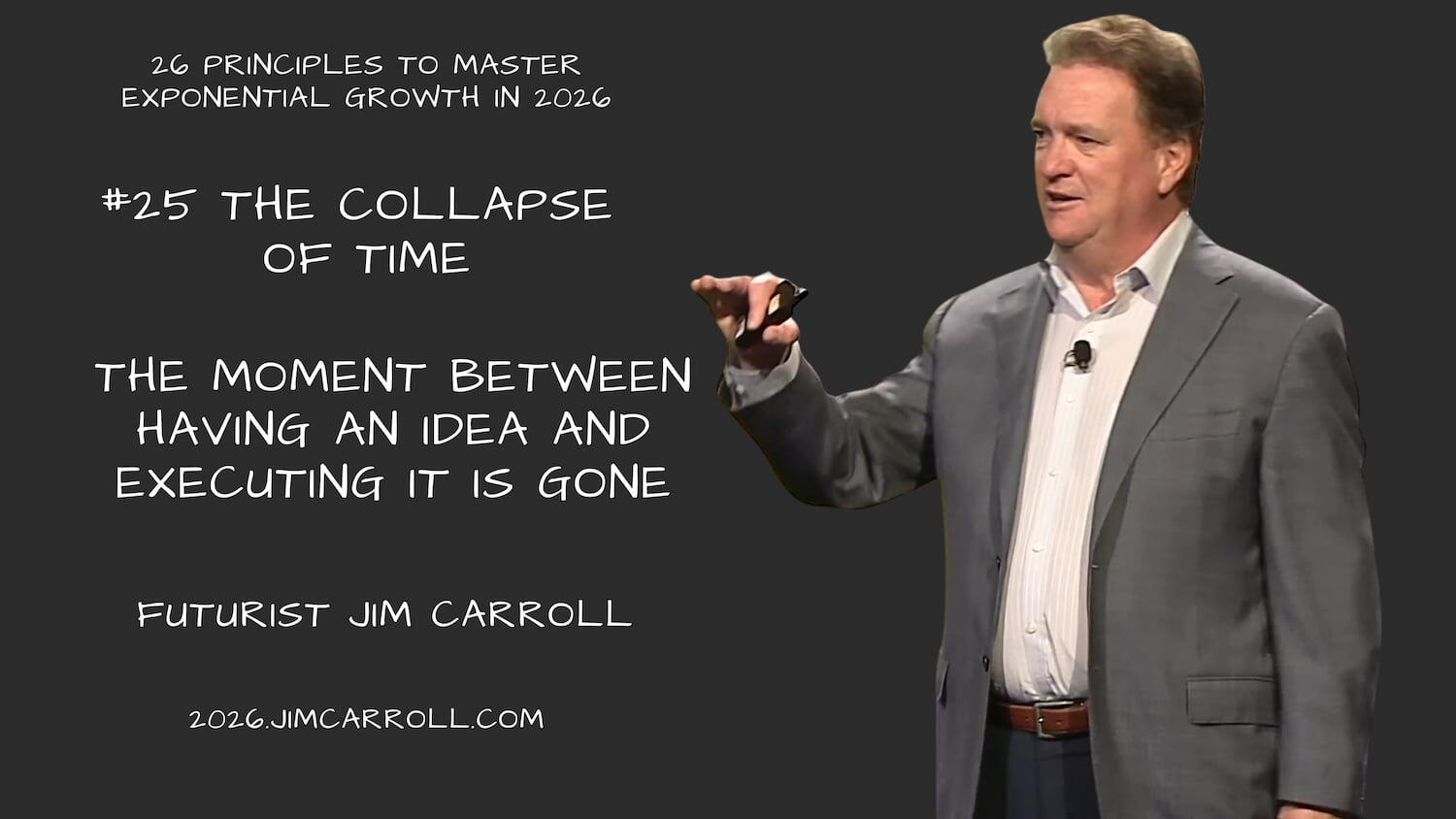
Get ready for the reality that the distance between ‘imagination’ and ‘reality’ is collapsingWe are on Day 25. We are one day away from the finish line!Today, you need to think about speed, velocity, and acceleration.Yes, I’ve covered a lot about the issue of speed (Day 1) and scale (Day 16). However, before we conclude this series, it is essential to understand the actual physics, science, and technology behind the phenomena unfolding in our exponential world.Here’s the core issue: for the vast majority of human history, the relationship between your imagination and the realization of what you could achieve was governed by the “friction” of the physical world. It took time to do things. If a civilization wanted to build a cathedral, it measured the project in centuries. If a pharmaceutical company sought to cure a disease, it measured the timeline in decades.Time was the constant barrier to progress, something that was not easily broken. In that way, you could think of it as a tax levied on progress.In 2025, that tax was repealed.We have entered the era of the “Collapse of Time.”The old “operating system” that has governed progress, where step B had to patiently wait for step A to finish before it could move forward, is being overwritten by an exponential new world in which many things happen all at once.This is not just a theoretical idea – over the last 24 months, we have witnessed the compression of timelines across every sector.Here’s your chalkboard summary!
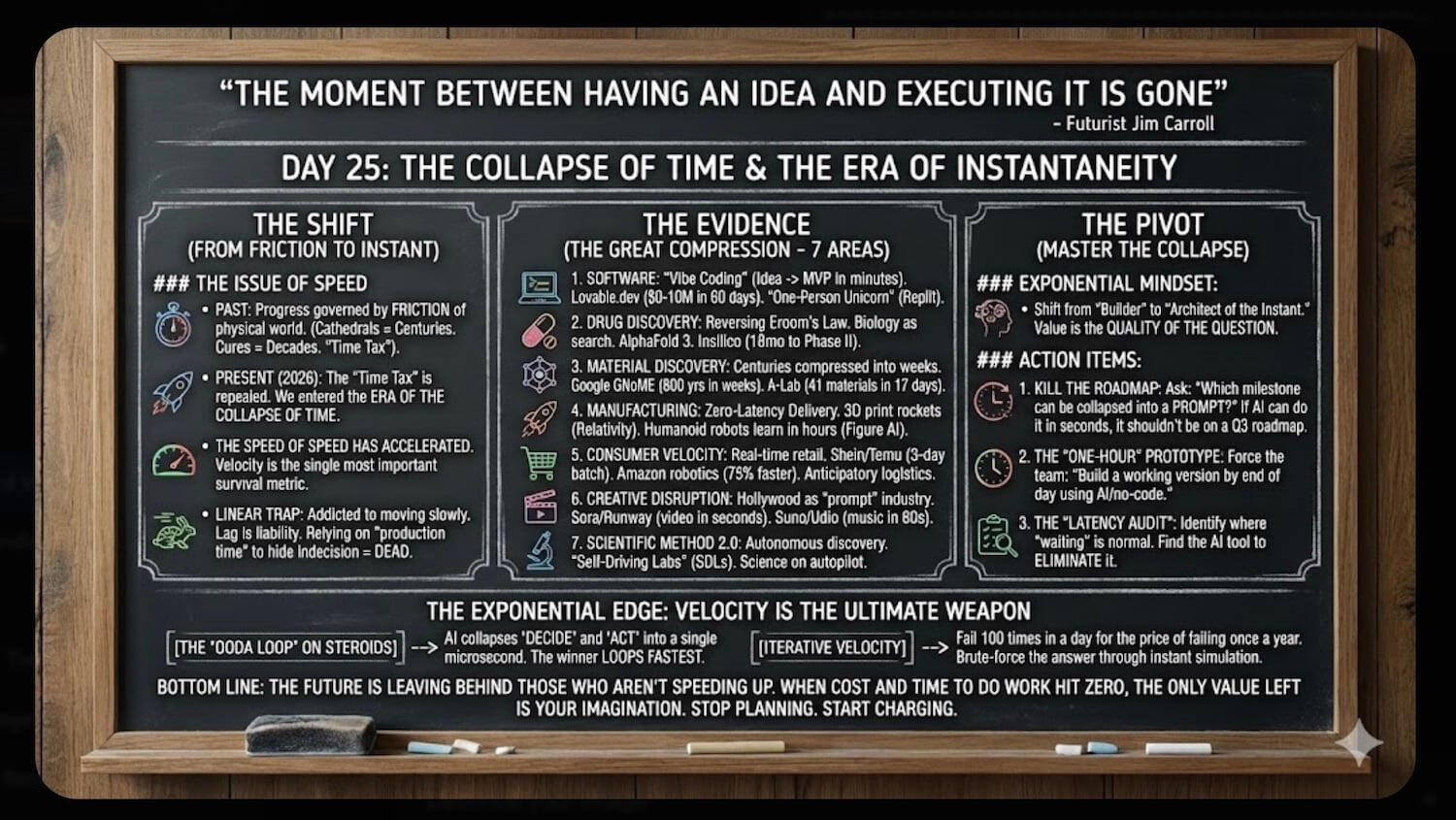
The Issue of SpeedThe issue of speed is not a new one for me and those who follow me. What’s new is that the speed of the speed has accelerated to a degree that was unimaginable just a few years ago.Let’s revisit – if you look back at my writing over the last few decades, you will see a consistent thread. I have spent my career warning leaders that the luxury of “time” is disappearing, and that the window for action is closing faster than ever before. Countless global organizations engaged me to come in and speak to their teams on the importance of this topic – for many CEOs, speed of change has been the defining trend of our time.With that, I framed the idea in multiple books.
The Future Belongs to Those Who Are Fast. This book argued that size no longer guarantees success. The old rule was that “the big eat the small,” but in the modern economy, “the fast eat the slow.” It was established that velocity is the single most important metric for survival.
Ready, Set, Done: How to Innovate When Faster is the New Fast. Here, the focus shifted to agility. It wasn’t just about moving fast; it was about the “zero-latency” reality where you must execute a solution almost before you realize you have a problem. It introduced the idea that we are racing against a timeline that is constantly accelerating.
Think Big, Start Small, Scale Fast. This book provided the operational framework for speed. It made the case that you don’t need a perfect plan to start—you just need momentum. It emphasized that waiting for clarity is a death sentence; you must start small and then explode into growth at high velocity.
For thirty years, I have been telling you that the future is speeding up. The message is still powerfully relevant.But now, we have reached a new reality – we are no longer just “going faster.”The timeline isn’t just compressing.It is disappearing entirely.
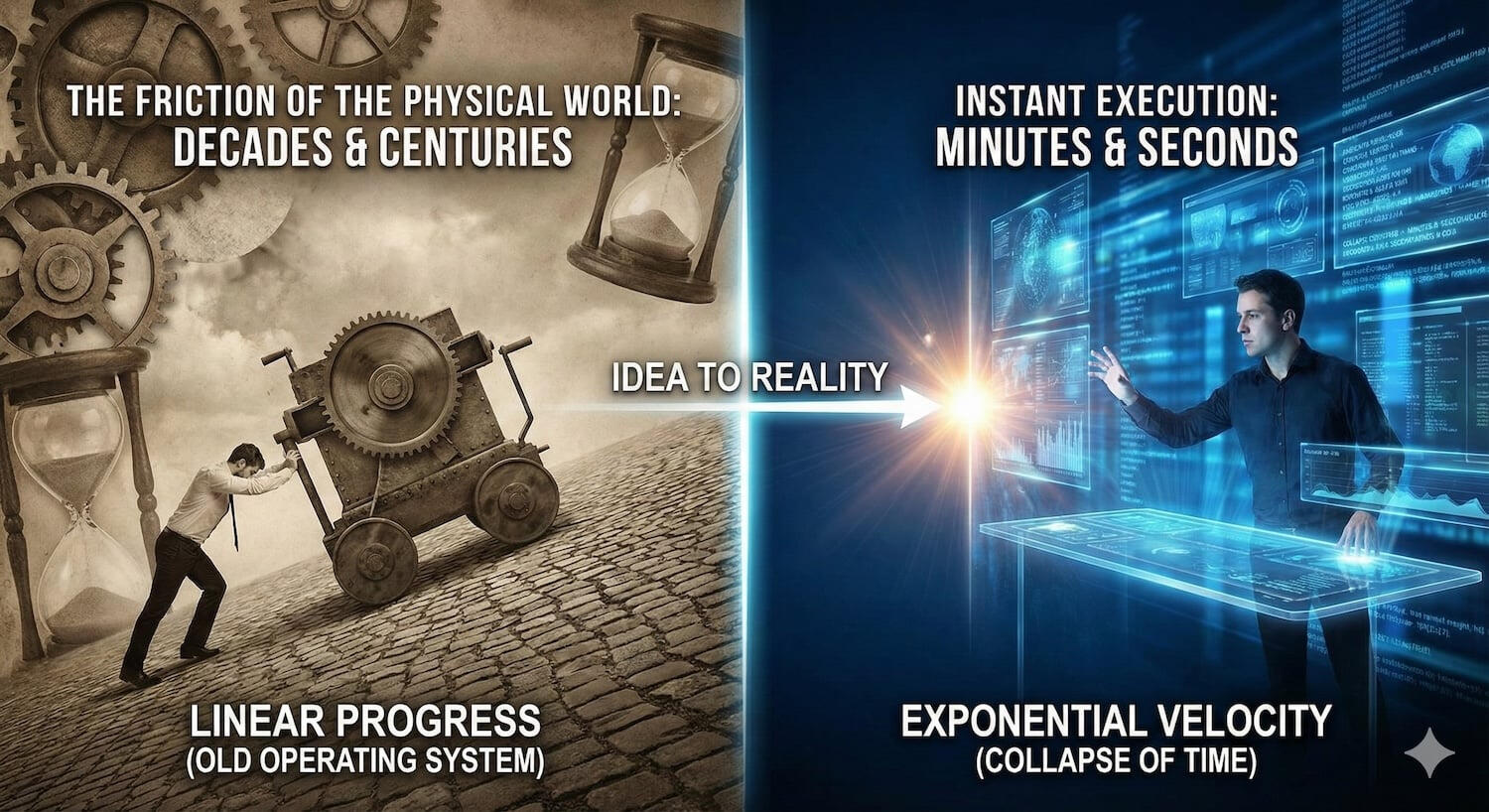
Here’s why.The Great Compression: Evidence of the CollapseIf we look back at what happened over the last two years, with the arrival of AI and the maturing of many other trends, the issue of acceleration is everywhere.1. Software DevelopmentSome folks suggest that the phrase of the year should be “vibe coding,“ which describes what happens when the traditional human role of computer programming is augmented by AI. I’ve certainly been doing a lot of it! The phrase makes sense: you describe the desired outcome, aka the “vibe,” and AI works with you to do the implementation, debugging, and deployment.
The Impact: The path from idea to what people call a “Minimum Viable Product (MVP)” has compressed from months to minutes. The “setup tax” of coding has been abolished.
The Example: The industry is taking to the idea with speed. Lovable.dev evolved from an open-source project to a platform that allows users to generate apps via prompts. In early 2025, they scaled from $0 to $10 million in revenue in just 60 days—defying all historical gravity for growth. Replit Agent is sharing the idea of the “One-Person Unicorn,” allowing founders to build complex platforms like LinkedIn clones in under two weeks. Think about that – two weeks.
What it Means Going Forward: The barrier to entry to create sophisticated applications and IT infrastructure is no longer technical skill; it is imagination. Over time, everyone becomes a coder, and applications proliferate at a speed that is unimaginable today.
2. Drug DiscoveryWe are talking about a new trend that involves biology at Silicon Valley speed. We are reversing “Eroom’s Law” (which stated drug discovery gets slower and more expensive over time) by applying generative AI to lab discovery.
The Impact: The timeline for identification of new potential target molecules – the key to drug development – is collapsing from years to seconds.
The Example: AlphaFold 3 can now predict the structure and interactions of all life’s molecules with unprecedented accuracy. Insilico Medicine brought the first fully AI-discovered drug to Phase II trials in just 18 months (which traditionally takes 4-6 years). Unlearn.AI is using “Digital Twins” to reduce the number of human subjects needed in clinical trials, shrinking enrolment times by months.
What it Means Going Forward: Biology has evolved into becoming a search problem. We are moving toward a future where biological therapeutics can be generated on-demand for new diseases and risks, reducing pandemic response times from months to days.
3. Material DiscoveryWe are now discovering new chemicals and materials at the speed of light. Traditionally, materials science was a serendipitous process of trial and error – the type of thing that happened in centuries before and has stayed with us. Now, AI has transformed it into a high-speed prediction engine.
The Impact: We are compressing centuries of experimental knowledge into weeks.
The Example: Google DeepMind’s GNoME tool discovered 2.2 million new crystals, including 380,000 stable materials—equivalent to 800 years of human experimental knowledge. The A-Lab at Berkeley operated 24/7 without humans to autonomously synthesize 41 new materials in just 17 days. Microsoft and PNNL used AI to screen 32 million battery materials and synthesize a working prototype in less than nine months.
What it Means Going Forward: All of this is leading to transformative new materials that continue to change entire industries. The transition to a sustainable energy future (batteries, solar panels) will happen faster than predicted because the materials required are being invented faster than we can regulate them!
4. Manufacturing & LogisticsThe time from design to delivery is collapsing – I’ve been speaking about the idea of ‘faster time to market,’ and the collapse of product lifecycles, for quite some time. But now, the trend is accelerating, driven by additive manufacturing, humanoid robotics, and digital twins.
The Impact: Design is now an instant software/AI process. Not only that, once we conceive the product, we might not need to tool a factory; we print the part on demand on a big 3D printer.
The Example: Relativity Space is 3D printing vast sections of rockets, reducing part counts by 100x and iterating designs in months rather than years. Czinger Vehicles uses generative AI design to print chassis structures, allowing them to change the design and print a new version immediately. Figure AI and Agility Robotics are deploying humanoid robots that learn tasks in hours rather than weeks, solving labor shortages instantly.
What it Means Going Forward: We are entering the era of Zero-Latency Delivery. The bottleneck is no longer design and execution; it is imagination.
5. Consumer Velocity. The gap between a consumer’s desire and its fulfillment is vanishing, driven by AI-optimized supply chains and “anticipatory logistics.” It’s a world of real-time retail – an influencer wears a product, and the product is shipped to stores worldwide in less than 24 hours.
The Impact: Supply chains are shifting from “forecasting” (guessing what people want) to “reacting” (making what they just clicked on).
The Example: Both Shein and Temu operate on a “real-time fashion” model, testing small batches and reordering in 3 days (compared to Zara’s 3 weeks – and Zara used to be the role model for speed!) Amazon Sequoia robotics have sped up inventory identification by 75%, while Zipline is using autonomous drones to deliver packages up to 10 miles in just 10 minutes.
What it Means Going Forward: The concept of “ordering” creates friction. We are moving toward a world where AI anticipates needs and goods arrive before the customer even fully articulates the desire.
6. Creative DisruptionHollywood is becoming a ‘prompt’ industry. The time required to visualize a scene through your imagination has dropped from weeks to seconds. The role of AI in filmmaking and music going forward will be recognized as a massive disruptor in 2026 – expect the first full-length motion pictures and TV shows generated entirely by AI this year.
The Impact: The cost of pre-visualization and concept art has collapsed to near zero. Filmmakers can now “storyboard” in AI full motion video with a few prompts. This is bigger than the shift to CGI years ago – indeed, a whole new generation of AI-enabled directors and producers is set to take over.
The Example: Sora and Runway Gen-3 allow creators to generate photorealistic video clips in seconds, a process that used to require weeks of animation. Suno and Udio are generating radio-quality music in under 60 seconds. Tyler Perry famously paused an $800 million studio expansion after seeing these capabilities, realizing physical infrastructure was becoming obsolete.
What it Means Going Forward: Content creation is no longer constrained by budget or technical skill, but purely by the quality of the idea, the sophistication of the model, and the skill of the prompter.
7. The Scientific Method 2.0We are moving to the era of ‘autonomous discovery' – a world in which we discover new science through a hypothesis-driven model to a data-driven, self-driving model.
The Impact: People are thinking about and developing “Self-Driving Labs” (SDLs). These integrate AI, robotics, and advanced computing to design and execute experiments without human intervention. Science, all by itself, on autopilot
The Example: The University of Toronto’s Acceleration Consortium and NC State are building labs that can reduce the time to bring advanced materials to market from 20 years to as little as one year. Moderna and IBM are using quantum computing to model mRNA, optimizing vaccines at a molecular level previously impossible.
What it Means Going Forward: We are industrializing the process of discovery itself. The rate of scientific breakthrough is about to decouple from the limitations of human labor.
All of these developments are occurring all around you at a staggering speed. The future doesn’t just belong to those who are fast anymore – it is leaving behind those who aren’t speeding up. In that reality, the discipline you must master is responding to the Collapse of Time.1. The Exponential MindsetThe Exponential Mindset understands that we have moved from the “Era of Creation” (which takes time) to the “Era of Instantaneity” (which takes the ability to use new tools to do things faster)In this reality, when the cost of doing the work hits zero, and the time to do the work hits zero, the only value left is the quality of the question you ask. Prompting. Prompt engineering. Learning how to talk to the machine.In that way, you are no longer a “builder.” You are an “architect of the instant.”2. The Linear TrapLinear leaders are addicted to moving slowly. They rely on long development cycles to hide their indecision. They hold meetings to build consensus. They seek reports to justify decisions. They use “production time” as an excuse to delay the strategy.They build 5-year roadmaps for technologies that change in 5 months!In 2026, lag is a liability; waiting is an anchor; pausing is perilous.If you are relying on the “time it takes to build” to protect your market share, you are already dead. While you are holding committee meetings to approve the prototype, your competitor has already conceived of the final product and is selling it.3. The Exponential EdgeWhen you master the Collapse of Time, you unlock the value occurring in an exponential world.
The “OODA Loop” on Steroids: The military concept of “Observe, Orient, Decide, Act” (OODA) " determines who wins a dogfight. In 2026, the AI collapses the “Decide” and “Act” phases into a single microsecond. The winner isn’t the one who plans best; it’s the one who loops fastest.
Iterative Velocity: As we discussed in Day 6 (Make Better Mistakes), the Collapse of Time allows you to fail 100 times in a day for the price of failing once a year. You don’t guess the future; you brute-force your way to the right answer through thousands of instant simulations. Vibing everything!
4. The Immediate PivotStop planning for the future. Start charging at it with the idea of instantaneity in mind!
The “One-Hour” Prototype: Challenge your team: “If we had to build a working version of this new product by the end of the day, how would we do it?” Force them to use AI, digital twins, and no-code tools to collapse the timeline.
Kill the Roadmap: Take your 12-month product roadmap and ask: “Which of these milestones can be collapsed into a prompt?” If an AI can do it in seconds, it shouldn’t be on a roadmap for Q3.
The “Latency Audit”: Identify the one process in your business where “waiting” is considered normal (e.g., waiting for legal review, waiting for code compilation, waiting for supply chain). Find the AI tool that eliminates that wait.
Think of it this way: the old rules of waiting and long-term planning are officially broken.We are living in a world where the only thing standing between you and a breakthrough is your willingness to act! To imagine! To do! To move forward.In this reality, you can no longer afford to pause, because the tools to build the future are already in your hands.Stop staring at the calendar and start building your future today.Get ready, because tomorrow we cross the finish line with Day 26.
#26 Escape Mediocrity
Don’t be average. Don’t be boring. Be bold. Be fascinating!
2025 is almost a wrap.And that brings me to 279 days of my Daily Inspiration post in 2025, continuing the tradition that began early in August 2016, where each workday involves a bit of fresh new insight.Since then, I have not missed ONE single workday. Come hell or high water, power failure or jet lag, the post has gone out!Here’s a slideshow of what I wrote in 2025. 279 inspirations! Today marks 280!
And then it starts all over again tomorrow, on Thursday, January 1, 2026 – with my “10 Great Words for 2026,” which itself began in 2006.If you haven’t signed up, join the 1/4 million who get it every day.Do so at subscribe.jimcarroll.comThere’s no doubt that there’s a lot of challenge to come in 2026, but there’s also a lot of opportunity.Opportunities become even bigger when exponential trends become a reality.But here’s the thing – it’s up to you whether you will turn it into an opportunity, or whether the challenge will bury you.It depends on the choices you make and the actions you take.But there is a dark side to velocity.If you choose to let the challenges rule, you’ll slide into mediocrity like everyone else – you’ll embrace it.But if you decide to be bold, be daring, you’ll escape it – and you’ll find it absolutely fascinating!Here’s your final chalkboard summary!
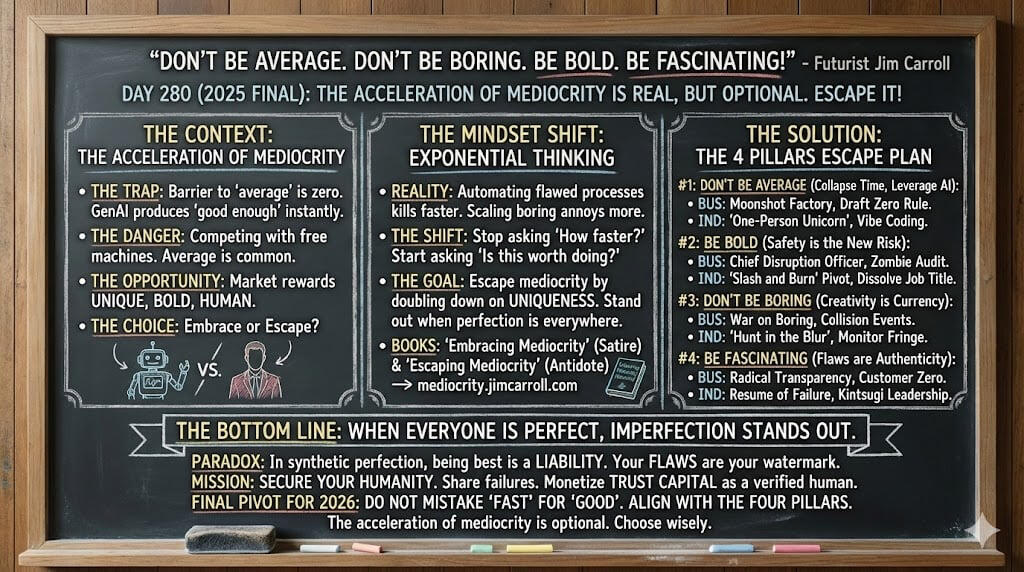
So what’s your choice – are you going to embrace, or escape, the potential for mediocrity that is in front of us with this exponential world?That’s why I wrote these books!
You need to think about the issue of mediocrity in terms of your personal choice and the company you are involved with. If you decide to do boring things and chase average, you’ll be mediocre. If you choose to be bold, you’ll find things to be far more fascinating! If you take a mediocre organization and give it average tools and vague objectives, you don’t get innovation. You get accelerated incompetence.I explored this side of the equation in my satire “Embracing Mediocrity”—a guide on how to do the bare minimum—and its antidote, “Escaping Mediocrity.” In the past, you could survive being “average” because the market moved slowly. You could hide in the margins.You should choose to buy the books right now. Be bold! You’ll find them to be fascinating!
Here’s what you need to think about.1. The Exponential MindsetThe trap many leaders fall into today isn’t just moving too slow – it’s trying to be fast on the wrong things.We are living in an exponential reality. But remember: exponentiation works on negative numbers too. If you automate a flawed process, you kill your business exponentially faster. If you use AI to scale a boring marketing message, you just annoy more people in less time. If you learn to use AI to focus on the wrong skills, you’ll get the wrong knowledge.The mindset shift here isn’t about speed; it’s about goals. You must stop asking “How can we do this faster?” and start asking “Is this worth doing at all?”2. The Trend: The Death of ‘Average.’Why is mediocrity suddenly fatal? Because the barrier to entry for “average” has dropped to zero.Generative AI can produce “average” copy, “average” code, and “average” strategy in seconds.
Automation can deliver “average” service instantly.
In a way, as powerful as it is, AI takes us on a race to the bottom where everyone and everything is average. How do you stand out?If your output is merely “good enough,” you are now competing with a machine that can do “good enough” for free.The trend is clear: Average is common.The market only rewards the unique, the bold, and the human.3. The Opportunity: Radical UniquenessThis is where the concepts in Escaping Mediocrity become your survival guide.When everyone else is mediocre, you need to escape it. You need to be unique. You need to stand out.The fact is, the only way to survive the acceleration of mediocrity is to double down on what makes you unique!We are living in a world where the instant eat the hesitant. But do not mistake “fast” for “good.” The tools of tomorrow will let you build anything instantly.That means the only competitive advantage left is your ability to stand out.To do that, you must align with the four pillars of the exponential age. Here is your 50-point checklist for escaping the gravity of the average.#1: DON’T BE AVERAGESmall thinking is a liability. You must collapse time, leverage AI, and refuse to accept linear limitations.For the Business:
Start a “Moonshot Factory”: Focus resources on wild ideas that improve things 100x, not just 10%.
Use the “Draft Zero” Rule: Use AI to generate immediate first drafts instead of starting from scratch.
Create a “No-Code” Zone: Empower employees to build apps without needing to write complex code.
Automate the Boring Stuff: Let AI handle paperwork so managers can focus on leading.
Build a “Digital Twin**: Use a virtual model to simulate thousands of scenarios before real-world launches.
Measure “Speed of Success”: Track velocity alongside profit; speed is now a critical asset.
The “Two-Pizza Rule”: Keep teams small; if two pizzas can’t feed them, they’re too big.
Predictive Customer Service: Fix problems before customers even realize they exist.
Flexible Pricing: Adjust prices instantly based on real-time market demand, not committee delays.
For the Individual:
Become a “One-Person Unicorn”: Leverage AI to build a massive business with zero headcount.
Master “Vibe Coding”: Remove the technical barrier to building big ideas by focusing on vision, not syntax.
Adopt the “Draft Zero” Rule: Collapse the time between thought and execution.
Become a “Partnership Operator”: Scale your output by orchestrating AI agents rather than doing the work.
Conduct a “Latency Audit”: Ruthlessly eliminate “waiting” from your life.
Leverage “Network Velocity”: Align only with those who move at exponential speed.
Embrace “Zero-Latency Delivery”: Ship instantly; don’t wait for “finished.“
Become a “Just-in-Time” Learner: Scale your knowledge instantly as needed.
The 10x Rule: Set goals that are mathematically impossible without exponential leverage.
#2: BE BOLDSafety is the new risk. You must kill the zombies and make the hard decisions that safety-obsessed leaders avoid.For the business:
Appoint a “Chief Disruption Officer”: Institutionalize the attack on your own business model.
Ban the “Annual Budget”: Kill the illusion of predictability; fund the now.
Implement a “Zombie Project” Audit: Have the courage to kill the 90% complete failures.
Gamify the “Kill”: Reward the bold act of stopping bad work.
Launch a “Bug Bounty” for Bureaucracy: Attack your own internal red tape.
Create a “Legacy Sunset” Date: Boldly plan the death of your new tech the day you launch it.
Shift to “Skill-Based” Hiring: Ignore the safe credentials (degrees) for the bold ones (ability).
For the Individual:
Execute the “Slash and Burn” Pivot: Burn your failed projects to fuel the next one.
Dissolve Your Job Title: Boldly define yourself by the problem you solve, not the role you hold.
Develop “Chameleon Revenue”: Bet on income streams that don’t exist yet.
Court Brutal Criticism: Seek the pain of feedback to grow faster.
Build a “Cognitive Firewall”: Aggressively reject the “safe” addiction of doomscrolling.
Presume Success: Operate with the audacity that the win is inevitable.
Act Decisively: Choose the risk of a “now” decision over the safety of a “later” one.
Own Your Outcomes: Take total radical responsibility for your future.
#3 – DON’T BE BORINGBoring is a death sentence. When execution is a commodity, creativity is the only currency.For the Business:
Declare a “War on Boring”: Refuse to publish “safe” corporate content that no one reads.
Sponsor “Collision Events”: Force the “weird intersections (e.g., biologists x coders).
Create a “Shadow Board” of Under-30s: Inject fresh, non-boring perspectives into leadership.
For the Individual:
“Hunt in the Blur”: Look for opportunities in the weird intersections others ignore.
Monitor the “Fringe”: Find your inputs in the subcultures, not the mainstream.
Defy Predictability: Intentionally break your patterns to stay cognitively alive.
Reject “Good Enough”: Refuse to produce output that an AI could generate.
#4: BE FASCINATING!In an era of synthetic perfection, your flaws are your ultimate watermark.For the Business:
Deploy “Radical Transparency” Dashboards: Fascinate the market with total honesty.
Create a “Customer Zero” Program: Build empathy by suffering the same friction as your users.
**Demand “Video-First” Communication: Replace boring text with human face and voice.
Replace “Exit Interviews” with “Stay Interviews”: Show fascination with your people before they leave.
Invert the “Hierarchy of Wisdom”: Show the humility to learn from the youngest in the room.
For the Individual
Publish a “Resume of Failure”: Fascinate others by showing your scars, not just your trophies.
Practice “Kintsugi Leadership”: Highlight your cracks as your most valuable features.
Monetize “Trust Capital”: Become a premium source of “verified human” truth.
Practice “Wisdom Inversion”: Actively seek mentors who are younger than you.
Escape the trap of mediocrity!The acceleration of mediocrity is real, but it is optional. You have the playbook.Now you just need the mindset.For a deeper dive into the strategies that will define the winners of 2026, you need the full manual.Whether you need the antidote to average or a satirical look at what to avoid, grab your copies of “Escaping Mediocrity“ and “Embracing Mediocrity“ today.Get them now at mediocrity.jimcarroll.com
Want This Straight to Your Inbox?
Sign up here, and Jim's Daily Inspiration will become a part of your daily routine!
Thank you!
You are now on Jim's Daily Inspiration list!